

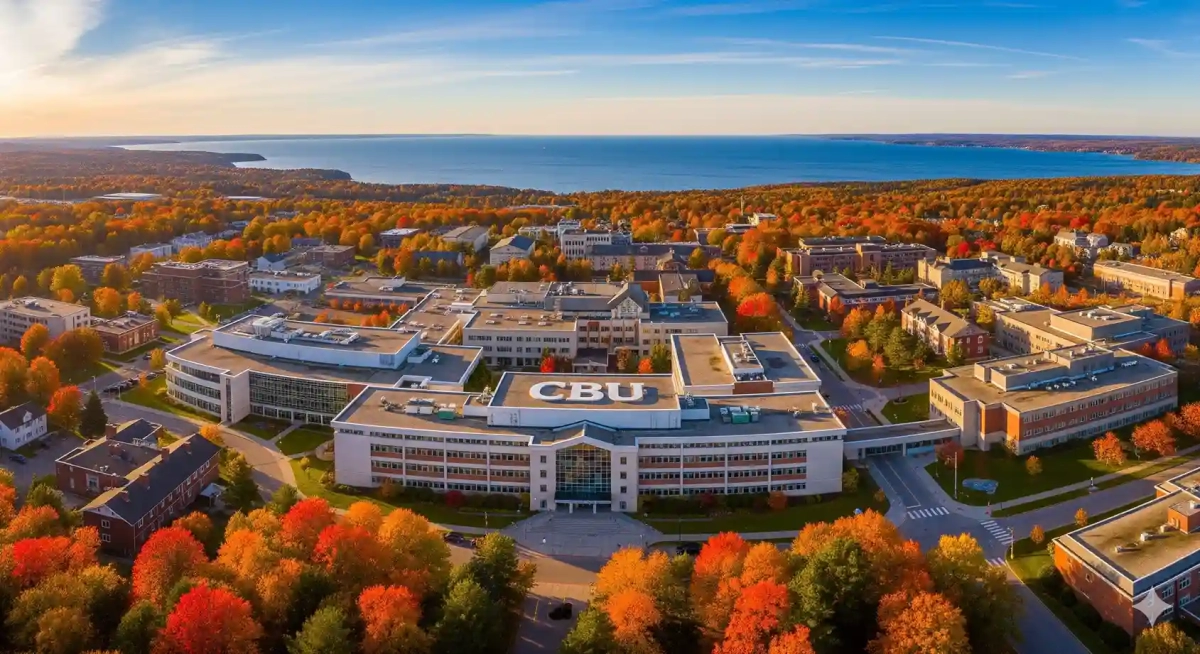
Cape Breton University (CBU) is located in Sydney, Nova Scotia, Canada. It is the only post-secondary degree-granting institution within the Cape Breton Regional Municipality and on Cape Breton Island. CBU offers a comprehensive set of liberal arts, science, business, health, and professional programs. The university is committed to excellence in teaching and learning, providing students with outstanding experiential learning and undergraduate research opportunities in a supportive academic environment.
| Acronym | CBU |
| Nickname | CBU Capers |
| Motto / Slogan | Perseverance Will Triumph |
| Colour | Orange, Green, and White |
| Mascot | Caper |
| Founded | 2005 |
| Location | Sydney, Nova Scotia, Canada |
| Address | 1250 Grand Lake Road Sydney, Nova Scotia B1M 1A2 |
Cape Breton University is committed to high-quality, accessible education; innovative research; and a vibrant, multicultural future for the Island.
Rooted in Cape Breton, connected to the world.
Provide high-quality education and research opportunities
Foster innovation and entrepreneurship.
Promote Indigenous education and culture.
Engage with local and global communities for sustainable development.
Support student success through comprehensive services and programs.
School of Arts and Social Sciences
Shannon School of Business
School of Science and Technology
School of Education and Health
Unama'ki College
CBU proudly upholds a respectful, inclusive and engaging campus atmosphere that supports, listens and responds to the needs of its community. We also offer a superior benefits package, a dynamic, supportive work environment and onsite childcare opportunities on one of the most beautiful, culturally rich islands in the world.
Found at the heart of the Cape Breton Regional Municipality, CBU’s location caters to a lifestyle that mirrors the vibrancy of an urban centre, yet offers the safe and genuine feel of a small town. When you chose a career at CBU, you will have an opportunity to not only thrive professionally, but you will also be exposed to the myriad of cultural landscapes that are found on Cape Breton Island, creating a truly unique style of living. title
From the moment your new career begins – the Human Resources Department is here to help. During orientation we try to assist new employees in the best way possible by answering questions and offering suggestions to help you easily transition into your new role at CBU. Among other benefits, CBU’s welcoming environment has made us an employer of choice for many.
Entry requirements vary by program. View program page for requirements.
General Undergraduate Admission Requirements
Students must be at least 16 years of age to apply to study at CBU.
An overall average of 65% is required for all students applying to most CBU credit programs based on high school performance. Additional requirements may apply to specific programs.
If space permits, CBU will accept all candidates who can verify that they have met the minimum entry requirements established by CBU for the programs in which they wish to enroll.
Note: CBU does not guarantee that applications completed after August 1, will be processed for September registration.
Entry requirements vary by program. View program page for requirements.
Post-Baccalaureate Programs
International Students
To meet MBA in CED Standard Admission Requirements, applicants must hold a bachelor’s degree (GPA 3.2 on a scale of 4.0 or 75% aggregate in undergraduate studies) from a recognized university.
Email: [email protected]
Phone : +1 -888-959-9995




Member of the Association of Atlantic Universities (AAU)
Universities Canada (UC)
Colleges and Institutes Canada (CICan)
Canadian Bureau for International Education (CBIE)
Bachelor of Education programs recognized by the Nova Scotia Office of Teacher Certification
Nursing programs accredited by the Canadian Association of Schools of Nursing (CASN)
Engineering programs accredited by the Canadian Council of Technicians and Technologists (CCTT)
Bachelor of Health Sciences (Public Health) accredited by the Canadian Institute of Public Health Inspectors
Prior to taking on his role at CBU, President Dingwall had a distinguished public policy career and extensive corporate governance experience. He has also had a prominent legal career, been, and continues to be, a corporate director, a distinguished public speaker, visiting lecturer and author.
He has bee... read more




Cape Breton Island has witnessed the creation of community economic development (CED), the Co-operative movement, innovation in telecommunications, and labour unions and rights in Canada. The role of our university by extension has been as a leader in the academic explo... read more
Our story begins as Xavier Junior College (XJC, later Xavier College), founded in 1951 under St. Francis Xavier University, as a satellite campus to handle the rapid population growth in Industrial Cape Breton. In 1968, the Nova Scotia Eastern Institute of Technology (NSEIT) opened on the Sydney-Glace Bay Highway, immediately east of Sydney. With a focus on technology and trades, the development of NSEIT was largely enabled by federal and provincial funding at a time when the coal and steel industries in Industrial Cape Breton were facing serious challenges.
The College of Cape Breton (CCB) was established on June 28, 1974, combining the Sydney Campus of St. F.X (Xavier College) and NSEIT into a single post-secondary institution under an autonomous Board of Governors. CCB became the University College of Cape Breton (UCCB) – the first university college of its kind in Canada – when it was granted university status in June 1982.
On February 25, 2005, the Board of Governors voted to change the instution’s name to Cape Breton University (CBU).