
CBNU operates on the core foundational spirit of "truth, justice, and pioneering." According to the CBNU Overview, the university's mission is “to embrace a new paradigm of education and research in response to the digital and artificial intelligence era, aligning with the Fourth Industrial Revolution.” It functions as a regional innovation hub integrating industry, academia, research, and local government across its primary campuses.
| Acronym | CBNU |
| Motto / Slogan | Nova aperio (I uncover new things) |
| Colour | Rich maroon |
| Mascot | Bull |
| Founded | 1951 |
| Location | Cheongju, North Chungcheong, South Korea |
| Address | Chung Buk National University, Chungdae-ro 1, Seowon-gu, Cheongju, Chungbuk 28644, KOREA |
University where a Better Future Begins
Make Your Dreams Come True
Heighten Your Pride
Grow up with You
Autonomy
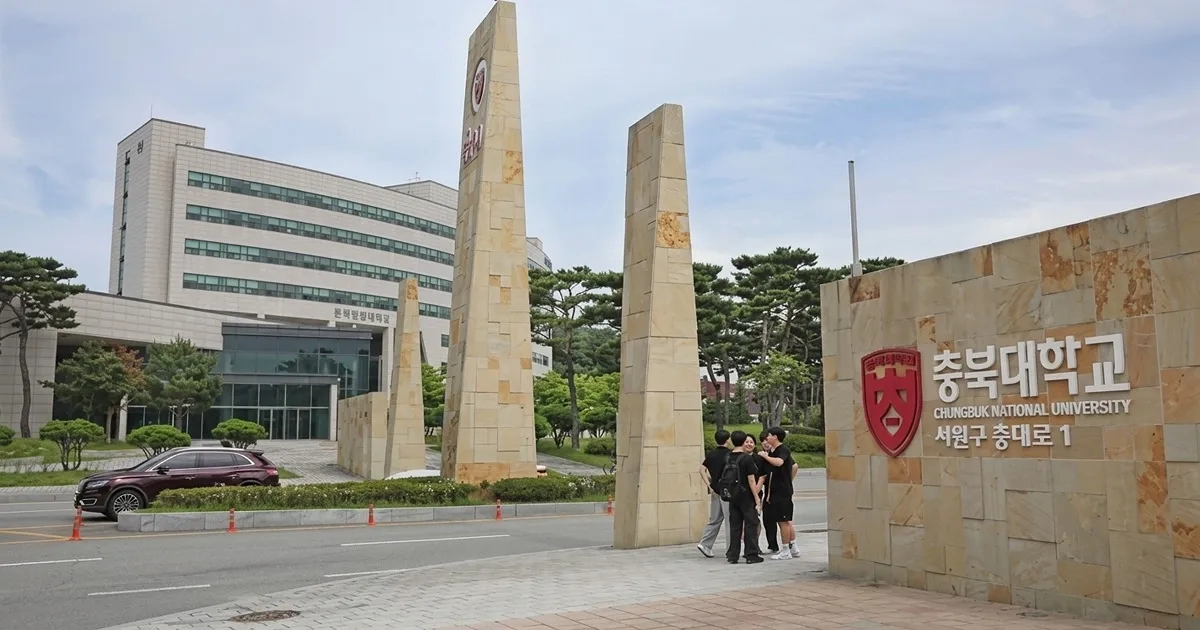
Autonomous, Communicative, and Happy Community
Future-oriented Education and Research System
Specialized, Networked Innovation Campuses
Strengthened Capabilities as a Leading Flagship National University
CBNU has tried to contribute to the development of the local community with its outstanding educational and research capabilities. Its efforts are proven by notable achievements in various fields and positive evaluations from outside.
The project capabilities and research infrastructure of CBNU have led to the successful acquisition of numerous government-funded projects. With approximately 154 billion KRW each year for government-funded education/research projects, private research projects, etc., CBNU has focused on fostering creative, interdisciplinary talent.
CBNU fosters creative and converged talent through an education system network with four specialized campuses. CBNU will begin a new future by establishing an innovative, prosperous ecosystem with the local community.
Application Fee A. Fee: KRW 50,000won / USD $50.0
1. Freshmen Admissions: Applicants must meet either A or B below
A. Foreigners whose parents are both non-Korean
1) They must have completed their entire elementary and junior high school education;
2) They must have completed (or are expected to complete before the 1 st semester
begins) high school education at a comparable and equivalent level to equivalent to
that provided in Korea.
B. Foreigners who have completed their entire education equivalent to South Korea’s
elementary and secondary education abroad.(Parents’ nationalities do not count.)
2. Transfer Admissions: Applicants must meet either A or B below regardless of
the previous major
A. Applicants whose parents are both non-Korean
1) They must have graduated 4 year university and obtained(expect to obtain)
Bachelor’s degree before the 1 st semester begins.(including expected Aug. 2026
graduates)
2) They must have graduated(including expected Aug. 2026 graduates) 2 or 3year
college or completed 2years(4semesters) of 4 year university before the 1 st semester
begins.(including expected Aug. 2026 graduates)
B. Foreigners who have completed their entire education abroad
1) They must have graduated 4 year university and achieved(expect to achieve)
Bachelor’s degree before the 1 st semester begins.
2) They must have graduated(expect to graduate) 2 or 3year college or completed
2years(4semesters) of 4 year university before the 1 st semester begins.
Study Year: Applicants begin as junior(3rd grade)
Applicants who have completed 2 years of 3 year college, are NOT eligible.
Applicants who graduated universities that do NOT have a credit system, are NOT eligible.
Applicants who are registered at our university are NOT eligible.
3. Eligibility for Language Proficiency
All dept. & Majors(School of Int’l Studies Not Included): Must meet one of the following requirements
A. [Korean] TOPIK Lv. 3 or higher
B. [English] TOEFL 530(CBT 197, iBT 71), IELTS 5.5, CEFR B2, TEPS 600(NEW TEPS 326)
C. [English as Official Mother tongue] Applicants from one of these 7 following countries ? 7 English speaking countries as mother tongue: USA, UK, Canada, Republic of South Africa, New Zealand, Australia, Ireland.
D. [CBNU Reference] Your academic(In Korean or English) ability must be recognized by receiving reference(Form 3-1) from CBNU prospective academic advisor even though the applicants do NOT have any official language certificate.
Freshmen Admissions:
Applicants must meet either A or B below
A. Foreigners whose parents are both non-Korean and have completed the equivalent education to South Korea’s elementary and secondary education from domestic or overseas institutions.
B. Foreigners who have completed their entire education equivalent to South Korea’s elementary, secondary and higher education(Undergrad. course) abroad.(Parents’ nationalities do not count.
2. Academic Eligibility:
A. Master’s: Must fulfill the conditions stated in the above "#1" and (expect to)holdBachelor’s degree before the 1 st semester begins.
B. Doctoral: Must fulfill the conditions stated in the above "#1" and (expect to)holdMaster’s degree before the 1 st semester begins.
C. Combined Master’s and Doctoral Program: Must meet either 1) or 2) below
1) New: Must hold(or expect to hold until Aug. 2026) Bachelor’s degree or be considered to achieve the equivalent level of education
2) Transfer: Only currently registered master’s students of CBNU, who haveachieved(or expect to achieve) more than 15 credits before Aug. 2026
Applicants who expect to complete M.s. program?as of application day, CANNOT apply
Applicants who are in Integrated BS/MS Program?as of application day, CANNOT apply
Applicants applying for a different major might have disadvantage in terms of credit andsemester admittance.
[NOTE] Applicants whose program changes from Master’s to Combined will keep the samestudent ID number while program title will be updated.
1. Choose your programme
Select the college/department you want to study and check whether it is available to international students.
2. Check the admission requirements
Review the relevant international admission guide for your programme. Requirements can include academic qualifications, nationality, language proficiency, transcripts, degree certificates, and other supporting documents.
3. Prepare your documents
Depending on the programme, you may need:
4. Contact a prospective supervisor — for postgraduate applicants
CBNU required applicants to contact their prospective academic advisor before the application deadline and obtain the required advisor's opinion form.
5. Apply online
CBNU's international admissions applications are submitted online through Jinhak Apply. For example, the 2026 Fall graduate application with a ?50,000 application fee.
For undergraduate admission with a ?72,000 application fee.
6. Submit the required original documents
After completing the online application, applicants must submit the required documents by mail or in person to CBNU's Office of International Affairs.
7. Wait for the admission result
CBNU reviews applications and, where applicable, conducts departmental evaluation/interviews before announcing successful applicants.
Email: [email protected]
Phone : +82-43-249-1869, +82-43-261-3841


As a national institution recognized by the South Korean Ministry of Education, CBNU holds full national accreditation and state recognition. Globally, it ranks well within international assessments, placing in the 601–700 bracket in the ShanghaiRanking ARWU listings, with notable high-ranking subject proficiencies in Veterinary Sciences.
Prof. Koh Chang-seop is the 22nd President of Chungbuk National University. He has served as president since April 2023. He is a professor in the Department of Electrical Engineering and holds bachelor's, master's, and doctoral degrees in Electrical Engineering from Seoul National University.




Tremendous Start
Cheongju Junior Agricultural College
First opened during wartime, supported by the local community’s desire for education and the future.
1956
Relocation
Chungbuk Provincial College
Higher education institutions in the central region to foster future talent for the country’s development.
1962
Foundation
Chungcheong National University
Evolved into a true ivory tower, made progress toward great dreams.
1963
Growth
Chungbuk National College
Quantitative growth towards becoming a full-fledged university with syste... read more
1978
Progress
Chungbuk National University
After 28 years, finally possessed the status of a university.
2000
Globalization
Global University CBNU Laid the groundwork for global university.
2015
Coexistence
CBNU, the Center of Coexistence with the Local Community
Tried to grow with the local community by establishing a wide campus cluster.
2024
Innovation
Global University CBNU
Constant Innovation to prepare for the future and grow together with the local community.