
GNU serves as the academic heart of South Gyeongsang Province, with its primary campuses situated in Jinju, Tongyeong, and Changwon. The institution was initially founded as a vocational agricultural school, growing over the decades into a comprehensive university network.
The university is deeply integrated into South Korea's high-tech industrial strategy. It is highly regarded for its regional contributions and academic excellence, notably being selected for the prestigious Glocal University 30 Project to spearhead advanced aerospace and defense education. GNU maintains competitive national rankings, particularly thriving in agricultural sciences, mathematics, and engineering.
| Acronym | GNU |
| Motto / Slogan | Fly with GNU |
| Colour | Blue |
| Mascot | Jinu |
| Founded | 1948 |
| Location | Jinju, South Gyeongsang, South Korea |
| Address | 501 Jinju-daero, Jinju-si, Gyeongsangnam-do, 52828, Korea |
GNU operates under the official slogan "SMART GNU" (Servant, Mission, Academy, Relation, Together).
As our mission is to “create promising future and realize happiness of the world,” the university focuses on reinforcing its status as a national flagship, cultivating creative professionals, and building sustainable research supports.
Gyeongsang National University, pioneering the future and sharing values.
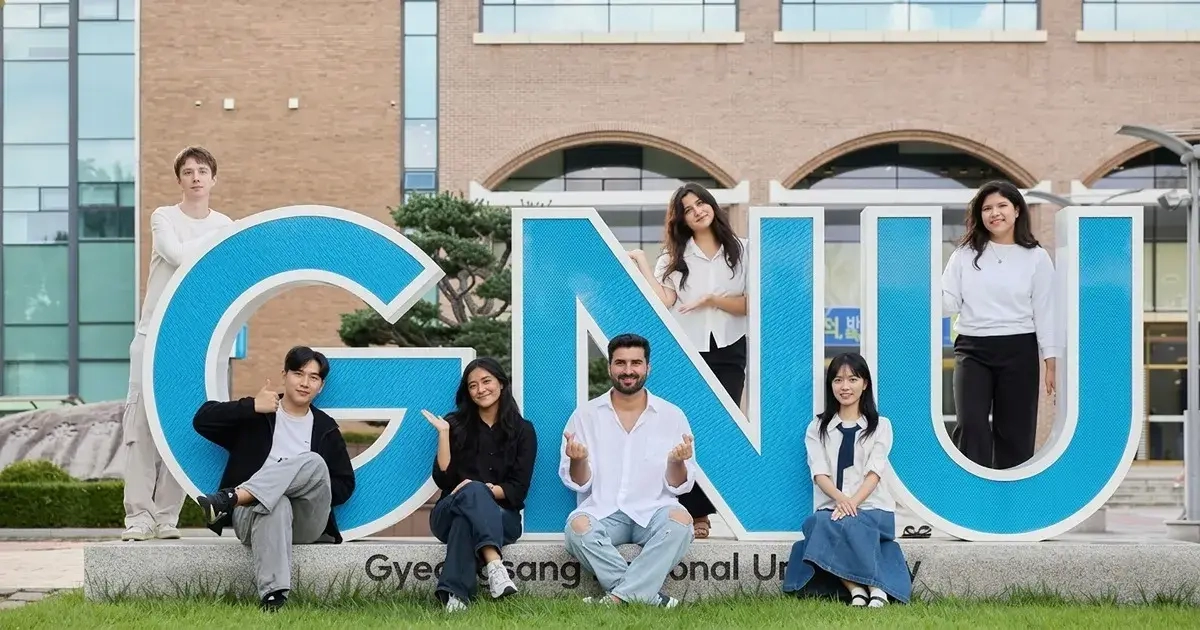
A national flagship university that nurtures talents to lead future society, drive regional innovations through sharing and mutual growth, and creates sustainable social value.
GNU has strategic strengths in aerospace, defense, biotechnology, artificial intelligence, advanced materials and energy-related fields. Its location in Gyeongsangnam-do also provides links to important industrial and aerospace companies.
The university has strong research activity and is particularly recognized for mechanical and aerospace engineering, life sciences, nano and advanced materials engineering, and chemistry.
GNU participates in the Global Korea Scholarship (GKS) for graduate students. For 2026, GNU was allocated places across the general, R-GKS, research and R&D tracks.
GNU offers programmes across areas including engineering, natural sciences, humanities and social sciences, business, agriculture, medicine, pharmacy and veterinary medicine. It is also the only university in Gyeongsangnam-do with medical, pharmacy and veterinary schools.
Nationality :
The applicant and both their parents should have non-Korean nationality.
? Applicants are not eligible if the applicant or either parent holds dual nationality. (All Korean nationality must be renounced or lost by both the applicant and parents before the application deadline.)
? In cases of immigration or adoption, eligibility is recognized only if both the applicant and parents acquired foreign nationality before the applicant entered high school.
B. Educational Qualifications
Applicants who have completed the full elementary, middle, and high school curriculum in Korea or abroad(including those expected to graduate in August 2026).
? Applicants with academic qualifications obtained through qualification examinations (GED), homeschooling, or online/cyber learning programs (domestic or overseas) are not eligible to apply.
C. Language Proficiency
• TOPIK Level 3 or higher (Level 2 or higher for Arts/Physical Education)
• King Sejong Institute (Sejong Hakdang) Intermediate Level 1 (or higher) OR King Sejong Institute Korean Language Assessment (SKA) score of 321 or higher
• KIIP(Ministry of Justice Social Integration Program) Level 3 or higher, or preliminary test score of 61+
• Completion of a one-year D-4 Korean language program at a university in Korea and passing its in-house test (equivalent to TOPIK Level 3)
• (For Global Interdisciplinary Studies) Pass GNU Korean proficiency test (Level 3+) or complete Level 3+ at GNU Language Program.
? Only language proficiency certificates valid at the time of application may be submitted. ? Those who fail to submit language requirements before screening applicants’ eligibility may submit a language proof before the conclusion of successful candidates after a consent from GNU in advance.
All documents must be submitted in original form. If the original must be retained, submit a notarized copy with Apostille or consular confirmation.
1) Documents in Korean or English: Apostille or consular confirmation required.
2) Documents in other languages: Notarized Korean/English translation + Apostille or consular confirmation required. § Apostille member countries (including China since Nov. 2023): Apostille required. § Non-member countries: Confirmation by a Korean consular officer required.
? For Apostille member countries: https://www.apostille.net ? Applicants must check visa requirements with the relevant embassy/consulate or immigration office before applying. ? All documents must remain valid until enrollment. - Required bank balance must be maintained before visa application. - If names differ across documents, official proof of identity must be submitted. ? Arrange documents in the listed order, mark each with its number and title at the top right, and submit by mail.
Basic Qualification (Nationality
Applicants must meet one of the following criteria
(1)Admission I: Applicants and their parents must be citizens of countries other than Korea
(2)Admission II: Applicants must have completed primary, secondary and university education outside of Korea equivalent to Korea ?An applicant who holds dual nationality is not eligible to apply as a foreign student but can apply through general admission.
Academic Qualification
Master's:
An applicant who applies for a master's program should hold a Bachelor's degree or equivalent (or those who are expected to earn a degree by February 2026).
Ph.D.
An applicant who applies for a doctoral program should hold a master's degree or equivalent (or those who are expected to earn a degree).
Combined Master's and Ph.D.?TypeI?
An applicant who holds a Bachelor's degree or equivalent.
Combined Master's and Ph.D.?Type II?
A student enrolled in a Master's program at GNU should meet all the criteria below.
-An applicant in their third semester who has completed or is expected to complete 15 credits can only apply.
-An applicant who already completed four semesters at the time of application can not apply.
-An applicantisonlyallowedtoapplyforthesamemajorastheirmaster'sprogram
Language Qualification
Korean
TOPIK Level 3 or higher/Certificate of Sejong Korean class intermediate 2 or higher
English
?Only applicable to the departments which offer English Track?TOEFL(PBT530,CBT197,iBT71),IELTS5.5,CEFRB2,TEPS 600dot(NewTEPS327dot)or higher results
Online Application Submission
Submission of Original Application Documents
Payment of Application Fee
Review of Eligibility
Departmental Evaluation (Including Interview)
Announcement of Successful Applicants
Payment of Tuition Fees
Issuance of Standard Admission Letter
Enrollment
POSTGRADUATE:
[Step 1] Online application
[Step 2] After online registration, deposit the application fee into the account below.
(After applying online, you have to transfer the fee during the application period.)
[Step 3] Submit relevant documents by mail
(Submit all the necessary documents by post during the application period)
Email: [email protected],[email protected]
Phone : +82 (0)55 772-0285



College of Medicine: Holds the continuous "Perfect Certification" (Full Accreditation) awarded four consecutive times by the Korea Institute of Medical Education and Evaluation (KIMEE).
2024.06 - Present12th President of Gyeongsang National University
Ph.D. in Aerospace Engineering, KAIST(Korea Advanced Institute of Science and Technology)
Co-Chair, Gyeongnam Regional Innovation System & EducationCommittee, Gyeongsangnamdo




In the late 19th century, the Korean Empire wanted to work towards being a modern nation, so Emperor Gojong proceeded to establish a vocational school to offer education to the general population. In April 1910, a vocational school was established by formal decree (proclaimed in April 1909). This led to the launch of the first 2-year middle school, and the beginning of modern education.
In November 1911, the school was renamed the 'Jinju Public Agricultural School.' It expanded its influence by relocating in 1921. One more relocation was completed, in 1931, to the current site of the Chilam Campus (formerly Gyeongnam National U... read more
The government revised the Higher Education Act to catch up with changes in the era and educational circumstances, and suggested special provisions for conversion from junior colleges to general university. The school, thus, prepared its transition to general university through activities by the University Restructuring Task Force in October 2009, and acquired the approval in February 2010. As a converted general university, the name of the school was changed to Gyeongnam National University of Science Technology on January 1st, 2011. The following restructuring works, which included reform in the academic organization based on choice-and-concentration strategy, scored Grade B (Superior) one year later in the restructuring assessment by the Ministry of Education in 2015.
As industry-academy cooperation has become significant in the society, in 2004, the university launched Industry-Academy Cooperation Foundation in a form of incorporation. At that same time, efforts were made to integrate with Changwon National University and also rename it as Gyeongnam National University. Newly established colleges and special graduate schools (such as Dept. of Pharmacy and Specialized Graduate School for Aerospace Engineering) in the 2010s expanded the scale of the university more, and the function as a research institute was reinforced as well. In addition, establishment of Changwon Industry-Academy Cooperation Campus was approved in August 2017, securing the bridgehead towards Changwon region.
The Ministry of Education approved the integration between Gyeongsang National University and Gyeongnam National University of Science and Technology on November 24th, 2020. This is the first example of autonomous integration between national universities with no condition of reduction in enrollment quota, unlike other cases of national universities that were promoted in the context of university reform policy since 2005. The name of the merged school was determined as Gyeongsang National University (GNU), which launched on March 1st, 2021, and the student recruitment is applied from 2021, targeting who will enter in 2022 and afterwards. The enrollment quota is 4,313; which is 3rd rank among 9 key national universities except Seoul National University
JUL. 14, 2020The agreement on details of university integration concluded
September 22, 2020The second agreement on details of university integration and its annex agreement concluded
NOV. 24, 2020The Ministry of Education approved the integration between Gyeongsang National University and Gyeongnam National University of Science and Technology.
Dec. 11, 2020Joint Preparation Committee for Establishment of the Integrated University organized
Dec. 23, 2020 - Feb. 24, 2021Meetings conducted by the Joint Preparation Committee (1st - 5th round)
FEB. 26, 2021Rules and regulations of Gyeongsang National University declared; Decree on Establishment of National Schools declared with partial revisions
MAR. 1, 2021Gyeongsang National University established