
Since its opening in 1952, Jeju National University has been at the forefront of advancing not only the local society but the nation of South Korea.
Confronted with the rapidly changing circumstances of the 21st century, Jeju National University has adopted a new educational philosophy and a more practical attitude to better equip its students to shape the ever-evolving world.
They thereby renew their ambition as a flagship Korean national university to lead the emerging Pacific era and proclaim their way forward as follows.
| Acronym | JNU |
| Motto / Slogan | Truth, Justice, Creativity |
| Colour | Blue |
| Mascot | Roe Deer |
| Founded | 1952 |
| Location | Jeju City, Jeju, South Korea |
| Address | Jeju National University, 102 Jejudaehak-ro, Jeju-si, Jeju Special Self-Governing Province, 63243, Republic of Korea |
Jeju National University aims to research, teach and develop profound theories and their applications in academic fields needed for the development of the nation and human society, while nurturing creative, cooperative and capable individuals with leadership qualities to meet the demands of the new era.
“Cradle for the Student's Growth, University Creating New Values” — under JNU Vision 2031, the university seeks to foster creative interdisciplinary talent, strengthen research competitiveness, create social value and establish a sustainable university development and management system. Its broader vision is expressed through “New Journey with You” and “Collaborative Future, Leap into New Innovations.”
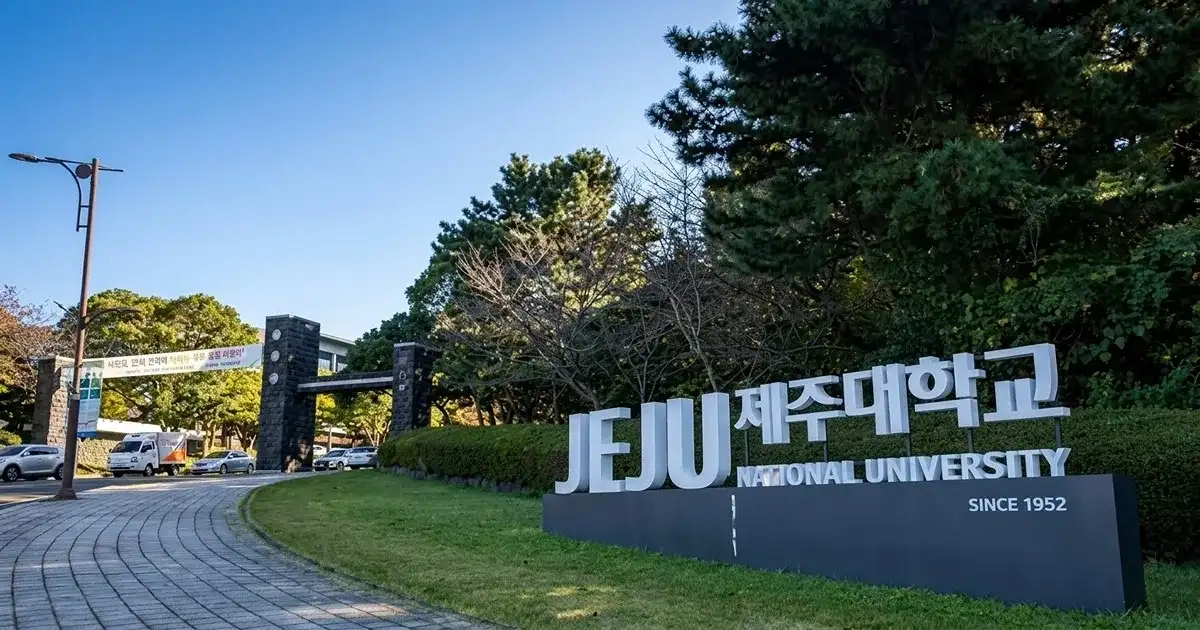
The university aims to research, teach, and develop profound theories and their applications in academic areas required for the development of the nation and human societies. It also aims to foster capable individuals with creativity and a cooperative spirit, who possess leadership qualities to meet the demands of the new era.
They foster warm-hearted, creative intellects who can take the lead in realizing universal human values based on retrospective insight gained about the world and mankind.
They strive to achieve a democratic and rational management of their university, create a motivating environment for their students, and offer the best welfare service for all members of their university.
They create a collegiate culture with a focus on academia for the purpose of nurturing creative human resources who maintain an intelligent balance of reason and emotion.
They implement a scientific plan for medium- and long-term student development for the purpose of achieving their educational ideals and objectives.
NATIONALITY
The applicant and both parents must be foreign nationals.
Both the student and parents must have acquired foreign citizenship before the applicant started high school.
Applicants (or parents) holding Korean citizenship, dual citizenship (including Korean), or no citizenship from any country are ineligible.
Academic Qualifications:
Freshmen: High school graduates (or expected graduates) who completed primary and secondary education (equivalent to Korea's 12-year system).
Transfer (2nd Year): Completed/expected to complete $\ge 1$ year (2 semesters) at a 4-year university, or graduated/expected to graduate from a junior college.
Transfer (3rd Year): Completed/expected to complete $\ge 2$ years (4 semesters) at a 4-year university, or graduated/expected to graduate from a junior college.
Special Criteria (Department of Nursing): Must have completed specific prerequisite credits (Anatomy $\ge 2$, Physiology $\ge 2$, Pathology $\ge 2$, Microbiology/Pharmacology $\ge 2$, Statistics/Practicum $\ge 3$, General Biology/Lab $\ge 3$).
Exclusions: Domestic/international GED, homeschooling, or cyber/online learning are not accepted.
Language Proficiency: Must meet at least one of the following conditions:
TOPIK (Test of Proficiency in Korean) Level 3 or higher.
Mandatory Level 4: Data Science, Computer Engineering, Biotechnology, Korean Language Education, and Computer Education require a minimum of TOPIK Level 4.
Completion (or expected completion) of Level 4 or higher at the Jeju National University Korean Language Course with an attendance rate of $\ge 90\%$ and an average score of $\ge 70$.
Nationality
Any student who can prove one of the two conditions below.
? Applicants themselves and both of applicant’s parents must be foreigners.
? Foreign nationals residing overseas who have completed all the education programs
equivalent to elementary, middle, and high school in South Korea, as well as regular
university education programs.
Academic Background
? Master’s course
: Applicants who have completed and earned a bachelor's degree or who are
expected to earn the degree or are expected to receive a degree.
? Master’s and Doctoral Integrated Courses
: Eligibility is same as that of a Master course, but applicants are required
to have an average grade of 85/100 or higher(2.55/4.0, 2.90/4.3, 3.10/4.5)
in their Bachelor's degree course.
? Doctoral degree
: Applicants who have completed and earned a master's degree or who are
expected to earn the degree or are expected to receive a degree.
Department of Nursing: Applicants should be a registered nurse.
Language Ability
Select one of the following four language proficiency options.
Please check the language proficiency requirements for each department
1) Applicants who have level 3 or higher in TOPIK (Test of Proficiency in Korean) <Exception>
TOPIK Level 5 is required for the Departments of Korean Language and Literature,
Faculty of Language Education(Korean Language Education), Interdisciplinary Course of
Korean Language as a Foreign Language
TOPIK Level 4 is required for the Departments of International Trade, Journalism
and Public Relations
Applicants who have completed over average score of 70 in the Level 4 Korean
Language program in the following departments may also apply: Chinese Language
and Literature, Public Administration, Horticulture, Data Science.
2) Applicants who have obtained over TOEFL iBT 3.5(for test-takers on or after
January 21, 2026) or TOEFL iBT 59(for test-takers on or before January 20,
2026), IELTS 5.5, CEFR B2, New TEPS 202.
Department of English Language and Literature: More than TOEFL iBT 80
Department of Biology: More than TOEFL IBT 75.
3) The applicants who have Korean or English learning ability recognised by a
to be assigned academic advisor.
: Submit [Form 5] Language requirement exemption letter.
4) Students who have nationalities of using English as their mother tongue or
as a legal official language.
: Certificate of completion of English courses
Online application Website: UWAYAPPLY (http://www.uwayapply.com)
B. Notices
university admission process. The admitted applicants' information will be
used for the Jeju National University school register.
? After the application fee payment, the information on the application form
cannot be modified or cancelled. So please be fully aware of this admission
guide and check the information on the application before the payment.
? Please make sure to put the exact address and contact number at home
and abroad on the application form so that the admission process and
guidelines can be notified immediately.
C. Online Application and Document Submission Process
? The Website sign up must be done with the applicant's information. The personal information will not be used for any other purposes but for the
D. Application Fee
? Application Fee: 70,000 won
? How to pay: Online payment on the application website
? Credit Card, Real-Time Account Transfer, Uway-Cash Charge and Payment,
Mobile Payment
The fee for internet processing is included in the overall processing fees and
this fee is non-refundable after your applications have been processed and
completed.
Email: [email protected]
Phone : +82-64-754-8280, +82 (64) 754-8244




2022
Jan. 6 -
Mar. 1 -
Mar. 4
2021
Jan. 2
Feb. 23
Feb. 26
Approved the change of school capacity (2,080 studnets {including 30 students} 2,175 students {including 30 students})
Mar. 1
Mar. 16
Mar. 30
Apr. 29
Jun. 29
Aug. 25
Oct. 25
Oct. 26
Dec. 7
2020
Mar. 1
Mar. 31
Apr. 28
Aug. 12
Dec. 30