
Jeonbuk National University was founded in 1947, rooted in the legacy of Iri Agricultural College, Jeonju Myeongnyun College, and Gunsan College. As a flagship national university in Korea, JBNU has grown alongside our community and nation, nurturing over 250,000 alumni who have contributed to society across a wide range of fields.
| Acronym | JBNU |
| Nickname | JBNU |
| Motto / Slogan | Freedom, Justice, Creativity |
| Colour | Maroon and Blue |
| Mascot | Amur Leopard (Panthera pardus orientalis) |
| Founded | 1947 |
| Location | Jeonju, North Jeolla, South Korea |
| Address | 567 Baekje-daero, Deokjin-gu, Jeonju-si, Jeonbuk-do, 54896 Republic of Korea |
To uphold fundamental principles in education and research, nurture creative and global-minded leaders, and spearhead industry-academia cooperation that empowers the local community, region, and nation.
Six Core Competencies
Core Values
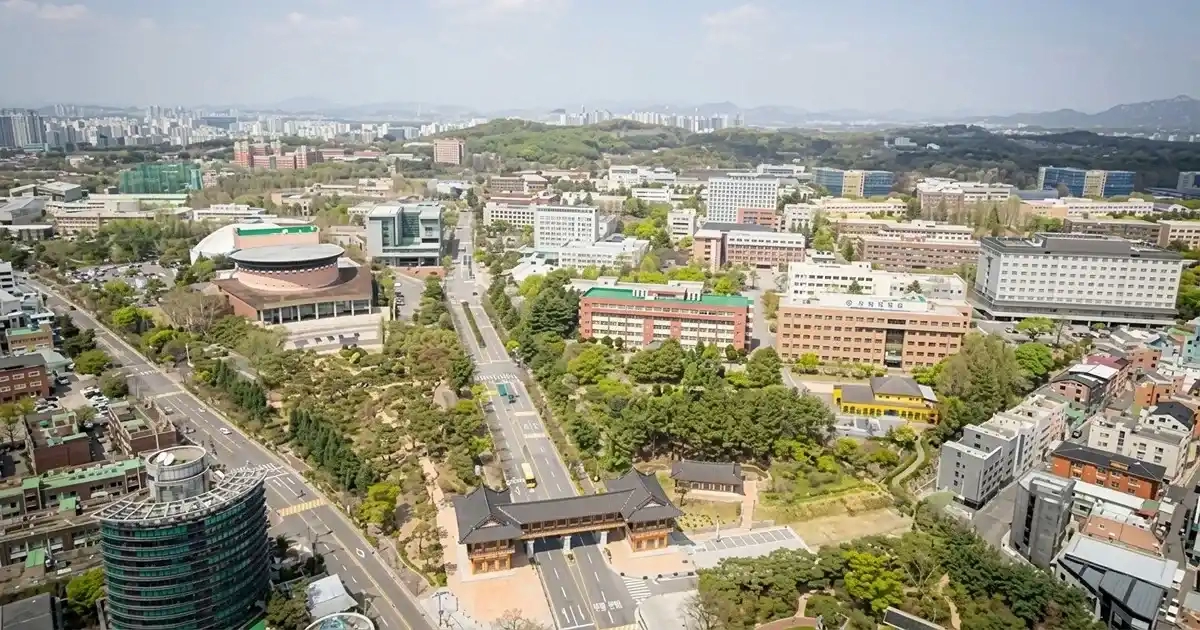
JBNU is a research-intensive national university with particular strengths in Engineering, Natural Sciences, Agriculture, Veterinary Medicine, Chemical Engineering, Materials Science, and Petroleum Engineering. In the 2026 THE subject rankings, JBNU ranked first among Korea's flagship national universities for research quality in Engineering and Natural Sciences.
JBNU has a growing international reputation. It is ranked #701–710 in the QS World University Rankings 2026, while several of its individual subjects achieve much stronger global positions.
JBNU has partnerships with more than 400 academic institutions worldwide, providing opportunities for student exchanges, international programs, and global academic collaboration.
JBNU works closely with regional industries and government-funded research centers, providing opportunities for students to connect academic learning with research, innovation, entrepreneurship, and industry.
Entrance Fee: 178,000 won
Applicants who meet one of the following criteria (must be a foreign national; dual nationality is not permitted)
Type 1: Both applicants and their parents should hold foreign nationality and be graduates of regular high school
Type 2: Foreigners who have completed all educational courses abroad
Applicants who hold dual citizenship are not allowed to apply
Korean and foreign high school graduation qualifying examinations are not admitted
Homeschooling, cyber education academic recognition methods are not admitted.
Nationality/ Academic Qualifications:
1. Applicants who meet one of the following criteria
- Type 1: Both applicants and their parents should hold foreign nationality
- Type 2: Foreigners who have completed all educational courses abroad
2. Must be graduates of regular high school
3. Applicants for junior year must have completed 4 semesters(2 academic years) and acquired at least 65
credits from a 4-year university
Applicants transferring to sophomore year must have completed 2 semesters (1 academic year) and acquired
at least 35 credits
Applicants transferring to senior year must have completed 6 semesters (3 academic year) and acquired at
least 95 credits
For junior college (2-3 academic years), only graduated (or anticipated) students can apply.
Language Proficiency Requirements:
1. Applicants to the International Engineering Science and School of International Studies
2. Applicants must fulfil one of the following requirements:
- IELTS 5.5, TEPS 600, New TEPS 330, TOEFL iBT 71 (For tests taken after January 20, 2026: 3.5 or higher)
- Applicants from English speaking countries can substitute official English exam scores with their secondary school
diploma.
Nationality:
A person who can prove one of the following two conditions.
•Condition 1) Applicant and both of applicant’s parents must be foreigners 3 people do not have Korean Citizenship
•Condition 2) Applicant who is not Korean has completed all levels of education equivalent to elementary, middle school, high school, undergraduate and graduate school in foreign countries.
Language:
Applicants should be able to attend classes in Korean or English. Those who meet the language qualification criteria by department.
Academic:
•Master Program(include combined Master and Ph.D course) - Applicants must hold a Bachelor’s degree or a diploma that is equivalent to a Bachelor’s degree.
•Doctoral Program - Applicants must hold a Master’s degree or a diploma that is equivalent to a Master’s degree. Applicants who are expecting to obtain the relevant required degree or diploma before the beginning of new semester.
Joint Research institute Program:
Applicants who have satisfied all conditions(Nationality, Language Proficiency etc.) and satisfy the followings
•Those who have been recommended by the head of the convention organization.
•Application can be submitted after consultation with the department in advance.
Please bear in mind, when the contract with institute was cancel or expired students of Joint research institute program can be discontinued.
Step 1: Visit Application Website
Step 2: Fill Out Application Form
Step 3: Pay Application Fee
Step 4: Submit Required Documents
Step 5: Interview
Step 6: Admission Results
Step 7: Tuition Payment
Step 8: Visa Application
Step 9: Arrival and Semester Start
Email: [email protected]
Phone : +82-63-270-4653, +82-63-270-4382.


General Institutional Accreditation: Recognized as an accredited national university under the Korean Council for University Education (KCUE) standards. It received a 5-year institutional evaluation accreditation covering core areas like governance, curriculum, faculty, and student support.
In July 2026, JBNU received the highest level of accreditation in the 4th Cycle University Institutional Evaluation and Accreditation conducted by the Korean University Accreditation Institute. The accreditation is valid for five years, through February 2032. JBNU met the standards in all evaluation areas, including university governance, curriculum and teaching-learning, faculty and staff, and student support and facilities.
In 2026, four JBNU engineering programs received KABEE accreditation with the highest rating, NGR (Next General Review):
This accreditation is valid through 2033
2025. 03. ~ Present
Chairman, Korean Council for University Education
2025. 04. ~ Present
Member of Committee, National Education Commission
2025. 01. ~ Present
Chairman, The 32nd KBS Jeonju Broadcasting Bureau's Audience Committee
2024. 12. ~ Prese... read more Co-Chairman, RISE Committee of Jeonbuk Statent



Opening of the Student Town
Opening of the Han Seung-heon Library
Establishment of the 7th JBNU International Center (Tajikistan)
Establishment of the 6th JBNU International Center (Uzbekistan)
Establishment of the 5th JBNU International Center (Cambodia)
Launch of the Physical AI Convergence Technology Project Promotion Group
Establishment of the Namwon Glocal Campus Management Headquarters
Selected for the 2025 Industry-Specialized Physical AI Leading Model Development and PoC Project.
Assumption and Operation of Gochang Campus of Korea Polytechnics V College