
Kyung Hee University was founded in 1949 with the intention of “Creating a Civilized World.” Since its establishment, Kyung Hee has followed a tradition combining academic and practical achievement, the pursuit of universal values and harmony. In 1965, the International Association of University Presidents (IAUP) was established, and its subsequent activities include contributions to the UN International Day of Peace in 1981. In 1993, UNESCO recognized the efforts of Kyung Hee University on the international stage with its Peace Education award. Kyung Hee’s three campuses (Seoul, Global, and Gwangneung) are part of a comprehensive and future-oriented academic system. As of 2025, the University has 25,573 undergraduate students, 8,769 graduate students, and 1,395 full-time faculty members, and is composed of 23 colleges and 88 departments (majors). As of December 2025, Kyung Hee University has established partnerships with 625 partner universities in 83 countries worldwide and offers a wide range of international education programs, including exchange and visiting programs, the Global Collaborative Summer Program, and short-term thematic online programs.
| Acronym | KHU |
| Motto / Slogan | Creating a Civilized World |
| Colour | Crimson |
| Mascot | Lion |
| Founded | 1949 |
| Location | Suwon, Gyeonggi, South Korea |
| Address | 1732, Deogyeong-daero, Giheung-gu, Yongin-si, Gyeonggi-do 17104, Republic of Korea |
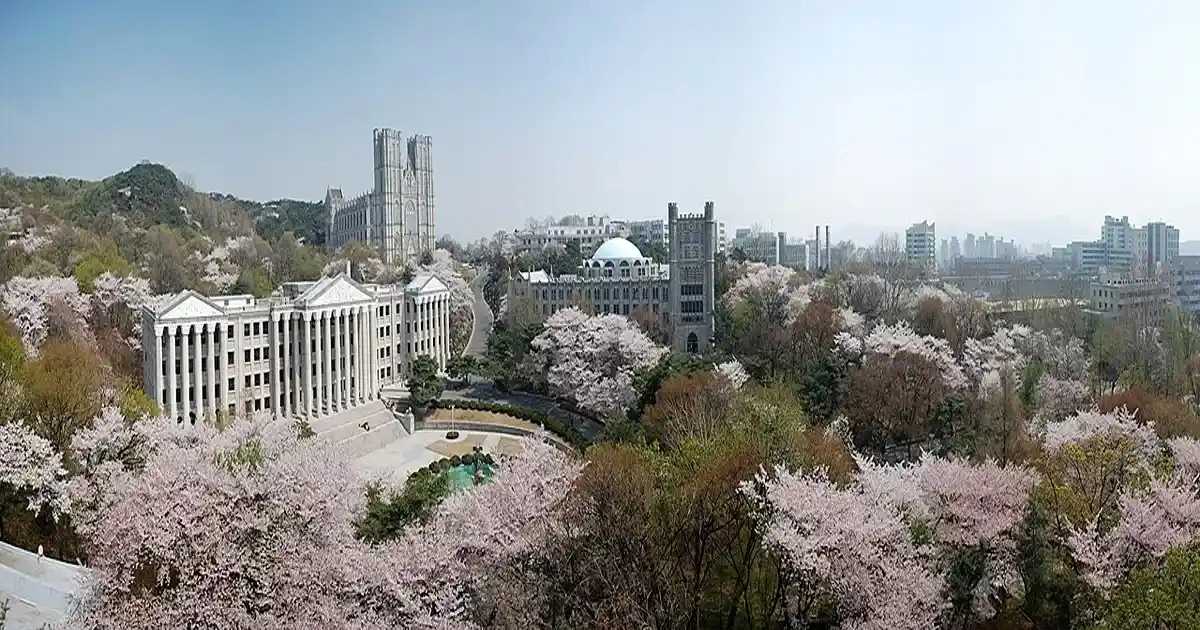
Kyung Hee University is committed to being a “university where students can learn and dream freely,” fostering imagination, creativity, and action for a better future. Through Humanitas College’s liberal arts education, interdisciplinary and industry-focused majors, and career development programs, students pursue self-directed learning. This empowers them to lead fulfilling lives and contribute to building a sustainable civilization.
As of 2025, Kyung Hee University is ranked 331st in the QS World University Rankings, 39th in the QS Asia University Rankings, and 252nd in the Times Higher Education (THE) World University Rankings. These achievements reflect Kyung Hee’s dedication to its unique values and traditions—"Creating a Civilized World" and "Academe and Peace"—as it continues its journey of challenge and creation for the future of humanity.
Kyung Hee University provides structured and continuous academic adjustment support programmes to help international students smoothly adapt to the academic system and teaching methods of Korean universities from the very beginning of their studies.
After international students have successfully adjusted to their academic studies, Kyung Hee University offers a range of global programmes that enable them to expand major-based learning into meaningful global experiences.Through these programmes, international students collaborate with peers from diverse cultural backgrounds to solve real-world problems and naturally develop the competencies required in a global environment.
Building on major-based studies and global experiences, Kyung Hee University supports international students in clearly defining their career paths and systematically developing practical skills in preparation for life after graduation. Through this process, international students reflect on their aptitudes and goals while exploring potential career pathways.
1. Nationality Requirement: Applicants and both of their parents must be non-Korean citizens and must meet all the following conditions: a) Both the applicant and both their parents must have non-Korean citizenship prior to the applicant beginning high school/secondary school (or equivalent to the level of Korean high school). Applicants whose nationality was originally Korean but changed after the beginning of high school are not qualified to apply to the international admission.
b) If an applicant’s parents abandoned (or lost) their Korean citizenship, the applicant must submit proof of denationalization (loss of nationality)
c) If the applicant’s legal support obligator is one of applicant’s parents, only the nationality of the person liable for support shall be considered for the application qualification (However, it must be proved by government - issued document) In case of divorce of parents, please refer to the ‘Eligibility for both Freshmen and Transfer students’ listed below. ? If the above does not apply, please contact us individually.
2. Academic Requirement: Applicants must have completed or be expected to have completed secondary education prior to admission ? Applicants whose school records include any notation related to school violence are not eligible to apply.
3. Language Requirement(Korean Track): Applicants must meet one of the following conditions:
a) Obtained TOPIK Level 3 or above (TOPIK iBT is acceptable except trial tests.) - The score must be valid at the time of application
b) Enrolled in and completed Intermediate 2 Korean Language Course through KHU-affiliated language institutes (Applicants must have completed the courses less than 2 years from the beginning date of the online application)
c) Passed level 3 of the KHU Korean Language Test (The score valid at the time of application)
d) Korea Immigration and Integration Program level 3 or above (or obtain 61 score or higher at the Pre-test)
e) King Sejong Institute Korean Language Intermediate level 1 or above(Practical program and online program are not acceptable)
f) Graduates(prospective graduates) of Korean high schools who are recognized to have sufficient Korean language skills(International schools and Foreign schools are not acceptable)
g) Department of Global Eminence(Seoul Campus): Applicants who hold a TOPIK score or are deemed to have an equivalent level of Korean language proficiency. ? KHU Korean Language Test: details can be found at ‘KHU Korean Language Test’ ? The terms of enrollment and issuance visa are subject to change according to Korean government policies. It will be notified separately.
4. Language Requirement(English Track): Applicants must meet one of the following conditions:tions:
a) Hold a citizenship of an English-speaking country or a country where English is an official language
b) Obtain an official English proficiency test. (The score must be TOEFL iBT 80, IELTS 6.0, or NEW TEPS 327 or higher)(The expiration date should be after the starting date of the online application. IELTS scores are valid for two years from the test date stated on the official score report.)
c) completed secondary education (high school) in a country where English is the native or official language. ? The terms of enrollment and issuance of visa are subject to change according to Korean government policy. It will be notified separately.
d) Departments: Department of Management, Department of Global Hospitality & Tourism Management, Department of International Studies, Department of Asian Studies.
1. Online KHU Application Form
2. Self Introduction and Study Plan
3. Official High School Diploma (certificate of prospective graduation) [translated and notarized] (issued within 6 months of online application. If the document is issued only once in a lifetime, it is accepted if it is notarized within 6 months.)
4. Official high school transcript of three years [Translated and notarized],(Full score criteria must be indicated on the transcript)
5. High School Student Record
6 A government-issued certificate of family registry to verify the applicant’s relationship with parent [Translated and notarized] - Copy of applicant’s passport - Birth certificate and Family Relation Certificate - Copies of parents’ passports or copied domestic ID is required - ID cards in hand-writing must be translated and notarized in either English or Korean.
7 Original Document for Proof of Language Proficiency [TOPIK Level 3 or above/KHU Korean Language Test Level 3 or above/Korean Language Intermediate Level 2 Completion Certificate from KHU affiliated language institutes/Korea Immigration and Integration Program level 3 or above (or obtain 61 score or higher at the Pre-test)/King Sejong Institute Korean Language Intermediate level 1 or above(practical program and online program is not acceptable)/Graduates(prospective graduates) of Korean high schools]
8 [Applicants with Practical Test] - Department of Postmodern Music: Submission of video in a USB. - Department of Taekwondo: Level 2 or higher Dan Certificate issued by KUKKIWON(the World Taekwondo Headquarters.
9 Certificate of Scholarship.
10 Certificate of Foreign Resident Registration(?????????) or Certificate of Overseas Korean Registraion(??????????)
Foreigner:
Applicants and both of his/her parents must be non-Korean citizens
Master's & Combined
Applicants who hold a Bachelor’s degree from Universities in Korea or abroad, or expected to acquire a Bachelor's degree before 2026.08.31.(Mon.)
? Applicants who are considered to hold a level of education equivalent to or higher than a Bachelor’s degree according to relevant laws.
Ph. D.
? Applicants who hold a Master’s degree from Universities in Korea or abroad, or scheduled to finish program by 2026.08.31.(Mon.)
? Applicants who are considered to hold a level of education equivalent to or higher than a Master’s degree according to the relevant laws.
Language Proficiency
Korean
All applicants to departments that require basic Korean proficiency must meet at least one of the conditions ?~?.
? Obtained TOPIK Level 4 or above
? Must have graduated with a major in Korean Language from Non-Korean university
? Must have registered or have grades for at least 4 regular semesters at universities in Korea while residing in Korea
? Completed KIIP (Korea Immigration & Integration Program) Level 4 or higher, or scored 81 points or higher from the Preliminary Evaluation
? Obtained Certificate of KSI (King Sejong Institute) General Curriculum Intermediate 2 from the local institution * Cases such as a Non-Korean residing in Korea obtains KSI certificate by taking online curriculum does not count.
English
Applicants to departments that require basic English proficiency, such as Global Hospitality & Tourism Management, Mathematics, Information Display, KHU-KIST Convergence Science and Technology and English Language & Literature, must meet either condition ? or ? below.
? Applicants holding nationality of an English-speaking country or a country where English is an official language (Only valid when completed education course is in English if from country where English is an official language), and submitted proof (Certificate of Graduation, etc.) of completing secondary or higher education from that country
? Applicants who have one of designated English test results as follow: - TOEFL iBT 80 or above - IELTS 6.0 or above - TEPS 326 or above
1) Applicants may submit an application for only one campus - please choose either the Seoul Campus or the Global Campus.
2) Online applications must be submitted by 17:00 (UTC +9:00 Seoul Standard) on the last day for submission. Please submit your application before the last days as the online system may be delayed due to the high volume of online traffic. After the application deadline, the application fee is non-refundable. (Based on Article 42-3 (Admission Fee) of the Higher Education Act Enforcement Decree).
3) The application fee must be paid in order for the online application to be printed. The application cannot be changed after the application fee is paid. After the application deadline, it is not possible to modify the application unit (major), application type (freshmen/transfer), or cancel the application, so please complete the application with caution.
4) Any applicant who falsifies information, fails to submit materials on time, or cannot be contacted by the school will be disqualified from admission review. Meeting the outlined criteria and deadlines is entirely the responsibility of the applicant, and KHU will not consider an objection to disqualification (Application fee is not refundable).
5) Application fee: KRW 180,000 - Department of Post Modern Music (Global Campus) ? KRW 250,000
Email: [email protected]
Phone : +82-2-961-9286






The university hosted the 1968 conference of the International Association of University Presidents, first proposed in 1981 the UN International Day of Peace, organized the 1999 Seoul International Conference of NGOs, held the 2009 ... read more
In 1993 Kyung Hee received the UNESCO Prize for Peace Education. ?p. 53?In 2006, Kyung Hee and the University of Pennsylvania initiated the Penn-Kyung Hee Collaborative Summer Program:?p. 458? and two years later, a formal Global Collaborative Archived 2016-01-19 at the Wayback Machine with Peking, Ritsumeikan, and Moscow State universities, with the cooperation of the United Nations Department of Economic and Social Affairs, and the Conference of NGOs (CoNGO).