
BYU is the flagship university of the Church Educational System and is known for its strong academic programs, vibrant campus life, and commitment to religious values. The university operates under a board of trustees, with the president of the church serving as chairman. It offers a unique environment where students can pursue academic excellence while adhering to a code of conduct that reflects the teachings of the LDS Church.
| Acronym | BYU |
| Nickname | Cougars |
| Motto / Slogan | Enter to learn; go forth to serve |
| Colour | Navy blue and white |
| Mascot | Cosmo the Cougar |
| Founded | 1875 |
| Location | Provo, Utah, United States |
| Address | Brigham Young University Provo, UT 84602 |
The mission of Brigham Young University — founded, supported, and guided by The Church of Jesus Christ of Latter-day Saints — is to assist individuals in their quest for perfection and eternal life. That assistance should provide a period of intensive learning in a stimulating setting where a commitment to excellence is expected and the full realization of human potential is pursued.
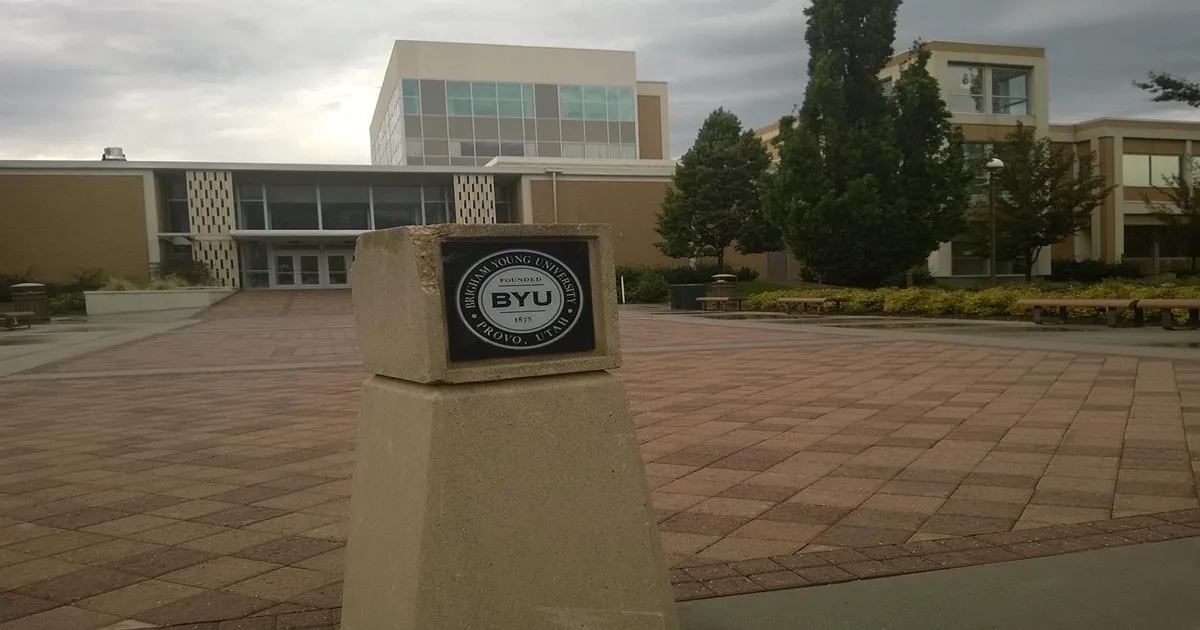
BYU offers strong academic programs with tuition significantly lower than most U.S. private universities, making it one of the best value options for international students.
The university is well known for excellence in business, engineering, sciences, and humanities, with experienced faculty and practical, career-focused learning.
Students benefit from internships, research opportunities, career mentoring, and strong employer connections that improve job readiness after graduation.
BYU combines academic excellence with Christian values, promoting integrity, service, leadership, and personal development in a respectful community.
UNDERGRADUATE:
POSTGRADUATE:
Entry requirements vary by program and course. Check the program page for requirements.
International Students:
International Students:
Application requirements are different for each graduate program. Learn the application requirements for your graduate program by referencing the admission requirements on the program(s) website.
Meet the University’s Minimum Requirements
Email: [email protected]
Phone : +1 (801) 422-4104, +1 (801) 422-4636, +1 801-422-4091




Reese’s research has centered on Bayesian hierarchical models and Bayesian optimal experimental designs. He has created statistical models addressing a range of issues from predicting the power of solar storms to determining the safest method for destroying chemical weapons to assessing climate impact on glaciers in high mountain Asia and Antarctica. His work has also been used by the U.S. Olympic volleyball team as well as the NFL’s Philadelphia Eagles.
Prior to her appointment, she served as the director of BYU Residence Life for 20 years. During her tenure in residence life, Franklin oversaw the renovations of Helaman Halls and led a comprehensive evaluation of the experiences of first-year students. The findings prompted the university to build the new Heritage Halls in 2016. Franklin has also collaborated with other areas within Student Life, from outreach efforts with Counseling and Psychological Services to accommodations with the Accessibility Center.
Collings joined the J. Reuben Clark Law School faculty in 2013 following a clerkship for Judge Guido Calabresi with the U.S. Court of Appeals for the Second Circuit. Before joining the university administration he served as associate dean for faculty and curriculum, as well as for research and academic affairs at BYU’s law school. Collings served as an associate academic vice president for faculty development before being appointed academic vice president in June 2023. He is a member of the advisory group and a former fellow of the BYU Wheatley Institute, whose mission is to fortify society’s core institutions of family, religion, and constitutional government.
Prior to working for BYU, he clerked on the United States Court of Appeals for the Ninth Circuit for Judge Andrew J. Kleinfeld in Fairbanks, Alaska, and was an associate at Morrison & Foerster, LLP in Irvine, California. Sandberg is licensed to practice in California, Hawaii, Idaho and Utah.
Forste taught three years as an assistant professor in the department of sociology at Western Washington University before joining the sociology faculty at BYU in 1995. She has served as an associate dean in the College of Family, Home, and Social Sciences, department chair of the Sociology Department and most recently as director of the David M. Kennedy Center for International Studies and associate international vice president.


Classes at B... read more
In 1903, Brigham Young Academy was dissolved and replaced by two institutions, Brigham Young High School (BY High) and BYU. The BY High class of 1907 was ultimately responsible for the giant "Y" that remains embedded on a mountain near campus. The Board elected George H. Brimhall as the new President of BYU. Under his tenure in 1904, the new BYU bought 17 acres (69,000 m2) of land from Provo called "Temple Hill". After some controversy among locals over BYU's purchase of this property, construction began in 1909 on the first building on the current campus, the Karl G. Maeser Memorial. Brimhall also presided over BYU during a brief crisis involving the theory of evolution. The religious nature of the school seemed at the time to collide with this scientific theory. Joseph F. Smith, church president at the time, settled the question for a time by asking that evolution not be taught at the school. Over time, students and faculty found a way to reconcile the factual elements of evolution with the church's teachings. Even though a few at this time described the school as little more than a "religious seminary", many of its graduates from this time would go on to great success and become well renowned in a variety of fields.