

Founded in 1852 by Christian Universalists, Tufts has evolved into a globally recognized institution emphasizing active citizenship and public service across its diverse academic offerings.
| Nickname | Jumbos |
| Motto / Slogan | Pax et Lux |
| Colour | Brown and Blue |
| Mascot | Jumbo the Elephant |
| Founded | 1852 |
| Undergraduate Programmes | |
| Postgraduate Programmes | 100 |
| Location | Medford, Massachusetts, United States |
| Address | Tufts University, 419 Boston Ave, Medford, MA 02155 |
Founded in 1852 by Christian Universalists, Tufts has evolved into a globally recognized institution emphasizing active citizenship and public service across its diverse academic offerings.
The Tufts Public Health Program seeks a world where all people live in conditions that allow them to achieve their highest attainable level of health, are supported by equitable political, economic and social systems, and have access to integrated, effective, high quality public health and health care services.
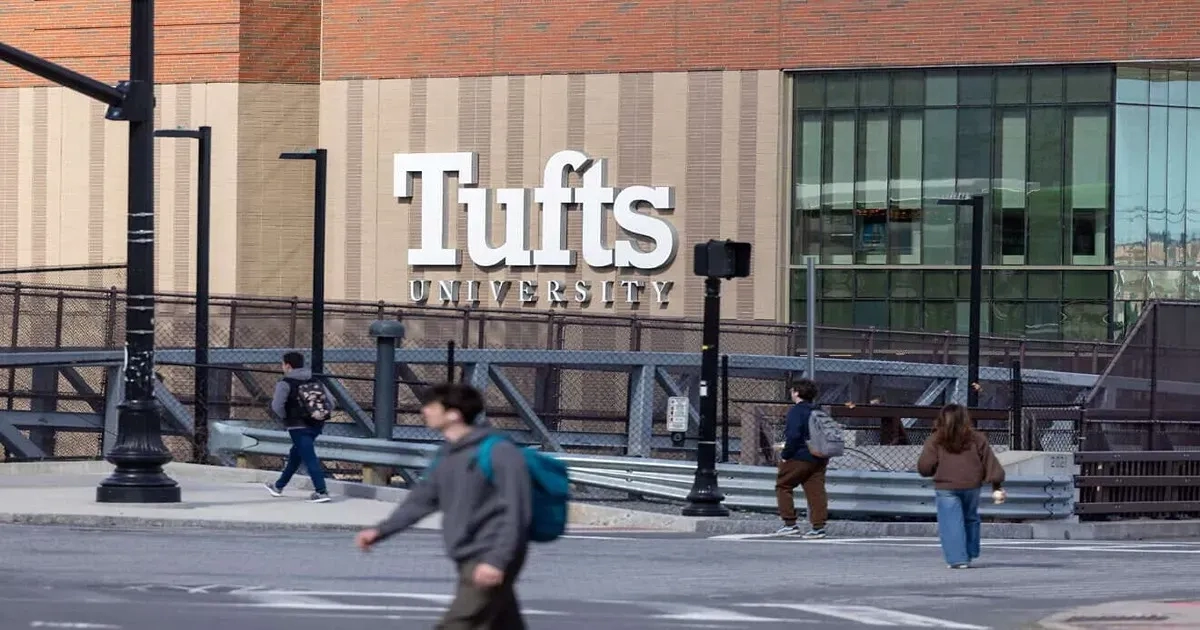
The interdisciplinary offerings at Tufts mean you can pursue your interests in and across our three undergraduate schools, all led by inspiring faculty members eager to work with undergraduate students.
We believe that the cost of attending Tufts should not be a barrier to students and their families. That is why Tufts proudly meets 100% of demonstrated financial need for all admitted students, regardless of citizenship status. And with the Tufts Tuition Pact, U.S. undergraduates will attend Tufts tuition-free if their annual family income is under $150,000, with typical assets.
Catch students talking excitedly with one another between classes, over a meal, or in a residence hall. Regardless of the topic of conversation, Tufts students care ...about their ideas, activities, and communities.
Tufts is known for rigorous academic programs and a high level of scholarship across arts, sciences, engineering, and professional fields. It’s a research-intensive university where students can work with faculty on meaningful research and innovation — not just in labs but across disciplines like public policy, biotechnology, and international affairs.
Entry requirements vary by course. Check the page for requirements.
International Applicants:
International students are asked to submit the same set of credentials required of all first-year or transfer applicants.
English Proficiency Testing
All applicants whose primary language is not English must submit proof of English proficiency, unless they have been enrolled in an English instruction school for at least three years. Students with at least three years of study in a secondary school where the primary language is English do not need to submit English proficiency testing, though they may if they would like. Students enrolled in ESOL classes during secondary school may be asked for proof of proficiency.
Tufts accepts the following English language tests: TOEFL, IELTS, PTE, Duolingo.
Some degree programs require additional documents. Please refer to the instructions in the online application to ensure you submit all required documents.
International Students:
Applicants who are not native speakers of English are required to take the Test of English as a Foreign Language (TOEFL), the International English Language Testing System (IELTS), or the Duolingo English Test. A TOEFL score of 90, an IELTS score of 6.5, and a Duolingo English Test score of 110 are generally advised for Certificate, MA, MS, and PhD applicants. However, we encourage all applicants to review department pages to understand program-specific score requirements, which can vary by department and program. A minimum score of 85 is required for MFA and Post-Baccalaureate Studio Art applicants.
We strongly prefer that official scores are sent to us by the test provider electronically. Please see the below instructions to send scores electronically:
Please note: student copies or photocopies of TOEFL/IELTS/Duolingo scores are not accepted.
If an applicant satisfies one or more of the following conditions, they are not required to provide a TOEFL, IELTS, or Duolingo score:
UNDERGRADUATE:
POSTGRADUATE:
Email: [email protected],[email protected]
Phone : 617-627-3395, +1 617-627-3458




Research Center: Tufts University is home to more than 45 interdisciplinary centers and institutes focused on a broad range of topics, from medicine, science, and technology to animals and the environment. Led by members of the Tufts faculty, these centers and institutes contribute extensively to education and research and promote higher learning at the university.
New England Commission of Higher Education (NECHE)
At Tufts, Kumar is strongly committed to preserving and enhancing the emphasis on a liberal... read more
Prior to Tufts, Kumar served as the 15th provost of Johns Hopkins University (JHU) from 2016-2023 and as Dean of the University of Chicago’s Booth School of Business, as well as the George Pratt Shultz Professor of Operations Management from 2011-2016. Before joining the Booth School of Business, he spent 14 years on the faculty of the Stanford University Graduate School of Business, where he was the Fred H. Merrill Professor of Operations, Information and Technology and served as the senior associate dean for academic affairs, overseeing the school’s MBA program and leading faculty groups in marketing and organizational behavior.
Dr. Genco previously served as the Vice Provost for Research (VPR) from 2019 to 2021 and as chair of the Immunology Department at Tufts University School of Medicine (TUSM) from 2015 to 2019. In her role as VPR, she worked with faculty and university leadership to develop and implement strategic research priorities at Tufts, facilitated strategies to increase extramural research funding, and enhanced the university research structures and programs, while also pivoting to respond to opportunities and challenges as they arose.
The EVP also maintains indirect reporting relationships with the Executive Associate/Administrative Deans of each of Tufts University's schools to ensure the University's administrative functions are coordinated and integrated at each level.
Prior to joining Tufts, Mike was the executive vice president for finance and administration at Smith College, vice president of finance at MIT, senior vice president at Fidelity Investments and held senior positions at Deloitte Consulting. Mike has an undergraduate degree from Massachusetts Institute of Technology in mechanical engineering and M.B.A. from the University of Chicago Booth School of Business.
Boucher’s clinical interests include infections in immunocompromised patients and S. aureus infections. Her research interests focus on S. aureus and the development of new anti-infective agents. She is the chair of the National Institutes of Health (NIH) Antibacterial Resistance Leadership Group (ARLG) Innovations Working Group and serves on the Executive and Steering Committees. Boucher is the author or coauthor of numerous abstracts, chapters, and peer-reviewed articles, which have been published in such journals as The New England Journal of Medicine, Antimicrobial Agents and Chemotherapy, Clinical Infectious Diseases, and The Annals of Internal Medicine. She is Associate Editor of Antimicrobial Agents and Chemotherapy, editor of the Sanford Guide to Antimicrobial Therapy, and Infectious Diseases Clinics of North America.




As local lore has it, when a relative asked Charles Tufts what he would do with his land, and more specifically with “that bleak hill over in Medford,” Tufts replied, “I will put a light on it.” In 1855, a toast to the new Tufts College was offered at a Universalist gathering in Boston’s Faneuil Hall. Rev. Hosea Ballou 2d, minister of the First Universalist Church in Medford and the college's first president, remarked, “For if Tufts College is to be a source of illumination, as a beacon standing on a hill, where its light cannot be hidden, its influence will naturally work like all light; it will be diffusive.”
The nearest house on the Medford side of the Hill was the mansion of George L. Stearns. Stearns was among the “Secret Six” who helped finance John Brown's abolitionist rebellion at Harpers Ferry, Virginia in 1859. For a period, Stearns’ home served as a way station of the Underground Railroad, a network organized before the Civil War to assist the journey of enslaved people to freedom in Canada.
When the Commonwealth of Massachusetts chartered Tufts College in 1852, the original act of incorporation noted the college should promote “virtue and piety and learning in such of the languages and liberal and useful arts as shall be recommended.” Hosea Ballou 2d, elected as Tufts’ first president, spent much of 1853-1854 traveling within the United States and Europe visiting, observing, and studying other institutions’ approaches to undergraduate education and college administration. In 1854, the Trustees authorized faculty “to give instruction in the Latin and Greek languages and in Mathematics to such young men as desire to pursue those studies.” In Tufts’ earliest days, the original college building - which would eventually bear Ballou's name - served as both home and classroom for seven students, who were taught by four professors. By the time of Ballou's death in 1861, Tufts had 36 alumni and 53 students enrolled. Engineering instruction began at Tufts in 1865, with the introduction of a three-year degree in civil engineering.
The official college seal, bearing the motto “Pax et Lux” (Peace and Light), was adopted in 1857 and the student body selected the school colors of brown and blue in 1876. Tufts’ mascot became Jumbo the Elephant in 1885, when P.T. Barnum, circus showman and an early Trustee of Tufts, donated the stuffed hide of Jumbo to the college. Jumbo stood in Barnum Hall for 86 years until the building and elephant were destroyed in a fire in 1975.
In 1892, the Board of Trustees approved “that the College be opened to women in the undergraduate departments on the same terms and conditions as to men” and nine women enrolled that fall. This status changed in 1910, when women officially matriculated to Jackson College, a coordinate women's college associated with Tufts. In 1980, Tufts became officially co-educational once again.
The first identified Black graduate of Tufts College is Forrester Blanchard Washington, who graduated in 1909 and later served as director of the Atlanta School of Social Work, president of the NAACP Atlanta chapter, and a public policy advisor with the Federal Emergency Relief Administration under President Franklin D. Roosevelt’s “Black Cabinet.”
During the late 19th and 20th centuries, Tufts grew from a small liberal arts college to a top-tier research university offering master’s, doctoral, and professional graduate programs. This growth includes the establishment of a medical school in 1893, an engineering school in 1898, a dental school in 1899, and the Fletcher School of Law and Diplomacy in 1933. In 1954, Tufts College became Tufts University. During the 1970s, French American nutritionist Jean Mayer became president and increased the endowment six-fold while expanding the university and establishing the Cummings School of Veterinary Medicine, Graduate School of Biomedical Sciences, and Friedman School of Nutrition Science and Policy. In 2016, Tufts University acquired the School of the Museum of Fine Arts, with whom Tufts had partnered since 1945.
Today, Tufts is a student-centered research university that serves about 6,900 undergraduate students and 5,500 graduate students across campuses in Medford/Somerville, Boston, and Grafton, Massachusetts. Tufts no longer has a religious affiliation and students of all religious backgrounds worship in several sacred spaces, including Goddard Chapel, the 1882 Lombardic Romanesque chapel. We are proud to be home to a diverse community of students who represent a multitude of spiritual identities, ideological viewpoints, racial and ethnic backgrounds, and geographic origins.