
Founded in 1836, Emory University has grown into a leading institution recognized for its commitment to creating, preserving, teaching, and applying knowledge in the service of humanity. Its nine schools and colleges offer a wide range of undergraduate, graduate, and professional programs.
| Nickname | Eagles |
| Motto / Slogan | Cor prudentis possidebit scientiam |
| Colour | 1836 |
| Mascot | Swoop the Eagle |
| Founded | 1836 |
| Undergraduate Programmes | |
| Postgraduate Programmes | 50 |
| Location | Atlanta, Georgia, United States |
| Address | Emory University 201 Dowman Drive Atlanta, Georgia 30322 |
Emory University's mission is to create, preserve, teach, and apply knowledge in the service of humanity.
To fulfill this mission, the university supports teaching from the undergraduate to the advanced graduate and professional levels, and scholarship from basic research to its application in public service. As a comprehensive research university, Emory’s academic programs span a great range from arts and sciences to business, law, theology, and the health professions. These different fields of study are knit together by robust interdisciplinary programs and a core devotion to liberal learning.
The Emory community is open to all who meet its high standards of academic excellence and integrity. The university welcomes a diversity of ethnic, cultural, socioeconomic, religious, national, and international backgrounds, believing that the intellectual and social energy that results from such diversity is critical to advancing knowledge.
Emory is committed to opening disciplinary boundaries and supporting interdisciplinary research and teaching from a global perspective. Along with this, Emory strives to create a community characterized by respectful and mutually supportive interaction among faculty, students, staff, and the wider world.
In keeping with the demand that teaching, learning, research, and service be measured by high standards of integrity and excellence, and believing that each person and every level of scholarly activity should be valued on its own merits, the university aims to imbue scholarship at Emory with a commitment to humane teaching and mentorship and a respectful interaction among faculty, students, and staff; open disciplinary boundaries that encourage integrative teaching, research, and scholarship; a commitment to use knowledge to improve human well-being; and a global perspective on the human condition.
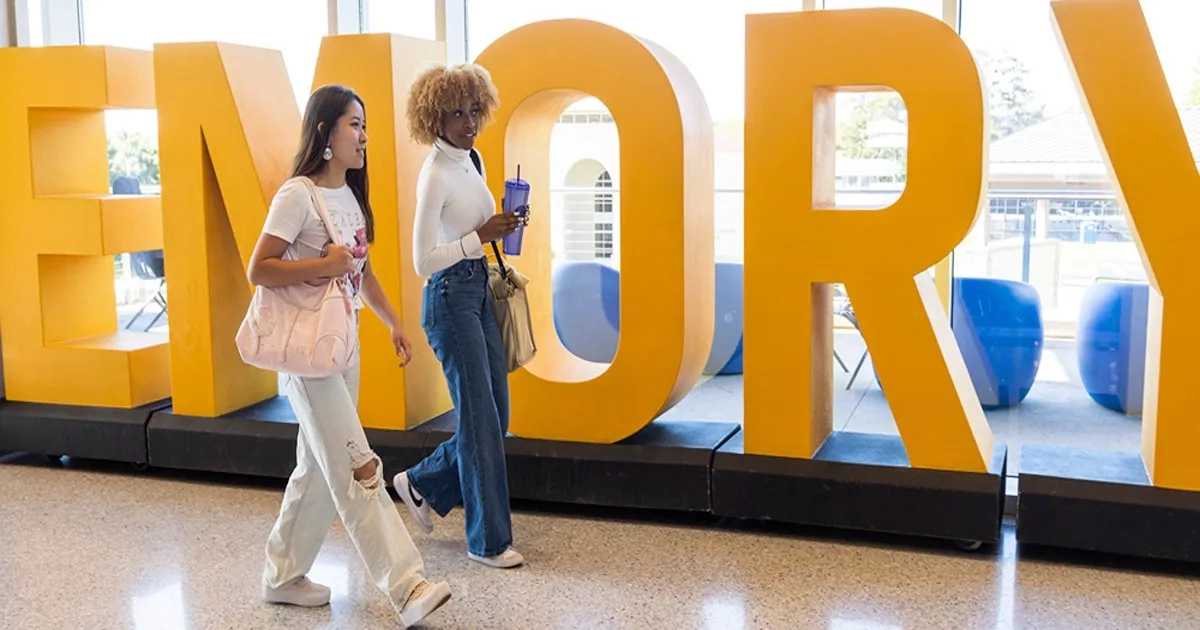
This is where you’ll find some of the brightest minds in academia. We don’t just teach or lecture—we equip and inspire students to make their own discoveries. We believe that creativity and innovation can make a difference in the world, and we encourage students to explore new ways to solve old problems.
We’re not just teaching students to change the world, we’re helping them do it every day. See just a few of the ways that leaving the classroom behind can help propel our world toward a better future.?
As a major research institution, Emory offers students hands-on research opportunities, often alongside world-class faculty. It has close ties to the CDC, located nearby in Atlanta.
Located in Atlanta, a major economic and innovation hub, Emory students benefit from internships and career links with top organizations, corporations, hospitals, NGOs, and startups.
Application fee $75
Entry requirements vary by program and course. Check the program page for requirements.
Admission requirements vary by program and degree. Check the program page for requirements.
UNDERGRADUATE:
POSTGRADUATE:
Email: [email protected]
Phone : +1 404.727.6036, +1 04.727.4303



Southern Association of Colleges and Schools Commission on Colleges (SACSCOC)
Her professional life has been nothing short of trailblazing. In 1982, she was appointed to the City Court of Atlanta by Mayor Andrew Young. Just three years later, she made history as the first African American woman to serve as a superior court judge in Georgia. Her distinguished service continued with her 1992 appointment to the Supreme Court of Georgia by Governor Zell Miller, the first woman to hold that position. Over the course of 17 years on the state’s highest court, including four as chief justice, Justice Sears earned a reputation for her steady leadership, her integrity, and her unwavering commitment to justice.
The Office of the Secretary facilitates the engaged collaboration of the president’s leadership team as well as others throughout the Emory community to promote effective and sound university governance. The office is also responsible for preserving institutional memory by maintaining the official record of the Board of Trustees.
Slutsky has worked with universities and health care systems throughout his career, and he and his teams have been selected by the Association of Corporate Counsel and various legal publications as the 2023 Outstanding Legal Department—Large Company, 2018 Outstanding General Counsel—Large Legal Department, and multiple years as a “Top Lawyer” / “Super Lawyer” in Georgia and California and a leading technology attorney worldwide.
Crespino is the senior associate dean of faculty, divisional dean of humanities and social sciences, and the Jimmy Carter Professor of History at Emory University. His scholarship focuses on the political and cultural history of the United States and the American South since Reconstruction.



Emory University acknowledges the Muscogee (Creek) people who lived, worked, produced knowledge on, and nurtured the land where Emory’s Oxford and Atlanta campuses are now located. In 1821, fifteen years before Emory’s founding, th... read more
The Georgia Methodist Conference receives a charter to establish a college in Oxford, Georgia—named after Bishop John Emory.
Emory's eighth president, Atticus Haygood, urges Southerners to broaden their thinking and embrace the dawn of the “New South.”
Eléonore Raoul becomes the first woman to enroll at Emory when she matriculates at the law school. She will graduate in 1920.
President Harvey Cox announces his plan for a $6M development program on December 10—exactly a century after Emory's founding.
Emory's first African American students earn degrees, a year after the school brought a suit against Georgia to overturn integration laws.
Former US President Jimmy Carter joins the faculty as a University Distinguished Professor and Emory establishes the Carter Center.
The university launches the Rollins School of Public Health, which begins a quick ascent to the top five among schools of public health.
His Holiness the XIV Dalai Lama speaks at Commencement and establishes an Emory program in Tibetan Buddhist Studies in Dharamsala, India.
Emory's Whitehead Research building is the first in the Southeast to be certified for Leadership in Energy and Environmental Design (LEED).
Emory University Hospital successfully treats the first Ebola virus disease patients in the Western Hemisphere.