
Florida State University (FSU) is a public research university located in Tallahassee, Florida. Established in 1851, it is one of the oldest institutions of higher education in the state. FSU offers a diverse range of academic programs and is recognized for its commitment to excellence in teaching, research, and service.
| Acronym | FSU |
| Nickname | Seminoles |
| Motto / Slogan | Vires, Artes, Mores |
| Colour | Garnet and Gold |
| Mascot | Osceola and Renegade |
| Founded | 1851 |
| Location | Tallahassee, Florida, United States |
| Address | Florida State University 222 S. Copeland Street Tallahassee, FL 32306 |
Florida State University preserves, expands, and disseminates knowledge in the sciences, technology, arts, humanities, and professions, while embracing a philosophy of learning strongly rooted in the traditions of the liberal arts. The university is dedicated to excellence in teaching, research, creative endeavors, and service. The university strives to instill the strength, skill, and character essential for lifelong learning, personal responsibility, and sustained achievement within a community that fosters free inquiry and diverse viewpoints.
Florida State University will be among the nation’s most entrepreneurial and innovative universities, transforming the lives of our students and shaping the future of our state and society through exceptional teaching, research, creative activity, and service. We will amplify these efforts through our distinctive climate—one that places a premium on interdisciplinary inquiry and draws from the rich intellectual and personal experiences of our students, faculty, staff, and alumni. These three forces—entrepreneurship, interdisciplinarity, and experiential breadth—deepen FSU’s impact and result in a powerful return to our students and the people of Florida for their continued support and trust.
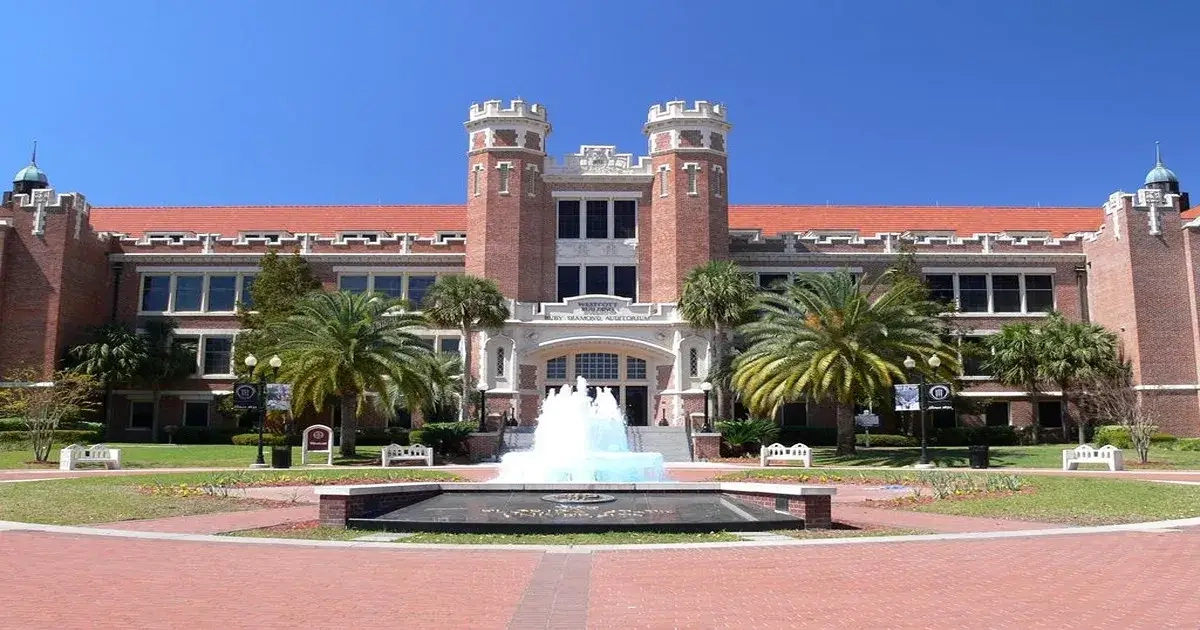
A comprehensive, graduate research university, FSU is among U.S. News & World Report's top-ranked public universities. In addition to a rigorous academic reputation, FSU is committed to student success. In 2024, the university's four-year graduation rate reached a new high of 76%, while the first-year retention rate remained steady at 96%. Students enrolled in fully online programs at FSU earn the same degree as their on-campus counterparts.
FSU’s distinguished faculty are leaders in their fields, including Pulitzer Prize winners, Fulbright Scholars, Nobel Laureates, and Guggenheim and NEH fellows. In 2024, the university recorded nearly $455 million in research expenditures, supporting groundbreaking discoveries and innovation. Online students learn from the same highly respected professors who teach on campus, ensuring the same quality education and academic excellence.
FSU is consistently ranked among the top public universities in the U.S., placed in the Top 25 national public universities by U.S. News & World Report. It also scores highly for academics, student life, and overall value.
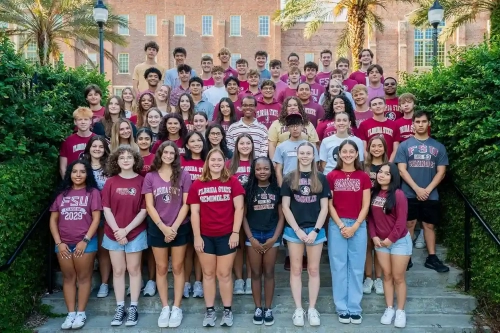
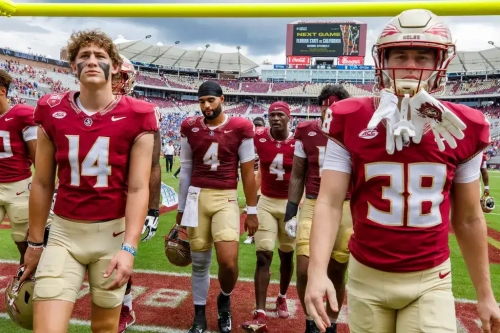
FSU is known for a lively and inclusive student life, with strong Greek life, athletics, clubs, and extracurricular activities that enrich the college experience.
UNDERGRADUATE:
POSTGRADUATE:
Entry requirements vary by program and course. Check the program page for requirements.
A graduate degree from a regionally accredited U.S. institution, or a comparable degree from an international institution.
Official test results are required from a nationally standardized graduate admission test. Use the following institution codes when requesting the official scores:
Although official scores are required, most departments will begin to review your application with self-reported scores, while they are waiting for the official scores to arrive.
Some programs offer an option to waive the GRE requirement. A list of these programs can be found here. In addition, FSU is currently waiving standardized entrance exam score requirements for all Masters and Specialists programs excluding The College of Business.
Unofficial Transcripts
To upload unofficial transcripts, go to your Application Status Page under the "upload materials" section, and select "Unofficial College Transcript". Be sure to upload transcripts from any university you have earned credits from. Florida State University only allows for application review with unofficial transcripts from U.S. institutions. If an applicant has a transcript from a non-U.S. and U.S. institution then, we must wait for the credential evaluation to be received for the non-U.S. institution before the application can be reviewed.
The university policy allows for application review based on unofficial transcripts. Then, if admitted, you must submit official transcripts within your first semester. However, your department may have additional requirements regarding transcripts. Please contact your department for additional information.
Official Transcripts
We recommend that you have official transcripts sent to FSU electronically to [email protected]. If this is not an option, you may submit an official transcript (in a sealed envelope) from each college and/or university attended directly to the Office of Graduate Admissions. Please note that there may be a delay in processing transcripts that are send via mail.
International Applicants:
International applicants or degrees earned from international institutions must submit their official transcripts through the The Evaluation Company pathway portal, or from another NACES approved evaluator. The Evaluation Company has created a custom application for Florida State University that will make sure you select the right kind of evaluation at a discounted rate. Florida State University recommends The Evaluation Company as our preferred credential evaluation because it offers an easy way to streamline the application process.
Please read more about our general transcript requirements on our Graduate Admissions page.
UNDERGRADUATE:
POSTGRADUATE:
Email: [email protected],[email protected]
Phone : (850) 644-6200


Research Center: The Center for Advanced Power Systems (CAPS) is a multidisciplinary research center organized to perform basic and applied research to advance the field of power systems technology. CAPS emphasis is on application to electric utility, defense, and transportation, as well as developing an education program to train the next generation of power systems engineers. The research focuses on electric power systems modeling and simulation, power electronics and machines, control systems, thermal management, cyber-security for power systems, high temperature superconductor characterization and electrical insulation research.
Library: The Florida State University Libraries provide collections and services to enhance the learning, teaching, research, and service activities of the University. The Libraries’ collections include over 4 million titles and provide access to more than 1,064 databases and 120,000 electronic journals. These holdings are supplemented by a robust resource sharing program, which includes UBorrow+ and our global Interlibrary Loan service. UBorrow+ offers access to over 15 million books from Florida's 40 public colleges and universities, with additional borrowing options from select partner libraries beyond the state. The Library Express Delivery Service delivers books and articles to faculty and graduate students on a daily basis. With almost 2 million visitors each year, Strozier Library, FSU’s largest library, is open 134 hours each week, providing around-the-clock research assistance and other services like free academic tutoring and a rich array of academic support throughout the day and late into the night. As a member of the Association of Research Libraries, the FSU Libraries rank among the largest research libraries in North America. The Libraries also belong to the Association of Southeastern Research Libraries, the Center for Research Libraries, the Florida Virtual Campus/Florida Academic Library Service Cooperative and are the designated Florida service hub for the Digital Public Library of America.
Southern Association of Colleges and Schools Commission on Colleges (SACSCOC)
Since assuming the presidency... read more
Under McCullough’s leadership, Florida State University launched FSU Health — one of the most ambitious projects in the university’s history — with a goal to improve health and health care throughout the region. FSU Health was initiated by a generous $125 million investment from the Florida Legislature to build a facility in Tallahassee, representing an academic health model combining education, research, and quality clinical delivery. Additional targeted investments have been secured to establish the
Florida Institute for Pediatric Rare Diseases and Sunshine Genetics, groundbreaking initiatives that position Florida as a national leader in improving the lives of children and families affected by devastating rare diseases.
Prior to joining FSU as the Vice President for Student Affairs, Dr. Hecht has served in a number of leadership roles including Vice President for Student Affairs at The College of New Jersey, Assistant Vice President for Student Affairs at Auburn University in Auburn, Alabama, the Associate Dean of Students at Temple University in Philadelphia, Assistant Dean of Students at Temple University, and Assistant Director of Student Activities at Cabrini College in Radnor, PA.
A professional in the field of student affairs since 2001, Dr. Hecht has served on executive leadership teams within student affairs organizations and has extensive experience leading and managing in higher education.



By 1854 the City of Tallahassee had established a school for boys called the Florida Institute with the hope that the State could be induced to take it over as one of the seminaries, and in the 1854 session of the Legislature of Florida the City of Tallahassee presented a memorial asking that the institution west of the Suwannee be located in that city. That effort was not successful, but in 1856 the Intendant (Mayor) of Tallahassee again offered the Institute's land and building to the Legislature. Francis Eppes, who spent his formative years on the estate of his grandfather President Thomas Jefferson at Monticello in Virginia and shared his views of the importance to a democracy of a liberally educated citizenry, was the Mayor of Tallahassee who made the offer. This time they chose to accept the offer and designated Tallahassee as the site of one of the state seminaries because of its railway connections, its "salubrious climate," and its "intelligent, refined, and moral community." The bill to locate the Seminary in Tallahassee passed both houses and was signed by the Governor on January 1, 1857. On February 7, 1857, the first meeting of the Board of Education of the State Seminary West of the Suwannee River was held, and the institution began offering postsecondary instruction to male students. Francis Eppes served as President of the Seminary's Board of Education for eight years and instilled in the institution the Jeffersonian ideals which characterize it today. The school first became co-educational the following year (1858) when it absorbed the Tallahassee Female Academy, begun in 1843 as the Misses Bates School. Thus the West Florida Seminary, founded in 1851, began operating in 1857, only twelve years after Florida achieved statehood. It was located on the hill where the Westcott Building now stands, which has been the site of an institution of higher education longer than any other site in Florida.
Classes were held at the West Florida Seminary from 1857 until 1863, when the state legislature changed the name to The Florida Military and Collegiate Institute to reflect the addition of a military section which trained cadets. During the Civil War, cadets from the school, ranging in age from twelve to eighteen, fought in the Battle of Natural Bridge and helped make Tallahassee the only Confederate capitol east of the Mississippi not captured during the war. As a result of the brave action of the West Florida cadets in this battle, the Florida State University Army ROTC cadet corps today is one of only three in the nation authorized to display a battle streamer with its flag, which bears the words NATURAL BRIDGE 1865. After the end of the war in 1865, however, Union troops under General McCook descended upon Tallahassee and occupied the city (including campus buildings), remaining for more than a month.
2010 to 2015 saw Florida State earn the designation of most efficient university in the nation for two years in a row. The university also became one of the most veteran-friendly public universities in the country, and benchmarks were developed, leading Florida State to being named a preeminent university, setting the university on the path to become one of the Top 25 public universities in the nation.
Recent efforts have focused on elevating the university’s reputation as a preeminent research institution; presiding over a $1 Billion fundraising campaign; advancing the university’s academic and research mission; and welcoming the best and brightest students in the university’s history.
In each succeeding decade, Florida State University has added to its academic organization and presently is composed of 16 independent colleges. It has expanded from the original few acres and buildings to 542 buildings on 1,550 acres, including the downtown Tallahassee main campus of 451.6 acres, a farm which for many decades supplied the Florida State College for Women with food, the Seminole Reservation — a recreational facility, the Marine Laboratory on the Gulf Coast, the Florida A&M University-Florida State University College of Engineering facility, the National High Magnetic Field Laboratory, and branch campuses in both Panama City, Fla., and the Republic of Panama. The University has over 50 years of experience in international education and is a nationally recognized leader in the field of study-abroad programs, with permanent study centers in London, Florence, Valencia, and Panama.