
The Lucerne University of Applied Sciences and Arts unites the departments of Engineering & Architecture, Business, Computer Science, Social Work, Design, Film, Art, and Music. It is headed by Rector Barbara Bader.
The Lucerne University of Applied Sciences and Arts is one of nine public universities of applied sciences in Switzerland. It was founded in 1997 and is supported by the concordat of the six Central Swiss cantons.
As one of the nine public universities of applied sciences in Switzerland, the Lucerne University of Applied Sciences and Arts is supported by the six Central Swiss cantons of Lucerne, Uri, Schwyz, Obwalden, Nidwalden, and Zug. It comprises the departments of Engineering & Architecture , Business , Computer Science , Social Work , Design, Film, Art , and Music.
The Lucerne University of Applied Sciences and Arts fulfills a performance mandate in four areas: education, continuing education, research & development, and services . It offers Bachelor's and Master's degree programs that are geared towards the needs of business, culture, and society and prepare students for the demands of the job market. It also provides ambitious professionals with a comprehensive and diverse range of continuing education opportunities.
With its research and specialized services, Lucerne University of Applied Sciences and Arts (HSLU) is an important and reliable partner for private companies, associations, and public authorities. It has a broad national and international network . Through the HSLU alumni network, graduates establish contacts and maintain connections after completing their studies or continuing education.
| Acronym | HSLU |
| Founded | 1997 |
| Location | Lucerne, Lucerne, Switzerland |
| Address | Lucerne University of Applied Sciences and Arts Werftestrasse 4 6002 Lucerne |
They are the Central Swiss University, bringing global developments in science and research to their region and disseminating their findings throughout Switzerland and beyond. Excellent quality and interdisciplinarity, along with both professional and personal connections, are their guiding principles in education and training.
At their institution, studying is more than just an intellectual pursuit: Their staff, students, and continuing education participants combine academic and practical skills to develop forward-looking solutions in society, business, and culture. They are specialists in their fields and deliver top-quality results for their students, continuing education participants, and partners across disciplinary boundaries.
They are shaping the digital transformation within their university and with the region, giving Central Switzerland a place on the digital map.
They are an equally inspiring and attractive place of learning for our students, continuing education participants, and staff. They think critically, develop collaboratively, and act competently and sustainably. In this way, they are pioneers in the truest sense.
They are at the forefront and lead the way: They understand digital transformation as an opportunity and shape it through their unique mix of digital and traditional formats. With their labs and workshops, the close interaction between teachers and students, and their close collaboration with their research and service partners, they are among the best universities in Switzerland.
Locally rooted and embracing global developments, they actively participate in the social, technological, economic, and cultural development of Central Switzerland. They establish key areas of focus, conduct research that is at the cutting edge and addresses the challenges of their time, thereby providing impetus for actively shaping the digital future. In this way, they create a clear profile.
They are convinced: The future belongs to the innovative and agile – to those who dare to challenge the status quo and who provoke with their ideas.
In a rapidly changing world, Lucerne University of Applied Sciences and Arts must also remain adaptable. Therefore, they will implement an adaptive strategy for the next four years. This strategy can be continuously adjusted and thus actively respond to new challenges.
Identity, culture and values ??as a foundation
We see ourselves as a university that values ??close relationships. This idea is also reflected in the new strategy. The strategy is based on HSLU-wide surveys, interviews, workshops with critical friends, and development by the university management, all of which sharpened HSLU's core values.
Shared orientation, individual development
The result of the strategy process: a common basis – the overarching strategy for the next four years. This will be further developed in the departments, taking into account their specific needs and objectives.
Our adaptive strategy consists of three elements:
Landmarks
Nine guiding principles will inform our future actions.
Strategic thrusts
Six strategic directions define clear goals for the next four years:
1. Inter- and transdisciplinarity
consolidate and thematically realign
2. Framework conditions for research & development
secure and improve
3. Health@HSLU
build up and expand
4. HSLU's presence
in the six supporting cantons
5. Transformation affinity
increase and cultivate
6. AI and Digitalization
use for the benefit of society
Transversal themes
Six overarching themes run throughout the entire university and receive special attention:
Since we pursue an adaptive strategy, the three core elements (orientation points, strategic thrusts, cross-cutting themes) can be continuously supplemented, questioned and changed.
The Lucerne University of Applied Sciences and Arts develops practical solutions and promotes sustainable thinking, decision-making, and action. As a center for education and research, it recognizes its responsibility to drive positive change. Through practice-oriented teaching, applied research, and collaboration with society and industry, the university contributes to sustainable development and creates solutions with lasting societal impact.
The Diversity Unit is responsible for addressing issues of diversity, equal opportunities, and respectful interaction. It implements the diversity policy, coordinates various projects and events, and provides selected services.
People differ in many ways: gender, ethnicity, social background, age, disabilities and abilities, sexual orientation, religion, and lifestyle.
Their experts provide information on their areas of specialization, including computer science, technology & architecture, social work, design, film, art, business, and music. They are always on the lookout for engaging topics. Here you'll find podcasts from all areas of research, teaching, and continuing education, as well as practical experience.
A practice-oriented degree at Lucerne University of Applied Sciences and Arts lets students apply what they learn in real-world settings. It combines theory with practice and offers strong support from experienced lecturers who share industry insights and professional experience. Lecturers also integrate current research into teaching and involve students early in research activities, ensuring up-to-date and hands-on learning.
Lucerne University of Applied Sciences and Arts offers teaching and research across multiple disciplines, allowing problems to be viewed from different perspectives. Its interdisciplinary approach encourages creativity and holistic problem-solving. Flexible study models let students complete a bachelor’s degree in six semesters or part-time over a longer period. Students can also work alongside studies, gain experience, and support their finances.
At Lucerne University of Applied Sciences and Arts, lecturers combine practical experience and research, applying both directly in teaching. Their practice-oriented work connects them to strong academic and industry networks. This gives students excellent career opportunities and smooth entry into the workforce, as programs emphasize real-world application. The university also supports students’ professional development and job entry through its Careers Service.
Lucerne University of Applied Sciences and Arts, together with the University of Lucerne and the University of Teacher Education, offers interdisciplinary study programs. These allow students to gain additional knowledge beyond their main field. The ISA programs cover culture, economics, technology, law, politics, and ethics, promoting collaboration across disciplines. They also build transferable key skills that enhance students’ future career opportunities.
To pursue a bachelor's degree at the HSLU, applicants must hold a vocational, academic, or specialized baccalaureate or equivalent qualification and/or pass an entrance examination. View the program page.
Vocational baccalaureate
Candidates who have completed an apprenticeship in a relevant field with a vocational baccalaureate (acquired during the apprenticeship or consecutively) are free to apply. Those with a vocational baccalaureate in an unrelated field are required to gain at least one year of professional experience in a relevant field before starting the program. Admission to a degree program in Social Work requires at least one year of previous employment.
Academic baccalaureate
Holders of an academic baccalaureate may pursue a bachelor's degree at the HSLU. However, before starting a program, they must gain at least one year of professional experience in a relevant field or pass an entrance examination. If the degree program is in Social Work, at least one year of previous employment is required.
Equivalent qualification
Holders of other educational qualifications applying for a bachelor’s program will be exempt from the entrance exam if the qualification is deemed equivalent to a vocational baccalaureate or federally recognized diploma, and if they have at least one year of relevant professional experience.
Entrance examination
Holders of any other qualification must pass an entrance examination to be admitted to a bachelor's programme. What is more, they must have completed at least three years of upper secondary education and have at least one year of relevant professional experience
Special requirements
Some of the HSLU’s degree programs require a specific aptitude or professional experience. Artistic subjects (which have an art foundation course), programs at the Schools of Music and Social Work have additional admission requirements. In some cases, the passing of an aptitude test is required.
Requirements vary by program and course. View the program page.
Apply through the application online.
Official Application Portal
Hochschule Luzern Online Application Information.
Email: [email protected]
Phone : +41 41 228 42 42, +41 41 228 41 30


Since 2026, he has been Head of Finance and Infrastructure, managing the Controlling, Accounting and Facility Management departments.



2025: Die HSLU schafft ein neues Ressort Gesundheit, um das Thema hochschulweit zu fassen.
2024: Das Departement Hochschule Luzern - Design & Kunst ergänzt seinen Namen mit "Film". Der neue Departementsname widerspiegelt die wachsende Bedeutung des Films in Ausbildung, Weiterbildung und Forschung.
Gemeinsam mit der Universität Luzern ist die HSLU am Aufbau der "Blockchain Zug... read more
Im Herbstsemester starten zum ersten mal die neuen Bachelor-Studiengänge in Pflege FH und Medizintechnik & Life Sciences.
2023: Barbra Bader ist neue Rektorin der Hochschule Luzern. Sie folgt auf Markus Hodel.
Der Konkordatsrat erteilt der HSLU Ende 2023 die Erlaubnis, Bachelor- und Masterstudiengänge in Pflege sowie Medizintechnik & Life Sciences zu führen.
1996: the Federal University of Applied Sciences Act, the legal framework underpinning Switzerland’s applied universities, comes into force. Its objective is to implement a dual education system in Switzerland at tertiary level and boost the country’s economic performance and innovation. The applied universities will be created by converting and merging existing professional colleges in the various Swiss regions. Central Switzerland files a formal request with the Federal Department of Economic Affairs for the establishment and running of the Fachhochschule Zentralschweiz (FHZ – University of Applied Sciences of Central Switzerland), beginning in the 1997/1998 academic year.
1997: founding of the FHZ as the third of Switzerland’s applied universities after the Scuola universitaria professionale della Svizzera italiana (SUPSI) in Canton Ticino and the Berner Fachhochschule (BFH) in Canton Bern. Summer 1997 sees the Central Swiss cantonal governments conclude an administrative agreement. The first entities to be established under the new regime are the erstwhile Schools of Engineering and Architecture, and Business. These are followed one after the other by Art and Design, Social Work, and Music.
2001: the first FHZ concordat comes into force.
2003: Switzerland’s Federal Council grants the country’s seven regional applied universities permanent licences to operate.
2005: the European Bologna system launches in Switzerland, including at the applied universities (bachelor: 2005, master: 2008).
2006: the Lucerne University of Applied Sciences and Arts adopts the internationally recognised model of the European Foundation for Quality Management (EFQM) and achieves the first quality level. In 2010 it becomes the first university in German-speaking Europe to achieve ‘Recognised for Excellence 3*’ certification. In 2016 it receives top honors in the category ‘Creating Value for Customers’ at that year’s ESPRIX Swiss Awards for Excellence, and also becomes the first university in Switzerland and Germany to achieve ‘Recognized for Excellence 5*’ certification.
2007: the FHZ acquires a new trading name: Lucerne University of Applied Sciences and Arts.
2012: the Alumni Association of the Lucerne University of Applied Sciences and Arts (Alumni Hochschule Luzern) is created from the merger of a number of legacy alumni associations: A-FHZ, Alumni HSLU-Wirtschaft, Alumni HSA and F+F HGK. Its aims are to facilitate networking amongst graduates, offer a varied programme of events and promote contact and exchange with the University.
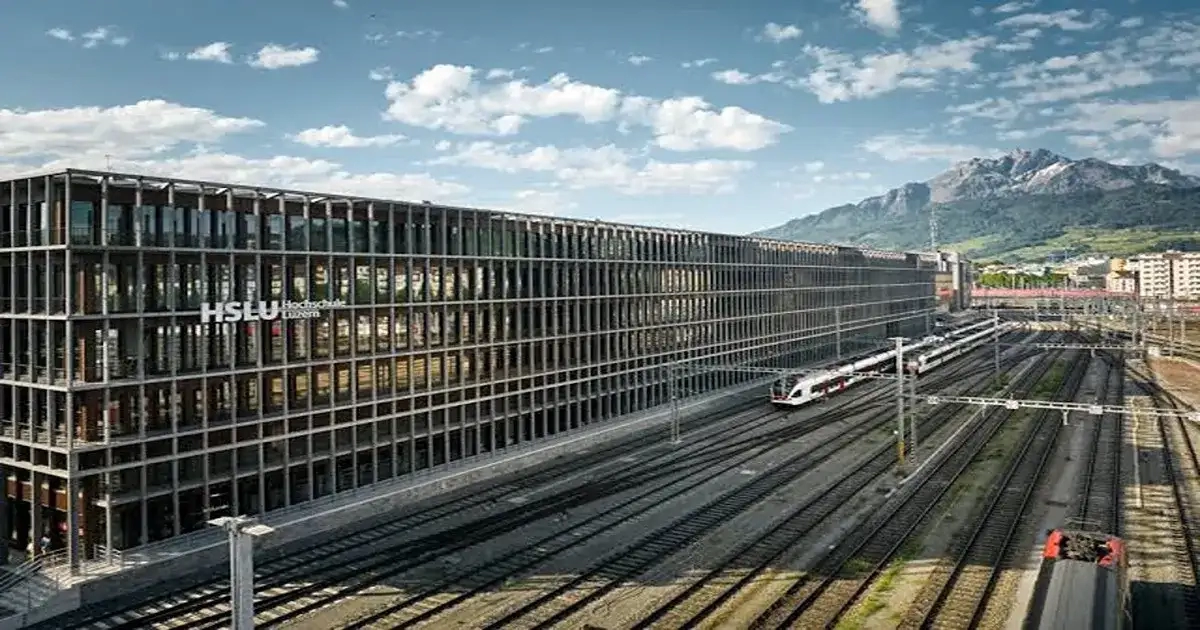
2020: At the beginning of the year, the first stone is laid for the Rösslimatt district development. Eventually, around 3,000 students, 6,500 continuing education participants, and 400 employees of the Departments of Economics and Social Work will move in here. The Department of Music, previously spread across four locations in Lucerne, will relocate to the new "Campus Südpol" building in Kriens.
The coronavirus pandemic forced Lucerne University of Applied Sciences and Arts to suspend the spring semester for a week and later continue it partially with online instruction. Staff worked from home during the lockdown. Thanks to the great commitment of the staff and the active support of students, continuing education participants, partner organizations, and the supporting cantons of Central Switzerland, the difficult situation was successfully managed.
2019: Lucerne University of Applied Sciences and Arts consolidates its two existing locations in the Canton of Zug onto the new Zug-Rotkreuz campus. The Department of Computer Science and the Institute for Financial Services Zug IFZ move into the tallest timber-hybrid high-rise building in Switzerland. In the same year, the Department of Design & Art moves into its new premises in the Viscosistadt building (745) in Lucerne-Emmenbrücke.