ListOfUni

Johns Hopkins University (JHU)

Maryland, United States
Visit School Website
  • Private Type
  • 40,000 Students
  • 1876Founded
  • YesAccept Int. Studs
  • YesDistance learning

About

Johns Hopkins University was established in 1876 with a $7 million bequest from philanthropist Johns Hopkins, making it the first research university in the United States. The university is known for its emphasis on research and graduate education. It pioneered the integration of teaching and research, setting a model for modern higher education. Today, JHU is a leading institution in various disciplines, including medicine, public health, engineering, and the sciences .

Acronym JHU
Nickname Blue Jays
Motto / Slogan Veritas vos liberabit
Founded 1876
Location Baltimore, Maryland, United States
Address Johns Hopkins University, Baltimore, Maryland

Mission

The mission of The Johns Hopkins University is to educate its students and cultivate their capacity for life-long learning, to foster independent and original research, and to bring the benefits of discovery to the world.

Johns Hopkins University

Main Academic Divisions (Faculties)

  • Krieger School of Arts and Sciences
  • Whiting School of Engineering
  • School of Medicine
  • Bloomberg School of Public Health
  • Carey Business School
  • School of Nursing
  • Peabody Institute
  • School of Advanced International Studies (SAIS)
  • Applied Physics Laboratory
  • Johns Hopkins University Press

Reasons to Study at Johns Hopkins University

  1. Research

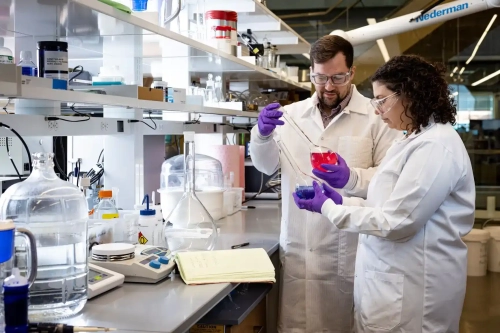
    One of the great aspects of going to a school like Hopkins is the wealth of opportunities open to its undergraduate students, no matter the age or level of experience. My suitemate is helping a professor with his research on the shifting modes of industrial governance in China since the Communist party take-over while my floormate is studying the different chemical synapses in a lab at the Med Campus. 
     

  2. Learning is a Daily Occurrence

    Even if you’re not involved in research, there is no doubt that you will learn new things every day, whether in class, out in the community, or from your friends. As an International Studies and Sociology/Public Health Studies double major (I’m still in the process of deciding), I had neither the need nor the inclination to take a computer science class and learn about programming or creating applications.

  3. Involvement in the Baltimore Community

    Another aspect of Hopkins I admire is its commitment to Baltimore (“Charm City”). Through initiatives like Rising to the Challenge and Presidents' Day of Service, the university invests in the community and beyond. My involvement in the city and hospital exposed me to local social issues and allowed me to build meaningful relationships with diverse community members. With over 400 clubs, student engagement with the community is strong.


  4. Caring Professors and Students

    Hopkins is also made up of brilliant and caring professors and students. Professor John Astin, who played Gomez Addams in the Addams Family, allows students to text him if they’re going to be late to class. Another professor brings her dog to class and allows students to take him on walks. There is no doubt that the professors at Hopkins are dedicated to helping students and to push them to their fullest potential.


Fees

Undergraduate Tuition

Indigenous Students USD 66,670
International Students USD 10,000 - USD 55,000

Postgraduate Tuition

Indigenous Students USD 66,670
International Students USD 10,000 - USD 55,000

Admission

Undergraduate Admission Requirement

Entry requirements vary by course and program. Check the page for requirements.

Postgraduate Admission Requirments

Entry requirements vary by course and program. Check the page for requirements.

How To Apply For Admission

UNDERGRADUATE:


POSTGRADUATE:

  • Apply Online through the application portal.


Admission Contacts

Email: [email protected],[email protected]
Phone : (410) 516-8171, (410) 516-6025

Apply For Admission

Campus Tour

Facilities

  • Classrooms
  • Library
  • Laboratory
  • Research Center
  • Accommodation
  • Sports
  • Gym
  • ICT
  • Cafeteria
  • Sport: Johns Hopkins fields 24 varsity teams, 22 of which compete at the NCAA Division III level. The other two, men’s and women’s lacrosse, both compete in Division I. Seventeen of our programs are members of the Centennial Conference. Hopkins men’s lacrosse is one of the most decorated athletics programs in all of college sports. We first fielded a men’s lacrosse team in 1883, seven years after the founding of the university. Since then, the Blue Jays have won 44 national titles, including nine since men’s lacrosse became an NCAA sport.


  • Hospital: Primary Care on our Homewood campus is open six days per week to address student health concerns, free of charge. Certified health care professionals provide care, including injury and illness treatment, routine gynecologic care, immunizations, and travel consultation.


  • Accommodation: Living on campus is an indispensable piece of the Hopkins undergraduate experience—nearly all our Homewood campus-based undergraduates live in residence halls during their first two years, and some stay longer.

School Contact

Address

Johns Hopkins University, Baltimore, Maryland

Email Address

[email protected]

Phone Number

+1 410-516-8000

Fax Number

(410) 516-6025

Website Address

https://www.jhu.edu/

Accreditations

Middle States Commission on Higher Education (MSCHE)

Vice Chancellor

Ronald J. Daniels

Ronald J. Daniels has served as the 14th president of Johns Hopkins University since 2009.  Under his leadership, Johns Hopkins continues its preeminence in education, patient care, and innovative discovery, and has continued its more than 40-year span as the recipient of more competitively allocated federal research funding than any other university in the country.

During his tenure, D... read more

aniels has focused his efforts on several key areas: strengthening inter-disciplinary collaboration in research and education, expanding student access and support, enhancing the Hopkins experience for undergraduate and graduate students, deepening the university’s partnerships with our neighbors in Baltimore, and supporting economic and social innovation. These priorities continue to shape the strategic vision for Johns Hopkins as it approaches its 150th anniversary.


Academic Staff

  • Ray Jayawardhana

    Provost Provost Ray Jayawardhana serves as the chief academic officer of Johns Hopkins University. He is also a Professor of Physics and Astronomy. As Provost, he is responsible for advancing the University�... read more
    �s research, teaching and outreach mission, and partners closely with President Daniels to realize the ambitious goals of the Ten for One strategic plan. He oversees its ten schools as well as a number of interdisciplinary programs, academic centers and support functions.

    Prior to joining Johns Hopkins, Jayawardhana served as the Harold Tanner Dean of the College of Arts and Sciences at Cornell University and the Hans A. Bethe Professor and professor of astronomy. As dean, Jayawardhana positioned the College as “the nexus of discovery and impact,” and focused on strategic priorities in the areas of faculty renewal and support, research and creative excellence, academic innovation and student experience, and public engagement. He oversaw the recruitment of 130 new faculty members and appointments to 65 endowed professorships. During Jayawardhana’s tenure, the College garnered over $308 million in new gifts and commitments and set consecutive fund-raising records. Signature initiatives launched under his leadership include the Klarman Fellowships for exceptional emerging researchers, New Frontier Grants for novel research projects with potential for transformative advances, Nexus Scholars program for undergraduate research, Humanities Scholars Program for select students, Distinguished Visiting Journalist program to recognize excellence in journalism while fostering meaningful engagement with the academy, the Arts Unplugged series of marquee events, and the $110M renewal of the iconic McGraw Hall. On his watch, the College adopted a new undergraduate curriculum, introduced first-year advising seminars to all entering students, implemented the highly coveted Milstein Program in Technology & Humanity, tripled funding for Summer Experience Grants, and enhanced career development support. Arts & Sciences increased media engagement dramatically, quadrupling annual media hits and increasing placement of faculty op-eds. Jayawardhana played a key role in establishing the new Cornell Brooks School of Public Policy and the “super-departments” of Sociology and Psychology and expanding Economics. He also partnered with select deans and faculty across the university to formulate and lead three signature initiatives –on climate, AI and quantum research.


  • Brittini Brown

    Associate Vice Provost for Student Engagement and Dean of Students Dr. Brittini Brown serves as the Associate Vice Provost for Student Engagement and Dean of Students, where she plays a vital part in leading the university’s efforts to facilitate and support studen... read more
    t engagement and enhance the student experience, with a focus on fostering a strong sense of community and belonging. Drawing upon her significant student affairs leadership, programming, and assessment experience, Dr. Brown develops and implements strategies and manages operations supporting undergraduate student engagement, leadership development, and student development. She also serves as a partner and adviser to Student Affairs units across divisions to ensure that processes, outcomes, and engagement efforts for graduate student life meet both student needs and desired university outcomes.


  • Demere Woolway

    Executive Director of Inclusive Excellence Education and Development Demere Woolway (any pronoun) is the Executive Director of Inclusive Excellence Education and Development within Johns Hopkins University’s Office of Diversity and Inclusion. In this role, Demere pro... read more
    vides strategy for evidence-based, comprehensive diversity education and professional development experiences for faculty, staff, and students.  From 2013-2021, Demere was the founding director of LGBTQ Life at JHU. In this role, they directed Safe Zone Training, advanced transgender inclusion through policy and practice, and facilitated numerous identity-based programs for students, faculty, and staff. Previously, they worked at Miami University of Ohio and Washington State University. Demere holds a PhD in Student Affairs in Higher Education from Miami University, and a M.A. in English from the University of Virginia. Demere has served as a co-chair of the Consortium of Higher Education LGBTQ Resource Professionals and a representative to the Council for the Advancement of Standards in Higher Education.
  • Caroline Tran

    Financial Manager Caroline Tran is the Financial Manager of the Office of the Provost. She supports financial planning, analysis, and reporting while working closely with the University Administration Business Office a... read more
    nd partners across the university to align financial activities with institutional goals. Caroline is responsible for all financial activities, including budget development and reconciliation, financial reporting, and analysis, to ensure the efficient use of resources and compliance with the University’s financial policies. She brings more than 20 years of experience in global financial management from Jhpiego and Pathfinder International. She holds a bachelor’s degree from Cornell University and a master’s from Johns Hopkins University, School of Advanced International Studies (SAIS).
View More Staff

Notable Alumni

View More Alumni

History

The university takes its name from 19th-century Maryland philanthropist Johns Hopkins, an entrepreneur with Quaker roots who believed in improving public health and education in Baltimore and beyond.

Previously adopted accounts portray Johns Hopkins as an early abolitionist whose parents had freed the family’s enslaved people in the early 1800s. New research has uncovered census records that indicate enslaved people were among the individuals living and laboring in Johns Hopkins’ home in 1840 and 1850, with the latter document denoting Johns Hopkins as the slaveholder. Other new findings documented additional links between the Hopkins family and slav... read more

ery, as well as indentured servitude.  Researchers are investigating these records in tandem with other archival documents to offer a more nuanced and complex understanding of the Hopkins family’s relationship with slavery. More information about the university’s investigation of this history is available at the Hopkins Retrospective website.

Mr. Hopkins, one of 11 children, made his fortune in the wholesale business and by investing in emerging industries, notably the Baltimore and Ohio Railroad, of which he became a director in 1847. In his will, he set aside $7 million to establish a hospital and affiliated training colleges, an orphanage, and a university. At the time, it was the largest philanthropic bequest in U.S. history.

Johns Hopkins University opened in 1876 with the inauguration of our first president, Daniel Coit Gilman. He guided the opening of the university and other institutions, including the university press, the hospital, and the schools of nursing and medicine. The original academic building on the Homewood campus, Gilman Hall, is named in his honor.