
Stanford University is situated on an expansive 8,180-acre campus in the heart of Silicon Valley. It is recognized as one of the world's leading research and teaching institutions, fostering a diverse and inclusive community of scholars, students, and staff.
| Acronym | SU |
| Nickname | Cardinal |
| Colour | Cardinal Red and White |
| Mascot | Die Luft der Freiheit weht |
| Founded | 1885 |
| Undergraduate Programmes | |
| Postgraduate Programmes | 150 |
| Location | Stanford, California, United States |
| Address | Stanford University 450 Jane Stanford Way Stanford, CA 94305–2004 |
Stanford has always been a wellspring of new ideas and innovative solutions, where curious people come to make a difference. But the scale and urgency of challenges facing us today require that Stanford amplify what has made us successful in the past and define new ways of making a difference. We are expanding avenues of discovery across all fields while creating new pathways for applying knowledge where it is needed in the world. At the same time we are ensuring that new ideas are grounded in ethics and solutions benefit from diverse perspectives.
Our vision guides Stanford's approach to research, education and impact and includes new initiatives that accelerate the creation and application of knowledge, anchor research and education in ethics and civic responsibility and promote access and inclusion across our activities. And it recognizes the need to forge deeper partnerships in our community and in the world to move ideas into action.
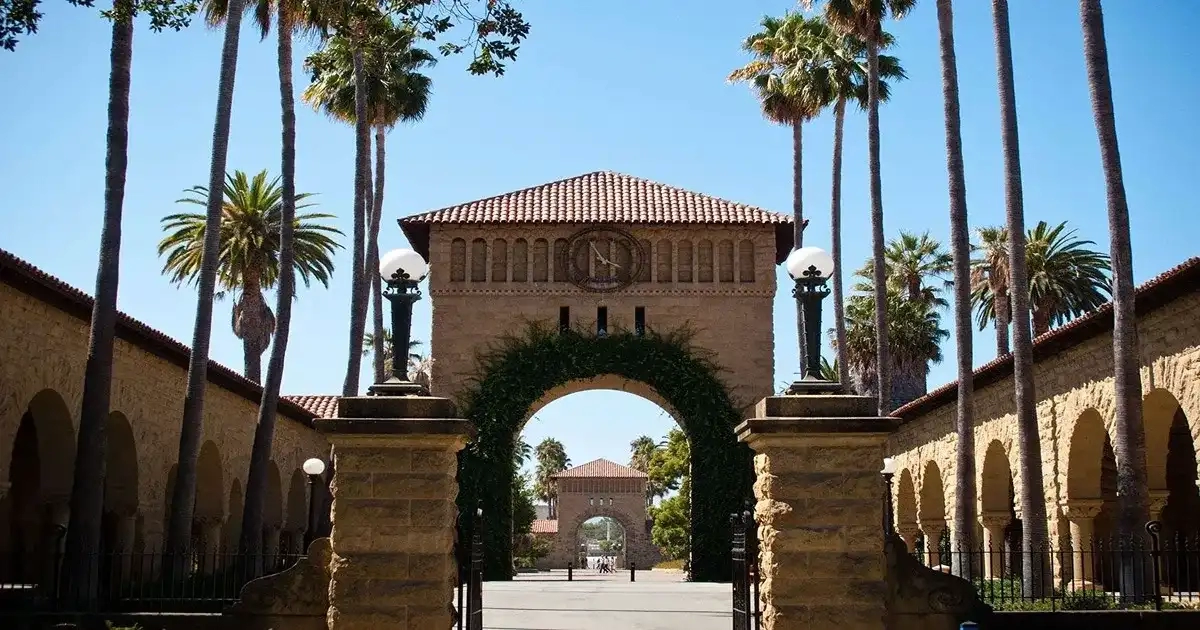
A flourishing residential campus is an integral part of the world-class educational experience Stanford offers. Stanford is home to a community of creative and accomplished people from around the world, from acapella singers to Olympic athletes.
Stanford provides students the opportunity to engage with big ideas, to cross conceptual and disciplinary boundaries, and to become global citizens who embrace diversity of thought and experience. We offer broad and deep academic programs across multiple fields, including the arts and humanities, natural and social sciences, engineering, sustainability, medicine, law, education, and business.
World-class researchers in Stanford School of Medicine and across the university are responsible for ground-breaking discoveries that are focused on predicting, preventing, and curing disease by tailoring health care to the unique biology and life circumstances of each of us. Our long history of innovation and achievement includes the world’s first successful heart and lung transplant, and development of one of the first in-house COVID-19 diagnostic tests.
A hallmark of Stanford is our extensive and vibrant ecosystem of interdisciplinary research. With all seven of Stanford’s schools located on our historic campus and many institutes serving as a hub for collaboration across academic fields, the opportunities for disruptive breakthroughs are numerous and the results are evident.
Entry requirements vary by program and course. Check the requirements.
Entry requirements vary by program and course. Check the requirements.
UNDERGRADUATE:
POSTGRADUATE:
Email: [email protected]
Phone : +1 650-723-2091




President Levin previously served as the Philip H. Knight Professor and Dean of Stanford Graduate School of Business. A leading economist, his scholarly work has spanned topics ranging from incentive contracts to game theory, e-commerce, and health in... read more
Jonathan Levin was born and raised in New Haven, Connecticut. He earned undergraduate degrees in English and Mathematics at Stanford in 1994, an M.Phil in Economics at Oxford University in 1996, and a PhD in Economics at the Massachusetts Institute of Technology in 1999. After joining the Stanford faculty in 2000, Levin rose through the ranks to become the Holbrook Working Professor of Price Theory in the Department of Economics. He served as department chair from 2011 to 2014, a period of rising stature for Stanford economics.
As chief academic and chief budgetary officer, Martinez is responsible for advancing Stanford's teaching and research mission, stewarding university resources, and working closely with deans and administrators in support of strategic priorities. These include promoting constructive dialogue on campus, sustaining Stanford's leadership on AI, and simplifying university processes.
Martinez joined the Stanford faculty in 2003. Her research spans a variety of issues in constitutional law and international law; her current research focus is freedom of speech and academic freedom. She has also been a senior fellow (by courtesy) of Stanford’s Freeman Spogli Institute for International Studies and a faculty affiliate of Stanford’s Center on International Security and Cooperation and Stanford’s Center on Democracy, Development and the Rule of Law. She previously served as a member of the U.S. State Department’s Advisory Committee on International Law. She is also a member of the American Academy of Arts and Sciences and the American Law Institute.
Lauder has held numerous leadership roles at ELC. From 2020 to 2024, she served as chief data officer and executive vice president of enterprise marketing and led ELC’s Artificial Intelligence Strategy and Task Force and its initiatives on women in leadership and gender equity.
Steve serves as a member of the University Cabinet and on the SLAC National Laboratory Board of Overseers Committee on Business, Technology, Audit and Compliance. He also co-chairs the Stanford CIO Council which is comprised of Stanford’s technology leaders from across campus. Steve reports to the Vice President for Business Affairs and Chief Financial Officer.



When railroad magnate and former California Gov. Leland Stanford and his wife, Jane Lathrop Stanford, lost their only child, Leland, Jr., to typhoid in 1884, they decided to build a university as the most fitting memorial, and deeded to it a large fortune that included the 8,180-acre Palo Alto stock farm that became the campus. The campus is located within the traditional territory of the Muwekma Ohlone Tribe. The Stanford made their plans just as the modern research university was ... read more
Leland Stanford Junior University – still its legal name – opened Oct. 1, 1891.
The Stanford and founding President David Starr Jordan aimed for their new university to be nonsectarian, co-educational and affordable, to produce cultured and useful graduates, and to teach both the traditional liberal arts and the technology and engineering that were already changing America.
Their vision took shape on the oak-dotted fields of the San Francisco Peninsula as a matrix of arcades and quadrangles designed for expansion and the dissolving of barriers between people, disciplines and ideas.