At Trinity College Dublin, the University of Dublin we provide a liberal environment where independence of thought is highly valued and all are encouraged to achieve their potential. We promote a diverse, interdisciplinary, inclusive environment which nurtures ground-breaking research, innovation, and creativity through engaging with issues of global significance.
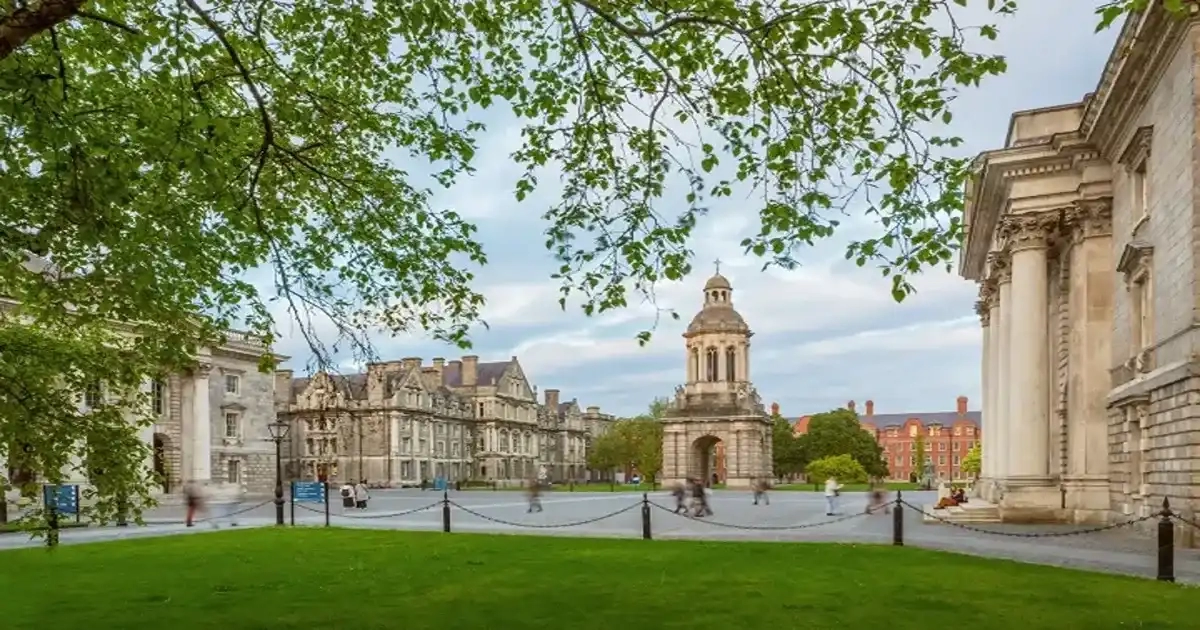
Located in a beautiful campus in the heart of Dublin’s city centre, Trinity is Ireland’s highest ranked university. It is home to 22,000 undergraduate and postgraduate students across all the major disciplines in the arts and humanities, and in business, law, engineering, science, and health sciences
| Acronym | TCD |
| Nickname | TCD |
| Motto / Slogan | Perpetuis futuris temporibus duraturam It will last into endless future times |
| Founded | 1592 |
| Location | Dublin, Leinster, Ireland |
| Address | Trinity College Dublin, The University of Dublin. College Green, Dublin 2, Ireland |
Trinity College Dublin's mission is rooted in advancing teaching, research, and public engagement. The core pillars of this mission encompass:
The university envisions itself as a globally connected community of learning, research, and scholarship. Its core vision is to inspire generations to meet the challenges of an increasingly interdependent world through collaboration, connection, and societal impact.
TCD’s overarching objectives are detailed in its strategic framework and are built upon foundational values of academic freedom, autonomy, and accountability. The primary objectives include:
Academic Excellence: Providing a rigorous, pluralistic education enriched by diversity, research, and the celebration of independent thought.
Research Leadership: Enhancing the university's status as a leading research-intensive institution that develops fair, innovative, and sustainable solutions to global challenges.
Societal Impact: Collaborating locally and internationally to tackle major global issues—such as climate change and planetary sustainability.
Community Flourishing: Nurturing a safe, supportive, diverse, and inclusive campus environment where staff and students can thrive.
Our students receive world-class education in a research-centred, collaborative environment and have the opportunity to work with global leaders in their field. Trinity is also the only Irish member of the prestigious League of 24 European Research Universities (LERU). Find out more about Trinity research.
With almost 173 clubs and societies, including many international groups, there's something for everyone. At Trinity, involvement in student organizations is not seen as just a hobby, but an integral part of your education. Find out more about clubs and societies.
Trinity also ranks as the 24th most international university in the world 3. The university provides an ever-expanding number of opportunities for students to undertake a global mobility experience at one of our many partner universities overseas. Find out more about studying abroad and exchange.
Trinity College Dublin is centrally located and easily accessible by public transport. The university has its own LUAS tram station, a DART suburban rail station opposite the campus, and numerous Dublin bus routes nearby. Dublin’s main train stations are close by, while Dublin Airport, located 13km from the campus, can be reached directly by bus or taxi.
Application fee of €55 per course
Trinity is a high-ranking university renowned for academic excellence. Entry to our programmes is competitive, and based on academic merit. This section gives you general entry requirements for admission into our Foundation, Undergraduate and Postgraduate programmes. In addition, each programme has further course-specific requirements, which you should also check in the detailed course description before applying.
Trinity programmes are taught through the medium of English, and all students must demonstrate their standard of English with a formal qualification in order to be admitted. The English Language qualifications we accept are listed at the bottom of this section. The Trinity International Foundation Programmes has different English Language requirements, which are explained within the Foundation entry requirements.
English Language Requirements
All applicants to Trinity are required to provide official evidence of proficiency in the English language. Accepted/Permitted English language qualifications can be found here.
Applicants will need to hold at least a 2.1 honors degree (60%) from an Irish university, or an equivalent result from a university in another country. If you have any queries in relation to your eligibility for programmes, please contact us at [email protected].
Some courses may have more specific requirements or require you to take further tests or attend an interview. Details of course-specific requirements can be found on the course profile pages, which you can find here. For further details, you can contact the course director, whose contact information is given in the course profile.
UNDERGRADUATE:
POSTGRADUATE:
Email: [email protected],[email protected]
Phone : +353 (0)1 896 4500, +353 1 896 1000
She is also the Chair of the League of European Research Universities (LERU), of which Trinity is a mem... read more
She served previously as Trinity’s Dean & Vice President of Research (2018-2020) and was the founding Director of CONNECT – the Science Foundation Ireland research centre for future communication networks. Before that, she was Director of the Centre for Telecommunications Value Chain Research (CTVR).




The organisational design of the new institution was influenced by Oxford, Cambridge and continental precursors, but from the beginning it was an autonomous corporation governed by ‘provost and fellows’, committed to teaching and to scholarship, the first and (as it turned out) only college of the degree-awarding University of Dublin. The College site, lying some distance east of the small walled city, was far larger than the small community of fellows and students required, and the first brick buildings of the 1590s occupied only a small part of what is now Front Square. But from the beginning the College’s library was a priority, and the energy with which early Trinity scholars (notably Luke Challoner and James Ussher) assembled the initial collections of books marked Trinity out from other sixteenth-century foundations. Many of its early graduates, well grounded in philosophy and theology, proceeded to clerical ordination in the state church, the Anglican Church of Ireland.
During the next fifty years the community grew: endowments, including landed estates, were secured, new fellowships founded, a curriculum devised and statutes determining internal governance were framed. The international reputation of Ussher, one of its first alumni, helped place the College on the European map. But its existence was gravely threatened at two points in the seventeenth century, first when central government collapsed in the wake of the 1641 rising, followed by the temporary eclipse of the Church of Ireland in the wake of Cromwell’s victories; secondly, with the roller-coaster events of 1689-91, when Tyrconnell’s short-lived Catholic government closed the university, expelled the fellows and students, and converted the buildings into a Jacobite barracks. The library however was spared.
Despite such dramatic interruptions, the College had become a much more substantial institution by the end of the seventeenth century. Many of the early buildings had recently been replaced, and a number of the fellows, notably William Molyneux and St. George Ashe were centrally involved in the Dublin Philosophical Society, a small body that was closely in touch with the ‘new learning’ in London.
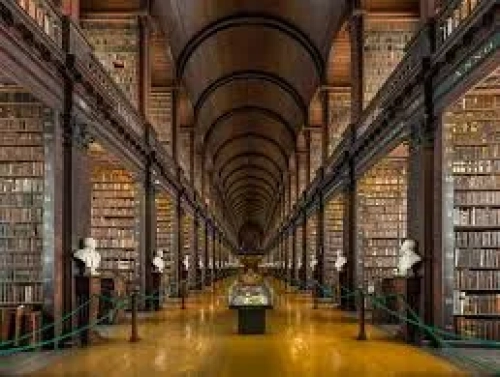
The following century was an era of political stability in Ireland, thanks to the firm monopoly on political power held by the land-owning and largely Church of Ireland upper class, and the College was in material terms a great beneficiary from this state of affairs: its landed income grew very substantially in the course of the century and it enjoyed the recurring patronage of the Irish parliament across College Green, evident in the scale and quality of its new buildings. The first structure dating from this era was a massive new library (1712-32), initiated while George Berkeley, another celebrated alumnus of the College, was librarian; its size, far greater than then required, reflected long-sighted enlightenment ambitions, and it was followed by a string of other classical buildings on the western half of the campus: the Printing House (1733-4), the West Front (1752-9), the Dining Hall (c.1760-65), and the Provost’s House (1759-61). During the second half of the century Parliament Square slowly emerged, shaped by the Public Theatre (1777-86) and the new Chapel (1787-98), which were designed from afar by George III’s architect, Sir William Chambers. The great building drive was completed in the early nineteenth century by the residential quadrangles of Botany Bay and New Square.
In 1993 the College also began to boost recruitment from within Dublin city by developing a series of access programmes (TAP). The aim was to raise the number of young adults from socio-economic and ethnic groups underrepresented in higher education coming to university. At the same time, new efforts were made to recruit mature students. In 2022, approximately 25% of entrants to the university were from groups underrepresented in Irish higher education, comprising socio-economically disadvantaged young adult and mature students, and students with a disability.
Another major change in the second half of the twentieth century was in the composition of the academic staff: it became progressively more international. Until the 1930s the great majority had been doubly indigenous, being Irish-born and Dublin University graduates, including many who returned, like Ernest Walton who came back from Cambridge in 1934 and shared the Nobel Prize for Physics in 1951, arising out of his work two decades earlier on splitting the atom. The dominance of indigenous graduates in the academic community had all but disappeared by the 1980s, and the increasingly cosmopolitan character of the College helped drive change in the curriculum, in research, and in the general appetite for innovation across the institution. And there was meanwhile an utter transformation in the scale of the academic community, from the modest group of 125 who had made up the total academic staff in 195In terms of physical development since that time, the College contributed to the small stock of fine modernist architecture in Dublin, beginning with the Boland Library* (1965-6), the Arts Building (1977-8), the O’Reilly Institute (1989), the Dental Hospital (1995-8), the Ussher Library (1999-2001) and the Long Room Hub (2008-10). But by 2000 the College had begun to burst out of its campus home, what with a huge expansion of its halls of residence off campus and with Nursing, Drama, and the Social Sciences putting down new roots a short distance away. But the most ambitious construction project in the College’s history, the Trinity Biomedical Sciences Institute in Pearse St (2008-11), has become the strongest physical statement of the College’s outward movement. The opening of this development, which now houses five academic schools, coincided with the development of the Trinity Academic Medical Centre, an alliance between the university and its two main teaching hospitals, St James’s and AMNCH, Tallaght. West along Pearse St, the Science Gallery was opened in 2008 as part of the new Naughton Institute: within a short time the Gallery became a highly successful centre for ‘science outreach’ and art-science collaboration, exploiting to the full the potential for creative interaction between college and capital city. Science Gallery Dublin held its final exhibition in January 2022. Strategic redevelopment along Pearse St continued with the construction of a new Business School, completed in 2019, followed by a major new student residential block, Printing House Square, completed in 2022, built further west along Pearse St on the campus perimeter. Along the eastern end of Pearse St, the development of Trinity East continues, a project whose vision is to deliver a major global centre for research and innovation.
Through times of turmoil as well as progress, Trinity has been the crucible for change across more than four centuries. Today, as Trinity imagines the world in the 21st century, it seeks to inspire new generations in new ways.