
ListOfUni

University of Michigan (U-M, UMich)

Michigan, United States
Visit School Website
  • Public Type
  • 1817Founded
  • YesAccept Int. Studs
  • YesDistance learning

About

The University of Michigan, founded in 1817, is a prestigious public research university located in Ann Arbor, Michigan, USA. Widely recognized as one of the top public universities in the United States, U-M has a rich legacy of academic excellence, innovation, and social impact. It offers more than 275 degree programs across 19 schools and colleges, ranging from liberal arts and engineering to medicine, law, and business.

The university is known for its strong research output, interdisciplinary programs, and diverse student body, including thousands of international students. U-M’s mission centers around the creation, communication, and application of knowledge to serve both the state of Michigan and the global community.

Acronym U-M, UMich
Nickname Wolverines
Motto / Slogan Artes, Scientia, Veritas (Latin)
Colour Maize (#FFCB05) and Blue (#00274C)
Mascot Biff, the Michigan Wolverine
Founded 1817
Location Ann Arbor, Michigan, United States
Address University of Michigan, 500 S State St, Ann Arbor, MI 48109, United States

Mission

The mission of the University of Michigan is to serve the people of Michigan and the world through preeminence in creating, communicating, preserving, and applying knowledge, art, and academic values, and in developing leaders and citizens who will challenge the present and enrich the future.

Vision

The University of Michigan will be the defining public university, boldly exemplified by our innovation and service to the common good. We will leverage our interdisciplinarity and excellence at scale to educate learners, advance society, and make groundbreaking discoveries to impact the greatest challenges facing humanity.
University of Michigan

Main Academic Divisions (Faculties)

  • College of Literature, Science, and the Arts
  • College of Engineering
  • School of Medicine
  • School of Business
  • School of Law
  • School of Education
  • School of Public Health
  • School of Social Work
  • School of Music, Theatre & Dance
  • School of Nursing
  • School of Pharmacy
  • School of Public Policy
  • School of Information
  • School of Kinesiology
  • School of Art & Design
  • School of Architecture & Urban Planning

Reasons to Study at University of Michigan

  1. Organizations and Activities

    Student life at U-M offers the kind of thoroughly engaging opportunities a major public university affords: the kind of opportunities that extend beyond the classroom, enabling students to learn the lessons of leadership, connect with one another and a myriad of on- and off-campus communities, explore new worlds, or simply have fun.

  2. Campus and City

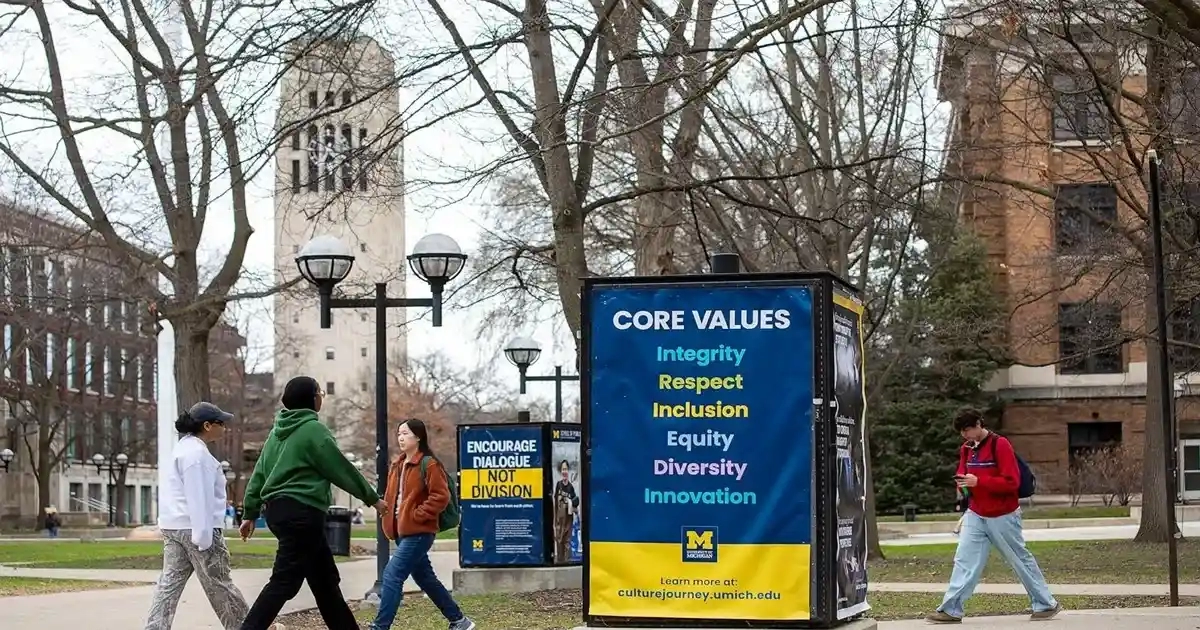
    Life is excellent on this quintessential American campus designed to fit every need. The city of Ann Arbor is considered one of the nation’s best college towns, and one of America’s most bike-friendly and sustainable communities, with art and culture everywhere (theater, music, literature, and lectures).

  3. Athletics and Recreation

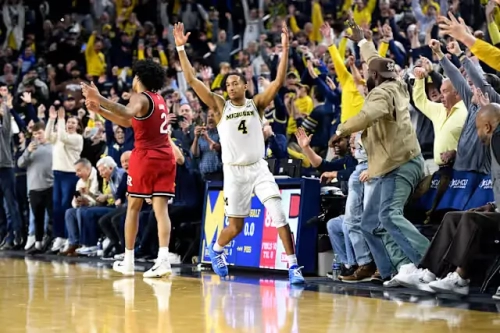
    From its famous winged football helmet and maize-and-blue uniforms (one of the most recognizable icons in American sports) to its domination on the world stage in the Olympics, U-M intercollegiate athletics program has a long tradition of winning and a legacy of championship teams.

  4. Campus Community

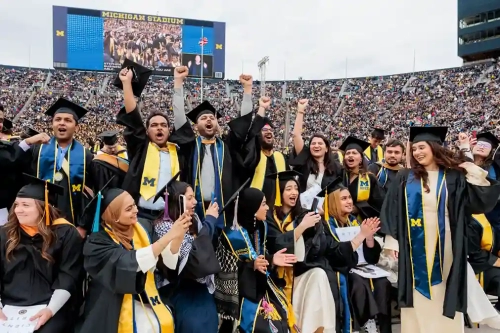
    U-M has a dynamic mix of people, cultures, backgrounds, nationalities, ideas, and ways of seeing the world. Ultimately, the interactions and discussions that happen in relation to differences — both in understanding and affirming them — may be the most important lessons you will learn as you prepare for life in the 21st century. 

Fees

Undergraduate Tuition

Indigenous Students USD 18,346 - USD 20,648
International Students USD 63,962 - USD 68,444

Postgraduate Tuition

Indigenous Students USD 11,285 - USD 45,946
International Students USD 11,893 - USD 48,946

Other Fees

Application fee: $75

Admission

Admission Rate (16%)

0% 16% 100%

Undergraduate Admission Requirement

Entry requirements vary by course; view the requirements page for more information.


International Students:

The requirements may vary depending on your country of origin and specific educational history, particularly the type of transcript you will need to submit.

Supporting Documents

  1. SAT or ACT score, if available.
  2. Submit the School Report.
  3. Submit one Teacher Evaluation (core academic teacher or other non-relative who can speak directly to the student's academic aptitude, potential, and classroom performance).
  4. Submit a Counselor Recommendation (encouraged, but not required).
  5. Submit your high school transcript. An official English translation is required to accompany the transcript if the transcript is not issued in English by the school. Students who have already completed high school, including university transfer applicants, should be sure to have final high school transcript submitted showing the graduation date. Also provide a detailed explanation of any educational gaps.
  6. If you are a speaker of English as a second language, you will need to submit a test score that demonstrates your English proficiency (e.g., TOEFL, IELTS, MET, etc.). See General English Proficiency Score Ranges for these tests.
     

Postgraduate Admission Requirments

  • Applicants complete a bachelor’s degree from a U.S. college or university accredited by a regional accrediting association, or complete an international degree that is equivalent to a U.S. bachelor’s degree from a college or university recognized and approved by the Ministry of Education or Commission responsible for higher education in the country where the degree is earned. (see Required Academic Credentials from Non-U.S. Institutions)
  • Applicants whose native language is not English must demonstrate English proficiency. Applicants are required to provide an official test score report. Photocopies and/or faxes of English proficiency scores will not be accepted. For more details, see Test Scores.
  • Individuals applying for a duplicate degree are not eligible for enrollment.

Supporting Documents

Visit the graduate program’s website for any additional requirements. Note that some programs may specify additional material (e.g., portfolio, auditions, test scores) that requires preparation. Links to program websites are listed in Programs of Study.

How To Apply For Admission

UNDERGRADUATE:


POSTGRADUATE:

1. Create an ApplyWeb Account to Begin Your Application

2. Upload Files and Submit Application

  • Review Rackham’s guidance and policies related to the use of generative artificial intelligence in your application before preparing your written materials.
  • Upload your transcripts, curriculum vitae or resume, academic statement of purpose, personal statement, and other documents to ApplyWeb, and fill in all required fields.
  • Submit your completed application.

3. Order Test Scores

4. Check That Letters of Recommendation Have Been Submitted

  • Use ApplyWeb to check the status of the letters.

5. Complete Any Additional Steps Required by the Graduate Program

  • Refer to the graduate program’s website and follow any instructions provided by them regarding additional materials, scores, special instructions for statements, etc.
  • Additional information and submission of many of these requirements can be found in your ApplyWeb application.

6. After the Download Confirmation Email Is Received, Create a U-M Friend Account If You Are New to the University

Please wait five business days after submitting your application before creating your friend account. You will receive an email confirming that Rackham has downloaded you application from ApplyWeb. This email will come from [email protected] and direct you to set up your friend account.

  • Go to the Friend Account Request Form and enter your email address.
  • You will receive a confirmation email with a link to create your friend account.

7. Watch for Email Notifications

  • The graduate program and Rackham will email you throughout this process.
     

Admission Contacts

Email: [email protected]
Phone : 734-764-8129, 734-764-7433

Apply For Admission

Campus Tour

Facilities

  • Classrooms
  • Library
  • Laboratory
  • Research Center
  • Accommodation
  • Hospital
  • Sports
  • Gym
  • ICT
  • Cafeteria
  • Library: Founded in 1838, the University Library is the university's main library and is housed in 12 buildings with more than 20 libraries, among the most significant of which are the Shapiro Undergraduate Library, Hatcher Graduate Library, Special Collections Library, and Taubman Health Sciences Library.


  • Accommodation: The campus housing system at the University of Michigan in Ann Arbor, referred to as University Housing (which is a unit of Student Life), provides living accommodations for approximately 10,000 undergraduate and graduate students. There is no requirement for first-year students to live in University Housing, yet approximately 97% of incoming students choose to do so.

School Contact

Address

University of Michigan, 500 S State St, Ann Arbor, MI 48109, United States

Email Address

[email protected]

Phone Number

+1 734-764-1817

Fax Number

734-936-0740

Website Address

https://umich.edu/

Accreditations

Higher Learning Commission (HLC).

Vice Chancellor

Kent Syverud

Kent Syverud is president-elect of the University of Michigan. He will begin a five-year term as the university’s 16th president by July 1.

Syverud is currently the 12th chancellor and president of Syracuse University, where he has served for 12 years. A U-M alumnus and former associate Law School dean, Syverud returns to lead the University of Michigan following a robust legal and educati... read more

onal career.

Hailing from Irondequoit in Upstate New York, Syverud came to Syracuse from Washington University in St. Louis, where he served as the Ethan A.H. Shepley Distinguished University Professor and the dean of the School of Law. Prior to that, he served as dean at Vanderbilt University Law School and as associate dean for academic affairs and professor at the University of Michigan Law School.

Academic Staff

  • Laurie McCauley

    Provost Dr. Laurie McCauley is provost and executive vice president for academic affairs at the University of Michigan, overseeing the university’s academic and budgetary affairs. The deans of the 19 school... read more
    s and colleges report to her, as do the vice provosts with portfolios covering academic and budgetary affairs; academic and faculty affairs; academic affairs-graduate studies; academic innovation; engaged learning; sustainability and climate action; undergraduate education; arts and humanities; access and opportunity; and enrollment management.

    During her tenure, the Office of the Provost has created new focus areas as identified by faculty groups and the strategic visioning process: the inaugural vice provost for sustainability and climate action is responsible for elevating and coordinating the university’s approach to sustainability education and research, and the university’s first vice provost for undergraduate education is the primary role responsible for coordinating the Student Success Initiative, which was created as a result of the Initiative Planning Group on Student Academic Success charged by Provost McCauley.
     

  • Jon Kinsey

    Vice President and Secretary of the University As Vice President and Secretary of the University and as an executive officer, Jon Kinsey serves under the direction of the president with responsibility to the Board of Regents. He is the liaison off... read more
    icer for the Board of Regents, responsible for facilitation, coordination and management of policy matters, governance, and communications pertaining to the board and the president and executive officers of the university.

    Prior to joining the Office of the Vice President and Secretary, Kinsey was the Chief of Staff at the University of Michigan’s President’s Office and served as a member of the university’s leadership team. He was an advisor and strategic partner to the president and supported the university’s executive team in implementation of the president’s priorities. He oversaw presidential initiatives and special projects and managed and coordinated the administrative functions of the President’s Office.
     

  • Jordan B. Acker

    Board of Regents Regent Jordan B. Acker is a Democrat from Huntington Woods, Michigan, and has served on the Board of Regents since 2019. He received his B.A. degree from the University of Michigan in 2006 and his J.D... read more
    . degree from American University in 2010. He is the first Regent to have graduated in the 21st century.

    Prior to law school, Acker worked as a communications aide to the House Judiciary Committee. After law school, Regent Acker served as an associate in the White House Office of Presidential Personnel before being appointed by President Obama to be an attorney-advisor to Secretary Janet Napolitano at the Department of Homeland Security. While at DHS, Regent Acker worked on cyber, immigration and other homeland security issues, and served on the staffs of both Secretary Napolitano and Deputy Secretary Jane Lute.

  • Sarah Hubbard

    Board of Regents Regent Hubbard is a Republican from Okemos. She holds her B.A. and M.B.A. degrees from the University of Michigan and her M.P.A. degree from Western Michigan University.

    Regent Hubbard previousl... read more

    y served as Board Member, Alumni Association of the University of Michigan, Board Member, Alumnae Council of the University of Michigan, President of the Alumni Club of Lansing, and President of the Alumnae Club of Lansing. She is a recipient of the National Service Citation from the Alumnae Council and a Life Member of the Alumni Association.
View More Staff

Notable Alumni

View More Alumni

History

The history of the University of Michigan traces back to the colonial era of New France, beginning as a system of Christian schools located at or near Fort Pontchartrain du Détroit. By the turn of the 19th century, the students and teachers at these schools had formed a corporation under the leadership of parish minister Gabriel Richard. The corporation's rights and legal status were later formally defined under the new constitution of the Territory of Michigan, which officially established it in 1817 as the Catholepistemiad, or University of Michigania, by the territorial government. The entity formed in 1817 is the direct legal antecedent... read more
to today's University of Michigan, thereby making it the oldest institution of higher education in the State of Michigan.

The Catholic parish of Sainte-Anne-de-Détroit is instrumental in the founding of the university, and a substantial portion of the university's initial endowment likely stemmed from a larger grant allocated for both the church and the university. At its foundation, the university oversaw all cultural establishments within the territory and only relinquished its control over the territory's preparatory schools after the passage of the first public school law on April 12, 1827. Michigan was the second U.S. institution to issue the Bachelor of Science degree in 1855, following Harvard's Lawrence Scientific School. Its university hospital, which opened in 1869, is the oldest in the country.