Fulda University of Applied Sciences celebrated its 50th anniversary in 2024 with numerous events spread throughout the year. Highlights included the official ceremony with Minister-President Boris Rhein in June and the open house for the public in November.
Unity of teaching and research
Fulda University of Applied Sciences is characterised by high-quality teaching in a broad range of subjects, modern, needs-based formats and a personal atmosphere. It is also a strong research university with independent right to award doctoral degrees in profile-defining areas. Teaching and research are closely interlinked and benefit from each other both in terms of content and structure.
Equal education and equal opportunities
The study conditions at Fulda University of Applied Sciences are particularly suitable for an increasingly heterogeneous student body. The university is committed to education and equal opportunities and thus addresses all prospective students. It sees it as its assignment to support motivated students with their diverse educational biographies in the best possible way right from the start.
Transfer and application orientation
The Fulda University of Applied Sciences stands for the practical and application-orientation of teaching and research. It picks up on impulses from practice and brings knowledge, ideas and technologies to application together with practical placement partners. Students acquire competences that are highly relevant for their future careers. This makes the Fulda University of Applied Sciences the central driving force in the regional innovation system. It combines local, regional and global issues and takes social, economic and ecological aspects into account.
Regionality and internationality
Fulda University of Applied Sciences is firmly rooted in the region and contributes to its sustainable development. It has been cooperating with a large number of regional players for years and offers regionally tailored education and continuing education programmes. At the same time, Fulda University of Applied Sciences is an international, cosmopolitan university that is highly attractive to prospective international students. It specifically supports the interculturality of its members and fosters intensive exchange with its partner universities worldwide.
Inter- and transdisciplinarity
Teaching and research at Fulda University of Applied Sciences are interdisciplinary. Stakeholders from society, politics and business are systematically involved in order to develop viable solutions for the complex challenges of our time.
Campus-based university
On a "campus of short distances" with a high quality of stay, Fulda University of Applied Sciences offers its members excellent conditions for studying and working. As a university and an attractive employer, the well-being and equal participation of all members of the university are particularly important to it.
| Nickname | Fulda |
| Founded | 1974 |
| Location | Fulda, Hesse, Germany |
| Address | Leipziger Straße 123 36037 Fulda |
Fulda University of Applied Sciences serves the realisation of the right to education and scientific knowledge. It guarantees and promotes the freedom of science in teaching and research and supports interdisciplinary and interdepartmental cooperation. In accordance with its specific mission, it provides education and training based on the knowledge of research.
In teaching, research and as an institution, it is committed to sustainable development.
Education and further training include, in particular, professional qualifications, but also the ability to reflect critically on the connections between the individual, society and the environment, between future professional practice and social and ecological responsibility. In this sense, the aim of the degree programme is to promote the formation of responsible personalities who are highly qualified professionally and meet the requirements of a humane perspective on life. In particular, Fulda University of Applied Sciences promotes the empowerment of its students for democratic co-determination. One of the constant tasks of Fulda University of Applied Sciences is to review and further develop the contents and forms of study with regard to the development of science and the changes in the professional world.
Fulda University of Applied Sciences promotes independent research by its members and institutions. It regards this research as indispensable for ensuring the quality and continuous improvement of teaching. The aim is a responsible approach to technological and economic development in the sense of a sustainable improvement in the quality of life.
Fulda University of Applied Sciences promotes internationalisation through the worldwide exchange of its students and teaching staff as well as cross-border cooperation in research. It prepares its students for the demands of advancing European integration and globalisation and promotes intercultural skills. It continuously increases its attractiveness for international students by offering suitable study programmes.
Fulda University of Applied Sciences is a family- and community-friendly institution. It strives to create family-friendly working and study conditions and provides a high level of support for its members with family responsibilities in reconciling family and studies or work.
All members of Fulda University of Applied Sciences have the right and the duty to participate in the self-administration and the tasks set in study reform and university reform. Fulda University of Applied Sciences contributes to the social and cultural advancement of its members, in particular it promotes the participation opportunities of students. It takes into account the special needs of disabled persons and promotes the expansion of Fulda University of Applied Sciences to make it accessible to disabled persons. In the performance of its tasks, it works towards eliminating the disadvantages that exist for women in higher education and society.
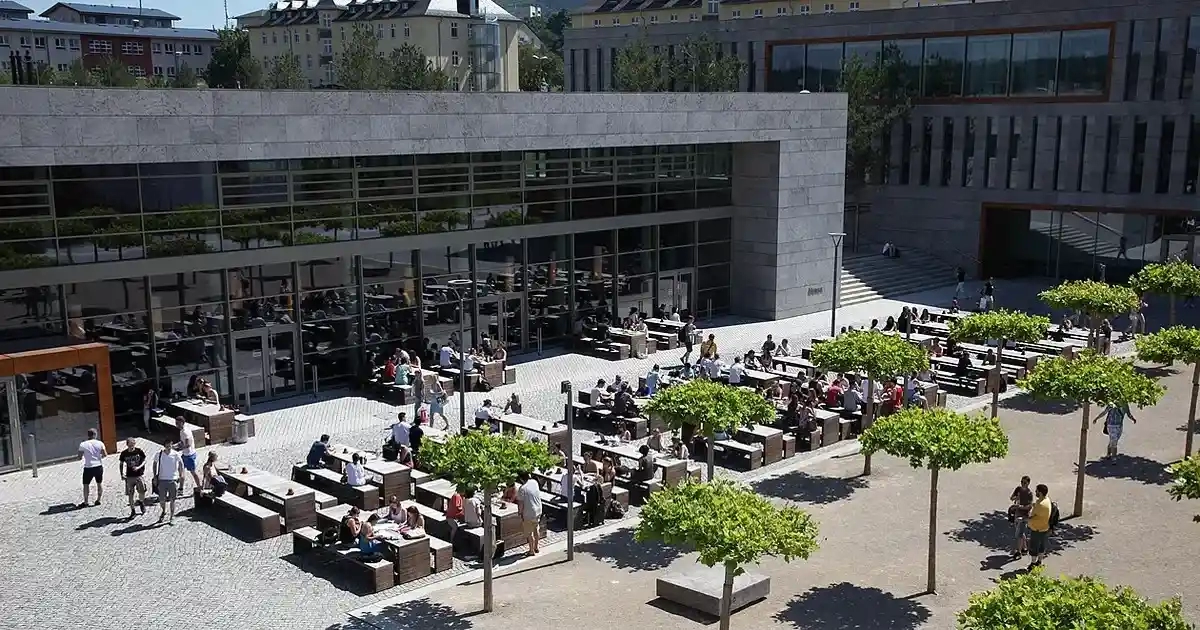
The campus of Fulda University of Applied Sciences is always worth a visit. The centrepiece is the plane tree courtyard between the library, cafeteria and Student Service Centre. But the sports facilities, the campus garden and the many cosy seating areas are also popular meeting places for students.
One of the great advantages of our university is the short distances and personal contact between students and their lecturers. Despite now having almost 10,000 students, Fulda University of Applied Sciences still has a family feel. People know each other and meet up.
Their university offers its students modern seminar rooms and laboratories. Resources with state-of-the-art technology are extremely important for good training. Students learn and work in modern facilities with high-quality resources.
Fulda is a beautiful town in the centre of Germany at the foot of the Rhön. The historic centre of the baroque city has a special charm. The green spaces such as the castle gardens or the Fuldaauen are wonderful places to relax from university studies and meet fellow students. It's not only nice to live here, it's also affordable.
Fulda University of Applied Sciences is one of the strongest research universities for applied sciences. This benefits not only researchers, but also students at the university. Innovative research characterizes teaching in Fulda and offers students and doctoral candidates the opportunity to participate in exciting research projects.
You are the best reason. With your university studies in Fulda, you are investing in yourself and your future. Your goals and interests take centre stage. The employees at Fulda University of Applied Sciences are there to support you with a comprehensive range of counselling services. Secure your place now.
Applicants who have a foreign university entrance qualification (Attestat, Baccalauréat, Lise Diplomasi, International Baccalaureate, Swiadectwo ukonczenia etc.) must apply for a Bachelor's programme at: www.uni-assist.de - regardless of their nationality.
This also applies to applicants
Admission requirements vary. View the requirements on the program page.
Applicants are exempt from applying via uni-assist if:
Phone : +49 661 9640-1420
Apply For Admission
The Service Centre for Accreditation (SAK) offers the departments of Fulda University of Applied Sciences information and support in all matters relating to accreditation and degree programme development.
The social services: benefits of the Accreditation Service Centre include
Advisory services and support for the further development of study programmes
(e.g. SPO amendments, good practice)
Support in the planning and scheduling of accreditation procedures
(e.g. individual timetables for each department)
Advisory services and support in the written assignment of accreditation applications (self-report)
Planning and support for on-site reviews (inspections)
The Fulda University of Applied Sciences is currently undergoing a system accreditation procedure
(project "ProSystem"), which will be completed in 2025.
The former University of Applied Sciences Library has a much more recent history, having o... read more
The history of the former Hessian State Library as the smallest academic general library in Hesse goes back much further.
In 1776, Prince-Bishop Heinrich von Bibra founded the "Public Library" with stocks that had been collected after the Thirty Years' War in the convent library, the court library, parts of the Jesuit library, which was cancelled in 1773, and the library of the papal seminar in Fulda. On 5 May 1778, the library opened its doors for the first time (in a building that still exists today. The so-called Auditorium maximum of the Faculty of Theology was the reading room at the time). Private foundations, the rich collection of the parish church in Hammelburg and additions from other libraries in the surrounding area after the secularisation of 1802/03 allowed the library's stock to grow continuously.
However, even at the time the library was founded, there were hardly any volumes left from the once famous Fulda monastery library, as most of them had already been lost during the Thirty Years' War. The library received an important addition in the form of 1,560 volumes from Weingarten Monastery on Lake Constance: in 1802, the hereditary governor of Holland, Frederick William V of Nassau-Orange-Dillenburg, was compensated for the loss of his Dutch rule with the Principality of Fulda as well as Weingarten and Corvey.
Parts of the Weingarten library were transferred to Fulda, including 146 manuscripts from the 10th to 13th centuries. Together with the three Bonifatian codices and a copy of the Gutenberg Bible (AT) printed on parchment, they form the highlights of the HLB's valuable historical stock.
Another stroke of luck for the library was the Acquisitions of the Schwank Foundation of 1886 with 209 manuscripts and 7,300 partly rare and old prints, including many on the history of Fulda. The HLSB also owns the largest collection of works by the humanist Ulrich von Hutten (1488-1523) in Germany. Together with a considerable number of early editions of the works of Luther and other reformers, these prints, manuscripts and portraits represent a fund of important intellectual-historical sources that should not be neglected.
Another important event was the city's decision to transfer responsibility for public library tasks to the library. In a cooperation agreement, which sealed a model project unique in Germany, the city of Fulda, the state of Hesse and the Fulda University of Applied Sciences agreed that the library at its location on Heinrich-von-Bibra-Platz would also be responsible for public library functions for children and young people in future. It has been doing this since 1 October 2011 in a modern extension and with great success.