ListOfUni

National College of Ireland (NCI)

Leinster, Ireland
Visit School Website
  • Public Type
  • 6,000 Students
  • 4 Faculties
  • 1951Founded
  • YesAccept Int. Studs
  • YesDistance learning

About

National College of Ireland (NCI) (Coláiste Náisiúnta na hÉireann (CNÉ) in Irish) is a not-for-profit, state-aided third-level education institution in Dublin. It was founded in 1951 as a joint venture between the Jesuits in Ireland and Irish trade unions, and was originally named the Catholic Workers College, Dublin. It is now an independent higher education institution, offering full and part-time courses from undergraduate to postgraduate level, in the areas of business, computing, psychology and education.

Acronym NCI
Nickname NCI
Founded 1951
Location Dublin, Leinster, Ireland
Address Mayor Street, International Financial Services Centre (IFSC), Dublin 1, D01 K6W2, Ireland

Mission

To change lives through education.

Vision

NCI will provide an inspiring educational experience that is innovative, responsive and enterprise focused. 
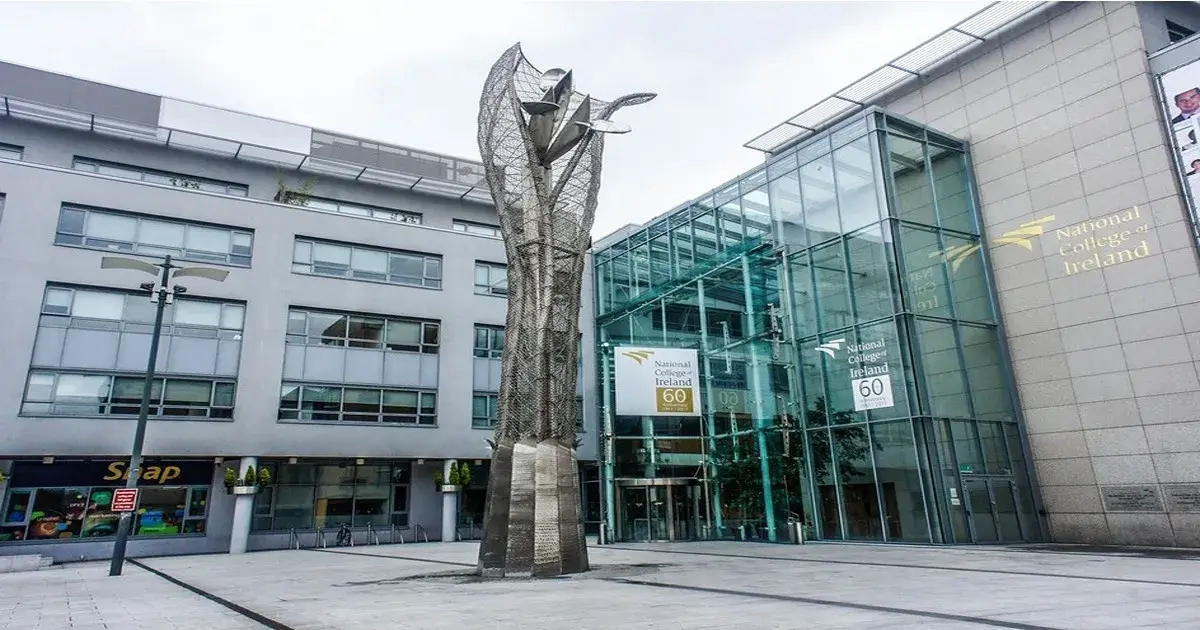
National College of Ireland

Main Academic Divisions (Faculties)

  1. School of Business
  2. School of Computing
  3. Psychology Department
  4. Centre for Education and Lifelong Learning

Reasons to Study at National College of Ireland

  1. Highly Relevant Courses

    Through our schools of business and computing we offer internationally recognised full and part-time programmes accredited through QQI. We work closely with industry and professional bodies to ensure courses remain closely aligned to industry needs.


  2. Small Class Sizes and Student Support

    Our small group teaching model mean students prosper in a friendly and supportive atmosphere where they get to know lecturers, staff and their fellow students. We also have great student support in place if you are having any difficulty adjusting to third level.


  3. Welcoming to International Students

    At NCI, we welcome international students from all over the globe. Our International Office will ensure you have all the information you need to arrive, live and study in Ireland and NCI.


  4. Experienced Faculty

    We work with a talented array of full-time and associate faculty. They are experts in their fields and combine the highest academic standards with industry experience and a real commitment to the learning of their students.


  5. Modern City Centre Campus

    Our purpose-built campus includes a spacious atrium area, tiered lecture theatres, modern computer labs and smaller executive suites and boardrooms. We have excellent transport links with the Luas and mainline train stations on our doorstep.


Fees

Undergraduate Tuition

Indigenous Students EUR 3,000
International Students EUR 12,000 - EUR 14,000

Postgraduate Tuition

International Students EUR 17,000

Admission

Undergraduate Admission Requirement

International Application:

All international students need to meet both our academic entry requirements and our English language requirements.

To learn about the academic entry requirements for your country, please visit our country pages and select the country where you were educated.

You should check entry requirements in three areas: 

  1. Country requirement: We accept a wide range of qualifications from universities around the world. For guidance on our international requirements, visit your country page.
  2. Programme requirement: Entry requirements vary depending on the course and are detailed in our international brochure and on individual course pages.
  3. English requirements: English language requirements are available on our English language requirements page.
  4. Applicants under 18: Guardianship Requirement:  Applicants under the age of 18 (and older than 17) on the day of the commencement of a programme at National College of Ireland (NCI) are required to provide evidence of guardianship as part of their application. Confirmation and evidence of guardianship must be provided to meet the entry conditions to NCI. 

Please also look at the requirements in your chosen course. Certain courses will have more detailed requirements regarding what you will have needed to study previously. If you need any assistance on understanding our entry requirements or whether you are suitable for a particular course, please feel free to contact us or we are happy to introduce you to one of our approved agents.

Supporting Documents

  1. Official transcripts for all completed studies, in both the original language and certified English translations.
  2. Official graduation certificate or degree scroll (if you have completed your study) in both original language and certified English translation.
  3. English language certificate (if available – if not this can be uploaded at a later date) 
  4. CV/Resume
  5. Passport (if you are currently residing in Ireland, we also require a copy of your immigration card)
  6. A Statement of Purpose (SOP) with a maximum 600 wordcount addressing the following key questions: *
    • Why do you want to study in Ireland and how does this align with your career goals?
    • Why you think the selected programme and NCI as an institution would be a good match for your further studies? 
    • How does your profile and experience make you a strong candidate for this programme?
    • If your chosen course does not directly relate to your previous education, then please outline why you have decided to change at this point and give reasons to justify the change with some evidence of relevant experience.

Postgraduate Admission Requirments

  • Bachelor's Degree: You typically need a primary degree from a recognized institution equivalent to an Irish Second Class Honours Grade 2 (2.2 or higher), depending on the subject area.
  • Work Experience Route: If you do not have a primary degree, NCI may consider you on an individual basis if you have 5–7 years of relevant professional work experience. 
  • Country-Specific: A recognized degree from a Nigerian university is typically accepted to satisfy academic entry requirements.

If English is not your first language or if you are an international applicant, you must provide proof of English proficiency:

  • IELTS: Minimum score of 6.0 or 6.5 (depending on the course) with no band below 5.5.
  • Alternative tests: NCI also accepts equivalent scores from tests like TOEFL iBT or Duolingo English Test.
  • Nigerian Applicants: NCI may accept an official letter from your Nigerian university confirming that your degree was taught entirely in English as a substitute for a language test

How To Apply For Admission

Undergraduate Student Applications

Applications for full-time courses should be made to the Central Applications Office (CAO), Tower House, Eglington Street, Galway before 1 February.

The CAO handbook gives details of application dates and procedures, find out more at their website www.cao.ie.


Postgraduate Student Applications

For our postgraduate courses you can apply online by visiting the course page of your chosen course and clicking on the 'Apply Online' button. 

International applicants

NCI welcomes applications from overseas students who satisfy the appropriate admission requirements. A certificate of competence in English is required.

Admission Contacts

Email: [email protected],[email protected]
Phone : +3531800 221 721

Apply For Admission

Campus Tour

Facilities

  • Classrooms
  • Library
  • Laboratory
  • Research Center
  • Accommodation
  • Sports
  • Gym
  • ICT
  • Cafeteria
  • Accommodation: There are many student residences around the city, as well as house and flat shares, homestays and more. We have compiled information on different accommodation options available to you to help you choose which suits you best. We highly recommend booking Student Residences and to apply early and to multiple locations.


School Contact

Address

Mayor Street, International Financial Services Centre (IFSC), Dublin 1, D01 K6W2, Ireland

Email Address

[email protected]

Phone Number

01 4498 500

Fax Number

01 4972 200

Website Address

https://www.ncirl.ie/

Accreditations

Quality and Qualifications Ireland (QQI)

Vice Chancellor

Professor Gina Quin

Professor Gina Quin will retire from her role as President of National College of Ireland (NCI) when she completes her second term in August of this year. 

The past ten years have seen continued growth at NCI and Professor Quin’s visible legacy will be the significant extension of the college in Dublin’s North-East Inner City through the purchase of Spencer Dock, a companion buildin... read more

g to the original Mayor Square building, forming a strong campus presence in the IFSC and NEIC. 

Professor Gina Quin is President of National College of Ireland (NCI), an independent not-for-profit College with a mission to change lives through education. NCI delivers programmes in Business, Computing, Psychology and Education to 6,000+ students from its Campus in Dublin’s IFSC. Gina is a member of the Governing Body of NCI; a Board member of the Irish Hospice Foundation; a Chartered Director, and recipient of the UCD Michael Smurfit Business School Alumni of the Year Award.        

Academic Staff

  • Ms. Barbara Cotter

    Senior Independent Director
  • Professor Cristina Hava Muntean

    Vice Dean of Academic Programmes and Research School of Computing Cristina Hava Muntean is a Professor with School of Computing and has over 20 years of research leadership, academic programmes leadership and management, teaching experience at both undergraduate and... read more
    postgraduate levels, and supervision of Masters and PhD students. She holds a B.Eng. degree in Computer Science and a Ph.D. degree awarded by Dublin City University, Ireland.
View More Staff

Notable Alumni

View More Alumni

History

National College of Ireland has enjoyed a long and intriguing history. Click on the links below to learn more about NCI's origins and evolution.

National College of Ireland has enjoyed a long and intriguing history. The first years of the new administration witnessed a number of significant developments. A Policy Research Centre was established in 1990. The following year, 1991-92, students became eligible for grants under the higher education grants scheme; and in 1993 the Board of Management of the college expanded to embrace a three-way partnership with trade unions, employers and the Jesuit Order. 
Other developments between 1990 and ... read more

1998 included:

  • The generous transfer by the Jesuits in 1995 of the land and buildings at Sandford Road to the Board of Management of the college
  • A significant increase in student and staff numbers
  • The securing of government funding, and of private funding for pioneering new courses
  • The establishment of a Centre of Educational Opportunity
  • The expansion of Library services
  • The opening of many off-campus programmes in different parts of the country

The college was very fortunate in having had as chairman during this period of extensive development, the late Mr. Paddy Moriarty, who worked tirelessly to bring the college to its fifth period of expansion and adaptation as National College of Ireland. To facilitate this development, the Jesuit community at Sandford Lodge fittingly agreed to make available to the college the building and grounds where, 47 years previously, the historic venture first commenced.