Resources of a contemporary university. A supportive community. Student-centred teaching. An international reputation in Theology, Philosophy, Canon Law and related areas. St Patrick’s opened its doors as an educational institution in 1795 as the National Seminary, becoming a Pontifical University in 1896. In the intervening two centuries, it has established for itself an impressive reputation for scholarship and learning. The Pontifical University and National Seminary are often referred to as Maynooth College. Today, as a Pontifical University, the St Patrick's specialises in the study of theology and philosophy and related areas, in one of the most beautiful campuses in Ireland.
| Acronym | SPPU |
| Nickname | SPPU |
| Motto / Slogan | An Education to Value |
| Founded | 1795 |
| Location | Kildare, Leinster, Ireland |
| Address | St Patrick's Pontifical University Co. Kildare, W23 TW77 |
The Mission of St Patrick’s Pontifical University naturally flows from this: ‘SPPU exists to?explore faith, enrich minds, equip leaders and empower?individuals and communities to bring about positive change in a?rapidly changing world’.
By 2030 SPPU will have become a leading, internationally renowned centre for theological, philosophical and pastoral education.
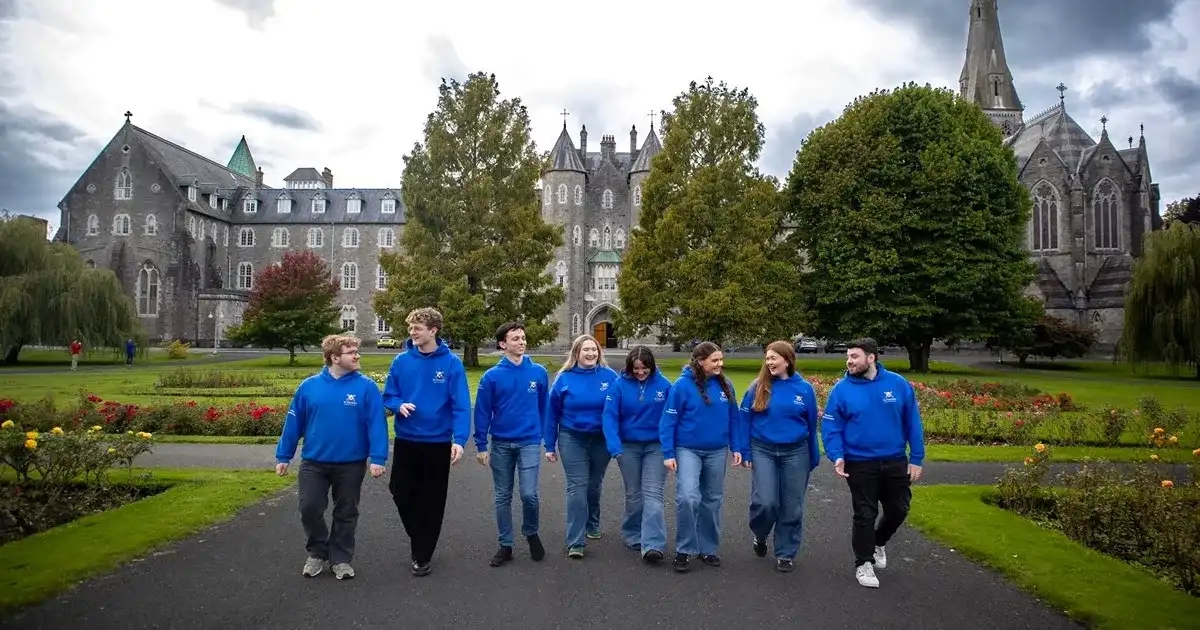
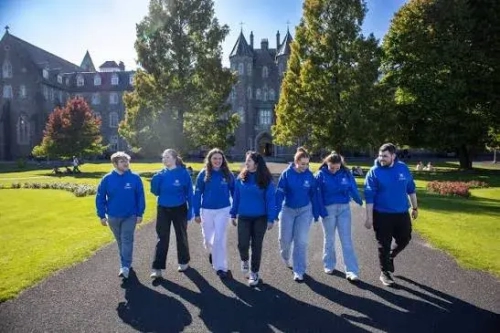
Students at St Patrick’s Pontifical University have the best of both worlds. On one hand, they have the attention of a small learning College and, on the other, they have all the resources and excitement of a large university. We support and challenge our students to achieve their potential. Our graduates develop a set of skills necessary to succeed in the world.
St Patrick's Pontifical University offers internationally recognised undergraduate, postgraduate, and professional programmes taught by leading theologians and philosophers. Students can pursue Bachelor's, Master's (taught and research), Higher Diploma, Postgraduate Diploma, Licentiate, and Doctorate programmes in Theology, Philosophy, Divinity, Pastoral Studies, History of Christianity, Ethics, Biblical Spirituality, and Christian Communications.
Our students experience the closeness of a small college community supported by the resources of a world-class contemporary university. You have full access to our Departments as well as courses and programmes on offer on campus. Our students also get involved in the many societies and clubs that flourish on our campus.
St Patrick’s Pontifical University is situated in one of Ireland’s most recognisable and beautiful locations. The Neo-Gothic architecture is evidence of the long and proud heritage. Higher education has taken place on this location for over 220 years. At the same time, there are a wealth of academic and technological resources on offer on our campus. As a small college, it is possible for a community atmosphere to thrive. Friends made here can be friends made for life.
‘Graduate attributes are the qualities, skills and understandings a university community agrees its students should develop during their time with the institution. These attributes include, but go beyond, the disciplinary expertise or technical knowledge that has traditionally formed the core of most university courses. They are qualities that also prepare graduates as agents for social good in an unknown future.’ (Bowden, 2000)
Undergraduate admission requirements vary by course and program. View the specific requirements on the program page.
Applicants under 23 on 1st January of the year of proposed entry must meet matriculation requirements as follows (see further down for GCE/GCSE matriculation requirements):
Post graduate admission requirements vary by course and program. View the specific requirements on the program page.
International/Non-Eu applicants do not apply through the CAO. International/Non-Eu applicants must apply through our application system. You can apply by clicking "Apply Now" on your chosen course page.
English Language Requirements
Minimum English language requirements:
Test of English as a Foreign Language (TOEFL): A minimum score of 600 (250 computer based, 100 Internet based) in the Test of English as a Foreign Language (TOEFL) administered by Princeton University.
International English Language Testing System (IELTS):
IELTS 6.5 (minimum 6.0 in each band)
To apply, visit the Course page and click "Apply Now". Full list of courses and how to apply can be found here https://sppu.ie/cou..
The application forms are for both EU and Non-EU/International applicants.
Email: [email protected],[email protected],[email protected]
Phone : +353 (0)1 708 4772, +353 (0)1 708 3391, +353 (0)1 708 4778

National Qualifications Framework (NFQ): Submits and aligns its academic awards with Ireland's statutory National Qualifications Framework, including joint honours degree awards alongside Maynooth University.
Undergraduate studies in UCD (BA Political Science and Philosophy, 1993) and Clonliffe College (BD Theology,1998); graduate studies at UCD (MA Philosophy, 1995) and the Pontifical Gregorian University in ... read more
Co-ordinating Committee Member of 'European Humanism in the Making' Network of the European Federation of Catholic Universities (2018 - present) St. Cuthbert’s Visiting Research Fellow, Durham University (2012), Secretary to the Bioethics Consultative Body of the Irish Catholic Bishops Conference, Chair of Irish Theological Association, Member of the Association of Teachers of Moral Theology, Catholic Theological Association (GB)
Priest of the Archdiocese of Dublin, ordained in 1998. Curate at Our Lady of the Assumption Parish, Ballyfermot (1998-2000); Curate at the Parish of Saggart, Rathcoole and Brittas (2006–2012); Parish Chaplain at the Parish of Saggart, Rathcoole and Brittas (2012-2019), Parishes of Oldbawn and Bohernabreena (2019-2022), Parishes of Springfield, Brookfield and Jobstown (2022 - present).
He has an MPhil in Philosophy from QUB, supervisor Rev. Prof. James McEvoy, external examiner Prof. Thomas Kelly, the... read more
He has a PhD in Philosophy from QUB, supervisor Rev. Prof. James McEvoy, external examiner Prof. John Haldane, thesis: The Metaphysics of St Thomas Aquinas and Neo-Theomistic Realism.
He has taught philosophy at QUB, St Malachy's Seminary Belfast, and Maynooth University.
He has taught theology at Mary Immaculate College Limerick.


The College was founded because it was urgently needed. In the seventeenth and eighteenth centuries it had not been possible to educate Catholic priests in Ireland. Institutions had been established in Catholic Europe, where they had become concentrated in France. The French Revolution... read more
The Bishops began to look for a site. It was desirable that the College be near Dublin, but they found themselves not exactly welcome in several desirable locations. They settled on Maynooth because the local magnate, the Duke of Leinster, was benevolent, and his Duchess even more so. This more than compensated for the fact that Maynooth was a little more distant from the city than they would have wished. The College opened in the autumn of 1795 in a house recently built by John Stoyte, steward of the Duke. Though heavily remodelled in the 1950s, it is still distinguishable as the projection on the row of buildings facing the front gate, and it is still called Stoyte House.