
For generations, the University of Mannheim has been preparing students to take on leadership roles in business, academia, and society. One of the university’s strengths in this task is its profile, which is characterized by the economic and social sciences. It is in these fields that the University of Mannheim has repeatedly been ranked as one of the top 20 European research universities.
Staff members at six schools and departments teach and carry out research in Business Administration, Economics, the Humanities, Social Sciences, Law, and Business Informatics and Mathematics.
| Motto / Slogan | In omnibus veritas suprema lex esto Truth in all things shall be the highest law |
| Colour | Mannheim Blue and White |
| Founded | 1907 |
| Location | Mannheim, Baden-Württemberg, Germany |
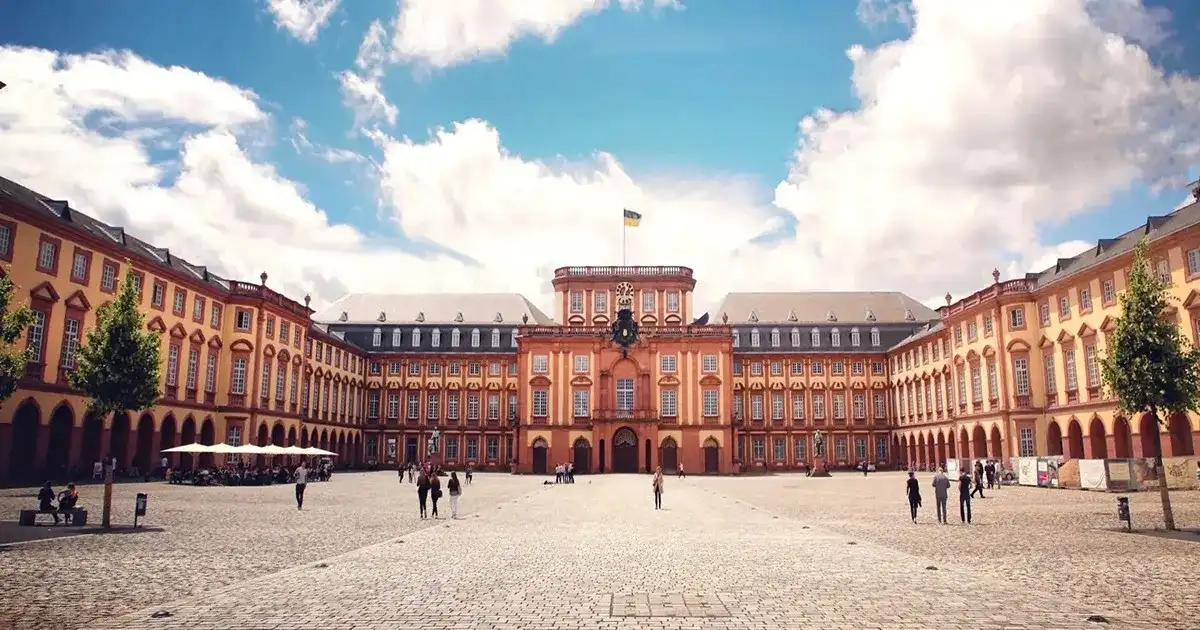
| Address | Schloss Ehrenhof Ost, 68161 Mannheim, Germany |
The university’s mission is to offer high-quality, research-oriented teaching that enables students to take on social, ecological, economic, and civic responsibilities. It promotes interculturality and interdisciplinary cooperation, fostering a culture of openness, diversity, and equal opportunity while maintaining a close dialogue with business and society.
The University of Mannheim aims to set the course for the digital future, strengthen its role as a premier research institution, and enhance its international reputation to remain at the forefront of higher education, striving to be a top-20 European institution.
The University of Mannheim feels a special social responsibility for promoting sustainable development. The understanding of sustainability encompasses the two pillars of environmental and social issues.
The university’s sustainability strategy takes into account both internal processes and the impact of research and teaching on society.
The international approach to research and teaching is a key feature of our university's profile. We work to ensure that all students are provided with the opportunity to gain an intercultural and international learning experience. Our campus is a meeting place for students and researchers from all over the world. The European University Alliance ENGAGE.EU is driving forward the university’s internationalization even more.
We strive to significantly increase the appointment of women to permanent professorships and achieve a significant improvement in the way to gender equality, also in the preceding career stages. Multifaceted perspectives and ideas strengthen research and teaching. We are currently drawing up a diversity strategy to ensure that the university becomes and remains a place characterized by openness and tolerance.
Theory-based, empirical, quantitative research and the further development of empirical methods constitute a key focus area that we want to strengthen even further. We would also like to improve the framework conditions for collaborative research projects. A key instrument in doing so is to establish a Center for Advanced Studies. We consider the professional qualification and promotion of early-stage researchers to be an essential part of this.
Entry requirements vary by program. View the program page for requirements.
To apply for our master’s programs, certain admission requirements have to be fulfilled. These can be certain subject-specific requirements of your bachelor’s program, but also other criteria such as a certain grade or proofs of language proficiency.
To participate in the admissions process, your application documents must prove that you fulfill these admission requirements, irrespective of whether the desired program of study is selective or not.
There are also selection criteria. By fulfilling the selection criteria, you can improve your chances of receiving a study place. Selection criteria may include internships, semester abroad, tests such as GMAT or GRE or text samples and letters of motivation.
Please go to the relevant selection statutes to see the detailed legal information.
Email: [email protected],[email protected]
Phone : +49 621 181-2222








The origins of the University of Mannheim date back to the Städtische Handelshochschule Mannheim (Commercial College of the City of Mannheim), which was founded in 1907 on the initiative of Mannheim's bourgeoisie. Funded by the Chamber of Commerce, the institution, which functioned as a college for future merchants up to the 1930s, became a center for higher education. The college offered courses in business administration and economics as w... read more
In 1933, the Handelshochschule was merged into the University of Heidelberg under National Socialist rule. Only 3 out of 14 Jewish teachers survived the Holocaust. Among the victims was Otto Selz, the head of the institute for psychology and president of the Handelshochschule. Today, the Otto-Selz-Straße, a street that begins at the east wing and goes around the university, commemorates the renowned pioneer of cognitive psychology.
Staatliche Wirtschaftshochschule
In 1946, the higher education institution reopened under its new name Staatliche Wirtschaftshochschule Mannheim (State College of Business and Economics). The university’s signet, which symbolizes the institution’s close connection with the city of Mannheim, dates back to 1955.
The signet is circumscribed with IN OMNIBUS VERITAS, the university's official motto in a shortened version, which was taken from the statutes of the Palatine Academy of Sciences that Prince Elector Carl Theodor had founded in 1763. The full quotation reads: “In Omnibus Veritas Suprema Lex Esto” and translates to “Truth in everything should be the supreme law”.
In 1967, the Staatliche Wirtschaftshochschule was renamed University of Mannheim. Since the institution gained “university” status, the number of students and degree programs has increased significantly. Today, the university is organized into five schools and offers a wide range of first-class undergraduate and graduate programs. Up to the present day, the university has been committed to the principle of education combining teaching and practical experience that informed its foundation 100 years ago. Several degree programs in the fields of social sciences, informatics, law, and the humanities offer students the opportunity to additionally acquire in-depth knowledge in economics and business administration. The strategic plan adopted in spring 2008 further consolidates this unique interdisciplinary approach.
When Carl Theodor assumed his regency over the Electoral Palatinate in 1743, the Schloss Mannheim was still unfinished. By 1760, work on the building of the east wing and the adjacent complex of palace buildings modeled on Versailles was concluded, thus completing the baroque palace building. The earliest starting point of the university’s tradition is the royal court library of Carl Theodor, today’s Aula. With the collection rapidly growing to 100,000 volumes, the library rated among the most important libraries of the time. Carl Theodor did not distinguish himself by military glory; yet, he was a generous patron of music, theater, and science. A connoisseur of the arts, he promoted a musical culture of European standing, and in 1779, he founded the National Theater. However, he was not only famous for his appreciation of the arts, but also cultivated sciences, and promoted trade. In 2007/2008, history students and senior citizen students, headed by the historian Dr. Rosmarie Günther, prepared information panels for the university’s most important lecture halls and publicly accessible rooms in the Schloss providing brief descriptions of the rooms’ respective function at the time of Carl Theodor (1743-1778).