
Rethinking education – digital, flexible, networked. As Germany's only state-run distance learning university, we have been shaping the digital transformation in research and teaching with societal impact for over 50 years.
The FernUniversität in Hagen holds a unique position as Germany's only state distance-learning university. For over 40 years, it has made higher education accessible to students who want an accredited university education but cannot or do not want to enroll in a traditional on-campus university.
What began in 1975 in rented rooms with 1,330 students is now Germany’s largest university, housed in an attractive and modern campus in Hagen. Througout its history, the FernUniversität has been dedicated not only to pioneering new approaches to teaching and learning, but also to a wide range of innovative research.
| Nickname | FernUni |
| Colour | Blue |
| Founded | 1974 |
| Location | Hagen, North Rhine-Westphalia, Germany |
| Address | FernUniversität in Hagen, Universitätsstraße 47, 58097 Hagen |
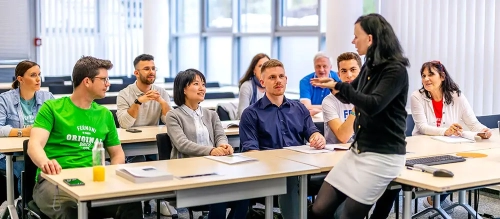
The FernUniversität’s teaching concept is based on a blended learning approach, which combines printed, multimedia, and online study materials with optional in-person seminars and events. This allows students the flexibility to learn when and where they want. At the same time, students receive support through personal advising and mentoring, study groups, and seminars on the Hagen campus and in regional centers throughout Germany and abroad.
Promoting equal opportunities and creating a non-discriminatory environment are key areas of focus at the Open University. Therefore, the term "equal opportunities" encompasses anti-discrimination, diversity, gender equality, and inclusion. Existing strategies and measures related to these topics will be consolidated through increased cross-referencing and intersectional integration.
The Open University of Hagen aims to contribute to making our world sustainable and worth living in. It aligns itself with international goals such as the United Nations' 2030 Agenda and the sustainability strategies for Germany and North Rhine-Westphalia.
Entry requirements vary by program. View the program page for requirements.
Furthermore, our Master's programs have additional subject-specific requirements. You can find information about these on the linked program pages.
Entry requirements vary by program. View the program page for requirements.
Email: [email protected]
Phone : +49 2331 987-2444
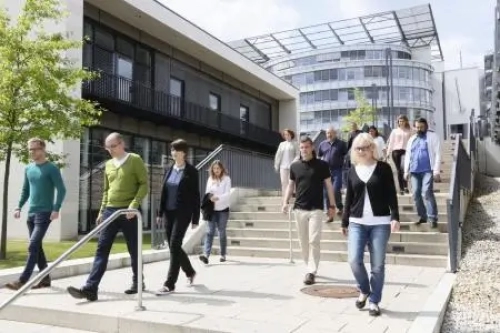
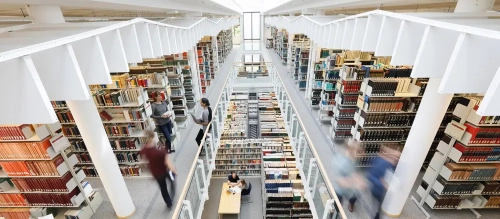
Library: The University Library (UB) is located in the center of the university campus. Around 50 staff members provide services, support, and advice at the University Library. The UB catalog currently includes over 850,000 volumes and over 1,170,000 digital resources. The University Library, with its comprehensive range of services, sees itself as the central service provider for the Open University – both locally and globally. In this context, the continuous expansion of digital resources and the promotion of information literacy are central to its work.
Research Center: This question is at the heart of the research at CATALPA – Center of Advanced Technology for Assisted Learning and Predictive Analytics. CATALPA operates as a real-world laboratory for application-oriented evidence, helping to meaningfully implement AI, adaptive learning systems and personalized teaching in higher education, thus providing students with tailored support for greater educational equity.
IT Service: Under IT Services you will find a list of services and products that are managed by the Center for Digitalization and IT . These are divided into the relevant categories. You will also find the most common applications at a glance.
Previously, Stürmer served as Vice-Rector for Teaching and Learning at the Open University from... read more
After studying law at Justus Liebig University Giessen, he received his doctorate in 2007 from Ludwig Maximilian University of Munich with a dissertation on the principle of guilt in criminal law. In 2012, he completed his habilitation at Goethe University Frankfurt am Main with a thesis on the application of criminal law. Before his appointment at the Open University, he was a junior professor of criminal law and criminal procedure at Ruhr University Bochum from 2009 to 2016.
From 1998 to 2004, he worked as a research assistant at the TU Dresden. There, he held a junior professorship in numerical analysis and boundary layer phenomena and completed his habilitation. In 2009/2010, research stays took him to the University of Limerick, Ireland, as a research fellow, and to the Academy of Sciences in Prague, Czech Republic.




As early as 1973, the state government of North Rhine-Westphalia adopted a project outline by Johannes Rau, which presented the basic principles of a nationwide distance learning university. It was to become the beginning of a success story in the German higher education landscape. In our chronicle, we trace the development of the FernUni – year by year. January 1, 1980: The General Services Center (AVZ) was the first building on the campus of the Open University. It is located in close proximity to the A45 and A46 motorways. Previously, the university's various departments had only rented apartments and buildings both within and outside of Hagen. Over the years and decades, the Philipp Reis Building (PRG), the Eugen Schmalenbach Building (ESG), a new building for the Department of Cultural and Social Sciences (KSW), the former Technology and Start-up Center (TGZ) with the Computer Science Center (IZ), the University Library (UB), and the cafeteria were added. June 11, 1990: The "International Conference on Computer-Assisted Learning," one of the largest international conferences on computer-assisted learning, takes place in Hagen. More than 300 scientists discuss the topic and learn about Hagen's distance learning system. The conference is chaired by Hagen computer scientists Prof. Dr. Gunter Schlageter, Prof. Dr. Hans-Werner Six, and Prof. Dr. Claus Unger. December 2, 2000: The celebration of the 25th anniversary of the start of academic operations also marks a milestone in student enrollment: approximately 59,000 people are enrolled at the Open University. Of these, around 14,000 already have access to online resources. The celebration, held in the unfinished university library, is attended by North Rhine-Westphalia's Minister of Science, Gabriele Behler, as well as Federal President and Open University founder Johannes Rau. The university celebrates its founding date with the first-ever University Night. December 15, 2009: Following a decision by the Rectorate, the Open University of Hagen implemented its first gender equality concept. The central goal: a gender-equitable and family-friendly university. Melanie Graf and the Equal Opportunities Commission played a key role in this development. Graf has been the university's Equal Opportunities Officer since 2004. In July 2014, the Open University achieved a top ranking in the Federal Ministry of Education and Research's (BMBF) program for female professors. This indicates that the prospects for newly appointed female professors at the Hagen-based university are particularly good. October 5, 2010: The Open University (FernUniversität) becomes part of the social web. It connects with students, prospective students, staff, and alumni on Facebook, Twitter, YouTube, and Xing. The FernUni press office team distributes current news, events, profiles, and activities to its fans and followers. The most important innovation: communication is now a two-way street. The editorial team engages in discussions with its readers and answers their questions with the support of the Service Center and student advisory services. February 2020 : If possible, everyone should work from home, a Corona task force was established, and then operations were gradually ramped up: In 2020, the effects of the coronavirus had a firm grip on the Open University. The first strict lockdown fell right in the middle of the exam period. However, studies continued. In the following months, scientists from a wide range of fields at the Open University will help to research and classify the new situation. September 2023: The Open University has begun equipping all suitable roofs on campus and in the logistics center with photovoltaic systems. In the future, this should cover 21 percent of its own electricity needs. March 5, 2024: Sustainable construction at high speed: The Open University of Hagen opens its new building for the Psychology Faculty. It was completed in just one and a half years. Furthermore, it has been certified with gold in the Sustainable Building Assessment System (BNB).
Oct... read moreober 1, 1979: After initially using equipment from another university, the Open University's first dedicated central computer was put into operation on October 1, 1979. From then on, it supported academic operations. In addition, a network node was established . This gave distance learning students online access to the Open University for the first time via other university computer centers .