Friedrich Schiller University Jena is a dynamic and innovation-driven university centrally located in Germany. With a broad range of disciplines, it shapes the future through excellent research and teaching. Its scientific excellence is reflected in its profile "Light. Life. Liberty.", which provides pioneering insights and sustainable solutions for the society of tomorrow. Through close collaborations with leading research institutions, innovative companies, and renowned cultural organizations, it advances interdisciplinary developments. With around 17,000 students and approximately 10,000 employees, it defines Jena as a vibrant, internationally connected city of science and innovation.
| Nickname | UNI JENA |
| Motto / Slogan | Light, Life, Liberty |
| Colour | Blue and White |
| Founded | 1558 |
| Location | Jena, Thuringia, Germany |
| Address | Fuerstengraben 1 07743 Jena |
What does the University of Jena stand for? Which values do we want to live? What gives us orientation for the future? The mission statement answers these questions.??
The Friedrich Schiller University Jena is part of society. It is committed to the freedom of research and teaching and contributes to shaping the future by providing solutions for society’s grand challenges through science and education.
Building on its interdisciplinary research profile and being mindful of its nearly five hundred years of eventful history, the university translates this commitment into the following values:
The mission statement was formulated by a Senate task force set up specifically for this purpose. In this video series, the members of the task force explain what the mission statement means to them and which aspects are particularly important to them (English subtitles available).
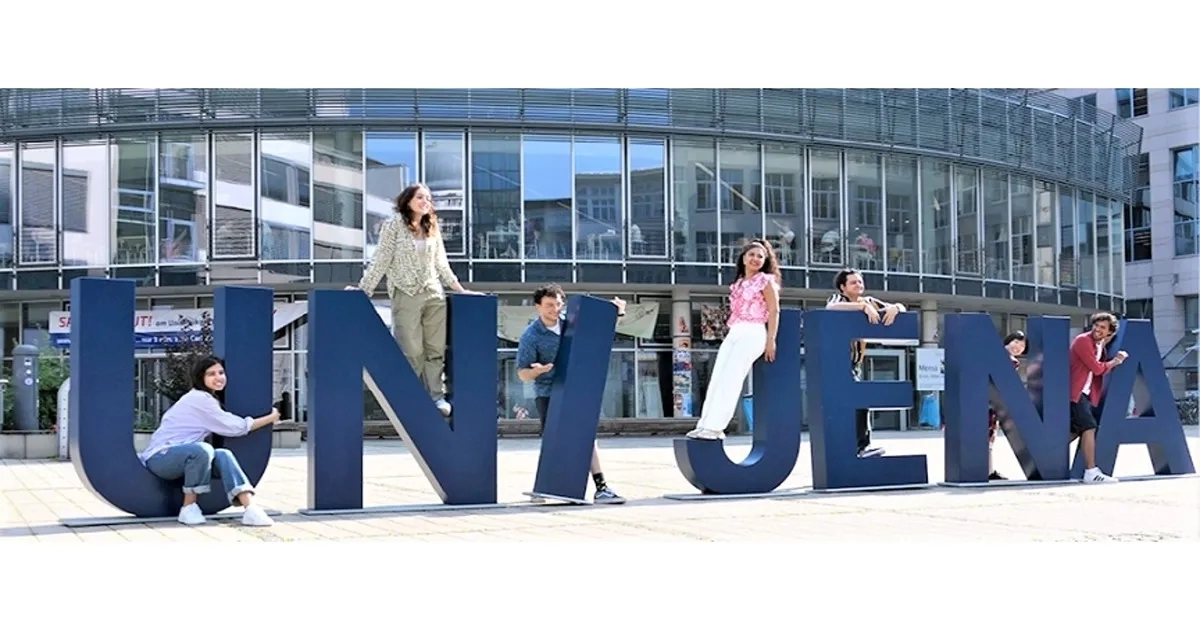
Diverse study opportunities, dedicated teaching staff, innovative ideas, and early promotion of gifted students. At the Friedrich Schiller University of Jena, teaching is of great importance because of the University
With around 16,500 students and more than 10,000 employees, the university significantly shapes the character of the city of Jena. The university recognizes the resulting social responsibility and aims to fulfill it by engaging in the sustainable development of the city and region.
At the University of Jena, the health of our employees, students, and all members of the university community is important to us. Together, we are creating a healthy study and working environment—with opportunities for exercise, nutrition, psychosocial health, and healthy working and studying conditions. Health management brings together all the various actors involved in health and makes their offerings visible here.
Friedrich Schiller University of Jena is a pioneer in promoting early career researchers in Germany: It was one of the first universities to set up a central Graduate Academy, which does not only provide services for doctoral candidates in structured programmes, but offers guidance for all phases of the academic career – from research-oriented studies to the doctoral and postdoctoral phases to the transition to professorship.
Students in Jena pay no tuition fees (except for extended study periods). Living costs are about €750–€900 monthly. International students must show proof of funds (€11,904/year; €12,324 for language courses) for visa purposes. With a residence permit, students must cover their expenses and are not eligible for German social benefits.
Entry requirements vary by program. View the requirements on the program page.
Entry requirements vary by program. View the requirements on the program page.
Apply through Online Application.
Email: [email protected]
Phone : +49 3641 9-401400, +49 3641 9-411555


The chemist Andreas Marx currently holds a chair and heads a research team of around 25 people at the University of Konstanz. With him as President, the University of Jena's global standing and its research excellence are to be further strengthened.




The University of Jena has once again become an internationally renowned centre of science. New success stories are written in research and teaching; and when browsing through the University’s history, one comes across the names of great scholars who worked in Jena. Ever since it was founded, the University has been through many ups and downs. Numerous famous names have passed through its doors ov... read more
This overview sheds light on the history of the University of Jena from the founding years to the present day by means of short texts and useful references.
The University of Jena owes its existence to a military defeat. John Frederick I, Elector of Saxony spearheaded the Schmalkaldic League, an alliance of Protestant princes in the empire that had been formed to oppose the Emperor Charles V. On 24 April 1547, the followers of the new faith suffered a severe defeat near Mühlberg. Hanfried, the name by which the Duke is known in Jena to this day, was taken prisoner and had to fear for his life. He was later pardoned by the Emperor, but stripped of his Electoral title and forced to forfeit big parts of his territories, including the city of Wittenberg and its university. His cousin Maurice, who had sided with the Emperor, was the beneficiary. John Frederick had to find something else. He chose Weimar as his new residence, and neighbouring Jena as the site for a Hohe Schule, an academy. This new educational institution was primarily intended to train pastors who should spread the Lutheran doctrine.
As early as 1555, the office of Rector had been introduced at the Hohe Schule. From then on, any of its professors could be elected rector. The university privileges were granted by Emperor Ferdinand I in 1557; his predecessor Charles V would not have done so. Even a faculty of theology was approved, although Jena had become a stronghold of orthodox Lutheranism in the meantime. In view of the religious disputes in the empire, this was rather surprising.
Johann Wolfgang von Goethe called Jena a city privileged to knowledge. Goethe, a member of the Privy Council, had laid the foundations for this himself in his role as superintendent of the local institutions for the arts and sciences. He created the necessary academic infrastructure by having libraries and the Botanical Garden expanded and by supporting various collections and laboratories. The University Observatory and the Mineralogical Collection also were established on his initiative. But the motives behind this were not purely altruistic. The poet’s own inclination towards research may have influenced some of his decisions. Admittedly, it also yielded results: Goethe persistently searched for the human intermaxillary bone and was successful. In 1784, he and the physician and anatomist Justus Christian Loder demonstrated the presence of the intermaxillary bone in the human skull in the Jena anatomical theatre. The ruins of this building—the Anatomy Tower—can still be visited today. In addition, the original preparations made by Goethe are kept in the University’s Anatomical Collection.
The Jentower is literally towering over the city centre to this day; at 159.60 metres, it is the tallest building in the new federal states. In its shadow, disobedient minds emerged in the last years of the GDR: Jena was considered a stronghold of dissidents in the country. In 1989, students and professors took to the streets together. They were protesting to overcome the crippling standstill in the country and to sweep away the restrictions on intellectual freedom in science and research. Immediately after the political changes, the University faced drastic cuts: All teachers were evaluated, and the previous sections once again became ten faculties of a clearly structured classical university covering all disciplines. A new central campus was built on the premises of the former main factory of Zeiss in the city centre; in 2000, the University Hospital in Lobeda was built, bringing together all the medical clinics and institutes in one location. At the end of 2001, a new university library was opened, which replaced the provisional building that had been constructed after the war.
Joint and often interdisciplinary projects, for example in the six DFG Collaborative Research Centres and the more than 20 Research Training Groups and Graduate Schools, are impressive indicators of where the University is heading. Its focal research areas are united under the slogan Light, Life, Liberty. The field Light includes Optics and Photonics as well as Innovative Materials, Technologies and Energy Storage; the field Life includes Microbiology, Infection Biology, as well as Biodiversity, Bio-Geo-Interactions and Aging Research. The third field, Liberty, includes Social Change and Enlightenment, Romanticism and Contemporary History.