

The University of Göttingen is an internationally renowned research university with a long tradition. Founded in 1737 during the Age of Enlightenment, it is committed to the values ??of democracy, tolerance, and justice, as well as the social responsibility of science. In 2003, it became the first comprehensive university in Germany to be transferred to the sponsorship of a public foundation. With 13 faculties, it covers a diverse range of subjects in the natural sciences, humanities, social sciences, and medicine. Approximately 28,000 students are enrolled in more than 210 degree programs.
The University of Göttingen is distinguished by the diversity of its subjects, particularly in the humanities, by its excellent facilities in the natural sciences, and by the outstanding quality of its research in its key areas.
| Nickname | Georgia Augusta |
| Motto / Slogan | In the Spirit of Enlightenment (Historical) |
| Founded | 1737 |
| Location | Göttingen, Lower Saxony, Germany |
| Address | Georg-August-University Göttingen, Wilhelmsplatz 1, 37073 Göttingen, Germany |
IN PUBLICA COMMODA - FOR THE GOOD OF ALL reads the inscription on the Foundation Medal of Georg-August-Universität Göttingen. Established in the age of the Enlightenment (1737) and committed to its critical spirit, the "Georgia Augusta" was one of Europe's first universities to abandon the supremacy of theology and achieve equality for all faculties. Emphasis on basic research and orientation towards source criticism and experimentation proved to be decisive preconditions for the development of the modern humanities and natural sciences, a development strongly influenced by the Georgia Augusta.
The history of Georg-August-Universität Göttingen has to this day been characterised by scholarly pragmatism and a sense of reality as well as keen awareness for science's societal responsibility. This tradition embraces the contributions of the "Göttinger Sieben" (1837) and those of Max Born, Otto Hahn, Werner Heisenberg and Carl Friedrich von Weizsäcker, who initiated the "Göttinger Erklärung" (1957) calling for the abandonment of nuclear weapons of every description. It is in this tradition that the Georgia Augusta today defines itself and its mission. Remembering the darkest chapter of its history during the period of National Socialism, the University is committed to utilising its strengths in shaping a humane, tolerant and peaceful world.
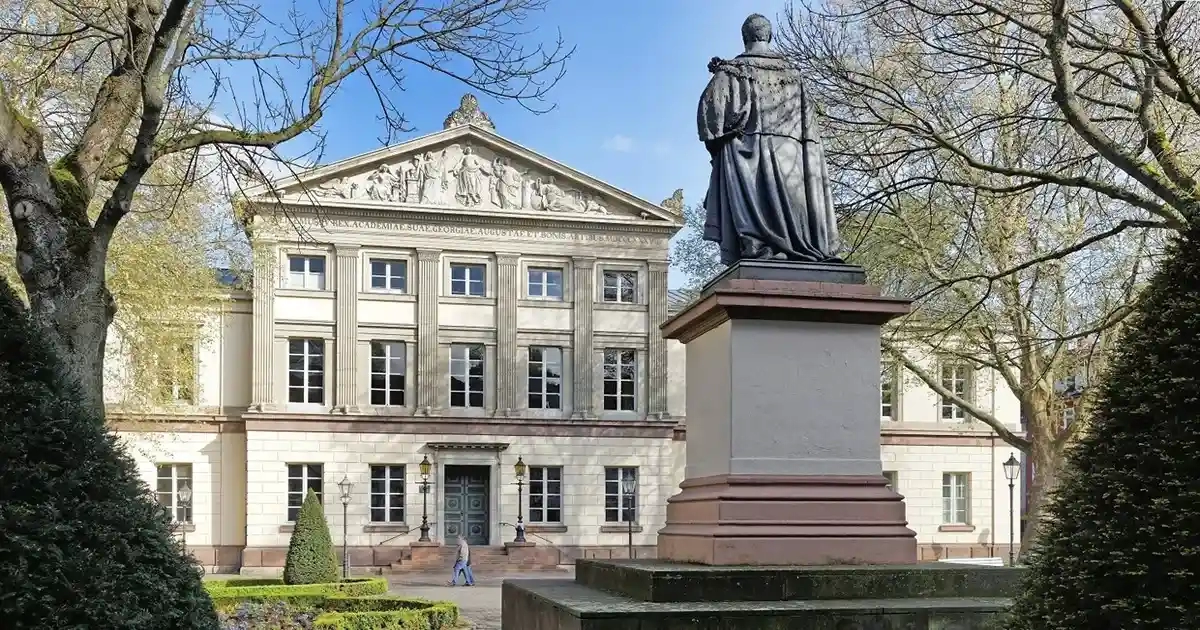
On the basis of its achievements in research and teaching, Georg-August-Universität Göttingen seeks to heighten its international reputation by concentrating on its special strengths:
Three theatres, four cinemas and lots of music festivals – our cultural life reflects the fact that we are a university town. Students benefit from the Kulturticket, which gives students free or reduced admission to almost all events. Those who need exercise after long days in the library and lecture hall will find it in the excellent range of our university sports, including climbing hall and fitness center.
Around 280 partner universities offer excellent exchange opportunities to almost every country in the world. Those who prefer to stay local benefit from the intercultural exchange at the University. The international students who make up 16 percent of the student body, the lecturers from all over the world, and the many degree programmes taught in English broaden students’ horizons and prepare them for the international job market.
Do you want to learn more? Then come to Göttingen! Bachelor students benefit from access to cutting-edge research; master’s and PhD students benefit from the superb networking opportunities with the excellent local research institutions. With four Max Planck Institutes, the German Primate Center, and the German Aerospace Center, the Göttingen Campus offers a high concentration of top-level science that is unique in Germany.
Everyone feels at home in the small city of Göttingen, and you, too, will soon feel the same way. The distances are short, to campus for your morning commute, to the cafeterias at lunchtime or to town in the evening. As far as nightlife, almost all the pubs and bars are easy on the small student wallet. After all, students make up about a quarter of our population.
Entry requirements vary by program and course. View the program page for requirements.
Entry requirements vary by program and course. View the program page for requirements.
Email: [email protected]
Phone : +49 551 39 21348/ +49 551 39 27777


The subject of system accreditation is the internal quality management system of a higher education institution in Teaching and Learning. System accreditation gives a higher education institution the right, with the involvement of external expertise, to assess the quality and accreditability of its study programmes itself and to award the seal of the German Accreditation Council for the study programmes it has assessed.
Professor Axel Schölmerich has been President of the University of Göttingen since March 2025. He was appointed by the Senate to fulfil the duties of a President in order to bridge the period until a new President takes up office. The psychologist was previously Rector of Ruhr-Universität Bochum from 2015 to 2021.




In Göttingen, a focus on experimentation, basic research, and source criticism has always been the methodological foundation of research and teaching. Scientific pragmatism and a sense of reality characterized the style of the University of Göttingen. This provided an excellent foundation for the development of modern natural sciences in the 19th century, which was significantly shaped by Göttingen scholars Carl Friedrich Gauss, Wilhelm Weber, and Friedrich Wöhler. It is therefore no coincidence that Göttingen and the University of Göttingen (Georgia Augusta) were able to establish themselves as a world center for mathematics and natural sciences between 1880 and 1933.
at the behest of the sovereign, Elector George Augustus of Hanover, who, as George II, was also King of Great Britain (a personal union since 1714), after whom the university was named. The true driving force behind the new foundation was the Hanoverian minister Gerlach Adolph Freiherr von Münchhausen, who created a new type of university with the Georgia Augusta: even more consistently than the University of Halle, which was only a few decades older, it served the goals of the Enlightenment. To this end, scientific research was freed from theological censorship (although Münchhausen, as the Elector's representative, reserved the right to censor), and at the same time, academic teaching was given high priority. The library, which was specifically promoted, was also open to students—an unprecedented innovation for the time—and Münchhausen created new professorships for young and promising scientific disciplines, to which he systematically appointed outstanding representatives of their fields. The university commenced teaching operations in 1734, and the official inauguration took place in 1737 in the presence of Münchhausen.
Göttingen had survived the Second World War without major damage, which gave the city and university an invaluable head start. With the permission of the British occupying forces, the Georgia Augusta University was the first German university to resume teaching, on September 17, 1945. Göttingen became a magnet for people, especially those from academic and artistic professions – for example, the elderly physicist Max Planck (1858–1947), who spent the last two years of his life there. Werner Heisenberg, who had already worked as a lecturer at the University of Göttingen in the 1920s, returned to Göttingen in 1946 and taught there from 1947 to 1958. On February 26, 1948, the Max Planck Society was founded in Göttingen, with the Nobel laureate and later honorary citizen of Göttingen, Otto Hahn, as its first president. In the same year, on November 19, writers untainted by National Socialism, among them Erich Kästner and Johannes R. Becher, Minister of Culture of the GDR from 1954 to 1958, gathered in Göttingen to found the first all-German PEN Center. In the
Göttingen University (Georgia Augusta) is the only university in Northern Germany to receive funding through the Excellence Initiative of the German federal and state governments. It was recognized for its future-oriented concept, "Göttingen: Tradition – Innovation – Autonomy." This concept, aimed at expanding the university's cutting-edge research through projects, encompasses the initiatives Brain Gain, Brain Sustain, LichtenbergKolleg, and Göttingen International. The Göttingen Graduate School for Neuroscience and Molecular Biosciences (GGNB) and the Cluster of Excellence "Microscopy at the Nanometer Scale" also secured funding through the Excellence Initiative.