Munich University of Applied Sciences: one of the most diverse universities of applied sciences in Germany.
A broad range of study programs, interdisciplinary research, an entrepreneurial mindset, strong regional networks, and a cosmopolitan outlook: these are the strengths of Munich University of Applied Sciences (HM). Fourteen academic faculties, as well as the study faculties MUC.DAI and MUC.HEALTH, educate over 18,500 students at Munich University of Applied Sciences.
They offer degree courses and active academic collaboration in the MINT subjects (mathematics, computer science, natural sciences and engineering), business, the social sciences and public health as well as in architecture and design. Our Department of General and Interdisciplinary Studies is unique in providing every student with a cross-disciplinary education and in developing their personal skills.
| Acronym | HM |
| Nickname | HM, Hochschule München |
| Founded | 1971 |
| Location | Munich, Bavaria, Germany |
| Address | Munich University of Applied Sciences , Lothstr. 34, 80335 Munich |
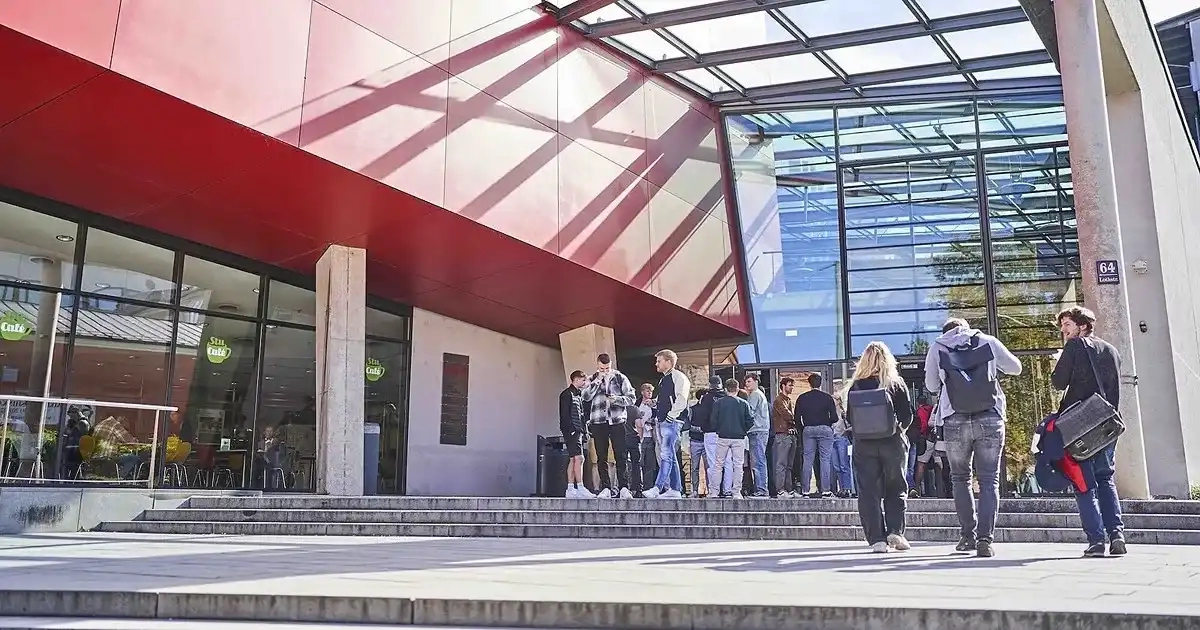
Those studying at HM today will help shape the future. To prepare them for this responsibility, a degree at HM combines excellent academic training with relevance to societal megatrends such as sustainability and internationalization. This is made possible by experienced lecturers and a vibrant campus that blends personal interaction with digital innovation.
Studying at HM promises academic qualification for professional expertise and management tasks, as well as the opportunity for in-depth scientific study up to and including a doctorate. HM's study programs encompass the fields of engineering, business, social sciences, and design.
HM's research projects provide impetus. We develop solutions for the challenges of our modern and diverse society, support their implementation, and thus strengthen our society's capacity for innovation. As a driving force for innovation, we are deeply rooted in the Munich metropolitan region.
For years, HM has been one of the leading universities in Germany in the field of entrepreneurship and understands it as a transformative force that ensures future viability. Munich is one of Europe's leading economic and scientific centers. At this location, Munich University of Applied Sciences (HM) plays a significant role in the regional innovation ecosystem.
They offer tailored services for international students and scholars and foster a welcoming, intercultural and vibrant campus community. HM students have numerous opportunities to gain international experience, either abroad or here at HM.
Strong partnerships with industry and business provide students with valuable internship opportunities and support a smooth transition into professional life.
HM ranks highly among employers, who recognise its graduates for their strong practical skills and extensive real-world experience, making them exceptionally competitive in the job market.
Munich is a powerhouse for innovation, home to over 22,000 high-tech companies across sectors such as automotive, electronics, engineering, telecommunications, and aviation.
Blending Bavarian traditions with an international vibe, Munich offers a huge range of cultural experiences – from history and art to festivals, exhibitions and many exciting events.
To participate in our summer school, you must be at least 18 years old.
Your application should include the following documents:
Language Requirements:
English: level B2 for enrolment at the latest.
German: no German language certificate is needed for enrolment, but you will be required to learn German to a basic level outside your studies in the first semesters.
1) Register with uni assist. Please use the "Bachelor-All Subjects" option and do not name any specific course.
2) A scanned copy of your school report and possibly your academic achievements.
3) An officially certified translation of your certificates into German or English.
4) A scanned copy of your passport or ID. (if necessary, certificate of name change, not notarized).
5) A complete CV / resume. Have a look at our sample German CV.
All documents must be uploaded to the uni-assist portal. It is not necessary to send it in by post.
Please also refer to the special information on certain countriesthat uni-assist provide.
An evaluation of your certificates takes 6-8 weeks. uni-assist charge an administration fee of € 75 for their services. The pre-check will only start once payment is received. Please remember to pay and submit everything on time.
Hochschule München enables a pure online application for the VPD application. You can easily submit your documents online.
You will receive a VPD (preliminary examination documentation) via the uni assist portal, which you will need to apply to Hochschule München.
If you have already successfully completed a state Studienkolleg, then apply directly to Hochschule München with your FSP certificate. You do not need a VPD-notification from uni-assist.
Admission Requirements for Specific Programmes
All information about required certificates, admission, language skills and tuition fees can be found on the website of the respective degree programme and department.
List of Master's degree programmes
Please note that the exam board of each department will decide about admission.
The language of tuition in most of our Master's degree programmes is German.
General Admission Requirements
For some master degrees, you can apply with a certified translation of your degree certificate directly. For some master degrees you need preliminary check of your Bachelor's certificate through uni-assist. Please note that the check trough uni-assist doesn’t replace the application under www.hm.edu/master-bewerbung (in German only).
You only need a preliminary check of your Bachelor's certificate through uni-assist for the following master degree courses:
Applied Research in Engineering
Business Administration:Digital Technology Management
Entrepreneurship and Digital Transformation
Elektro- und Informationstechnologie
Architecture
Mechanical Engineering, Automotive Engineering, Aerospace Engineering
Computational Engineering
Automotive Mechatronics
Mechatronik / Mechatronics
Industrial Engineering (Wirtschaftsinformatik)
Strategie und Innovation im Tourismus
Hospitality Management
Systems Engineering
Please also add a transcript of records.
You can get an estimation whether your Bachelor's certificate is usually recognized in Germany on the government website www.anabin.kmk.org (in German only). This is, however, only an estimate and no guarantee for admission to a place in a Master's programme.
2. Relevant work experience
Relevant work experience (if not a part of your previous degree program) and, for continuing education Master's degrees, at least 1 year of professional experience.
3. Entrance qualification test
Some departments may set mandatory entrance qualification tests.
4. Proof of German language skills
For the German taught Masters, you need German language at Level B2 or C1 (please check with the department directly).
Please note that the language of instruction is German except in the following programmes:
Paper Technology
Entrepreneurship and Digital Transformation
Business Administration: Digital Technology Management
Please refer to the individual department's website for further details.
This list is not comprehensive. Please refer to the department directly for further admission requirements.
Applications for more than one course are possible. You must submit a separate application form for each degree programme.
Email: [email protected]
Phone : +49 89 1265-1145, +49-89-1265-1140
Operates under the German higher education quality system guided by the German Accreditation Council
since 01.10.2016 president
2015–2016 Member of the Senate
2003–2005 Dean of the Faculty of Computer Science and Mathematics
2005–2012 Managing Director of HIS Hochschul-Informations-System GmbH, Hanover
2012–2014 and 2008–2012 Dean / Vice Dean of the Faculty of Supply and Building Technology, Process Engineering Paper and Packaging, Prin... read more
2002 Doctorate in Engineering (Dr.-Ing.) with summa cum laude distinction from the Faculty of Mechanical Engineering at the Chemnitz University of Technology
2015–2016 Dean of the Faculty of Tourism
2011–2015 Dean of Studies, Acting Vice Dean of the Faculty of Tourism
2007 PhD from ... read more
2018–2023 Head of the staff unit for data management and digitalization in public administration, University of Hamburg
2016–2017 Head of the Chancell... read more
2013–2016 Technical Assistant to the Chancellor of the University of Hamburg
2009–2016 Dean of Studies of the Faculty of Industrial Engineering
2005–2008 IBM Germany, Global Business Servic... read more




Munich University of Applied Sciences, originally founded as a university of applied sciences, was established in 1971. Its founding was the result of the joint efforts of directors, faculty, and students of engineering schools at the end of the turbulent 1960s. The aim was to reform engineering education and to elevate the status of higher vocational schools within the university system. Vocational schools specializing in business, social work, and design subsequently joined th... read more
Even the predecessor institutions of Munich University (HM) have a rich history. The tradition of the faculties of Architecture, Civil Engineering, and Geoinformation stretches back 200 years. Their predecessor, the School of Building Trades, began its regular lecture program at that time.
The diverse form that HM has taken today has grown over the decades. How the range of courses has changed, how new degrees have transformed education, and what else has shaped HM's development can be discovered in the timeline.
After "more than 32 master builders from the countryside" had presented themselves in the previous November, Hermann Mitterer, a teacher at the Sunday school, held a special building trade lesson at the beginning of 1821.
Gustav Vorherr, district building inspector of the Isar district since 1809, had already set himself the goal of standardizing Bavarian construction practices years earlier. To this end, he wrote a memorandum in 1810 on the organization of a state-run school for building trades.
1990
Bavarian universities are taking on sponsorships for universities in Saxony. Munich University of Applied Sciences is concluding a partnership agreement with Mittweida University of Applied Sciences, which is being continued as a pilot project for universities of applied sciences in the eastern part of Germany.
2000
Funded by the Bavarian High-Tech Offensive, the groundbreaking ceremony for the largest construction project in the history of Bavarian universities of applied sciences, the new technology building in Loth-/Heßstraße, took place.
2015
For the first time, Munich University of Applied Sciences will award "Oskars" at its Oskar von Miller celebration for excellent academic degrees and outstanding achievements in teaching and research. Companies can also receive an "Oskar" for their exceptional commitment to the university.
2024
The introduction of the right to award doctorates in 2023 marks a historic milestone: Munich University of Applied Sciences is establishing seven doctoral centers in a Bavaria-wide network with Nuremberg and Regensburg, three of which will have Munich University of Applied Sciences as the host university – a network model unique in Germany.
2025
A four-story modular building with 1,800 square meters of space is being constructed on the Lothstraße campus, designed for modern work concepts. The new building is a pilot project for flexible, future-oriented ways of working and was developed in collaboration with employees.
2025
TheTechnology and Transfer Center TIZIO It specifically strengthens knowledge transfer and regional cooperation. Starting in December 2025, HM scientists will collaborate with companies and regional stakeholders in four high-tech laboratories on application-oriented innovations.