

The HFT Stuttgart offers a wide range of Bachelor's and Master's degrees. In addition to classical courses of study such as architecture, civil engineering, business administration, computer science or applied mathematics, the HFT Stuttgart is the only university in Germany to offer bachelor's courses in building physics and digitalisation & information management. Other attractive study programmes that combines different study subjects are for exmaple the Bachelor's degree courses in Climate Engineering, Business Informatics, Infrastructure Management and Industrial Engineering (Construction/Real Estate).
Consecutive full- or part-time Master's programmes follow on from the undergraduate courses. In addition, internationally oriented master's programmes such as Interior Architectural Design (IMIAD) or English-language master's programmes such as Photogrammetry and Geoinformatics, International Project Management, Smart City Solutions and Software Technology are also offered.
Studying in the center of Stuttgart
| Nickname | HFT Stuttgart |
| Colour | Red and White |
| Founded | 1832 |
| Undergraduate Programmes | |
| Postgraduate Programmes | 21 |
| Location | Stuttgart, Baden-Württemberg, Germany |
| Address | Stuttgart University of Applied Sciences Schellingstr. 24, 70174 Stuttgart PO Box 101452, 70013 Stuttgart |
We are working on the future. Climate-literate, resilient, connected.
36 Bachelor's and Master's degree programs. 125 professors, 390 lecturers, about 100 researchers. At Stuttgart University of Applied Sciences, we all work on the future every day.
Climate expertise, resilience and networking form the basis for making the world of today and tomorrow a better place with qualified solutions. We connect faculties, research and partners on an interdisciplinary basis. We offer opportunities to think even more broadly and educate yourself even more comprehensively. Practical relevance and small learning and semester units guarantee students their own personal development. This leads to a degree that, like their studies, is geared towards the future and is in high demand from companies.
Being climate-literate means meeting the challenges of climate change with solutions in line with the UN Sustainable Development Goals. For more resource conservation that still allows for a progressive way of life.
Resilient means creating resilient living spaces together. With intelligent solutions that provide the best possible protection for environments and infrastructure against the consequences of external crises. Whether they come from climate change or are deliberately caused by cyber attacks, for example. It is also important to us to empower students. So that they can organize their studies and their lives well.
We connect students, lecturers and researchers. Projects repeatedly reach across faculties and degree programs, and current research is integrated into our future-oriented degree programs. Together with partners, we are driving digitalization and AI forward. For a future that connects.
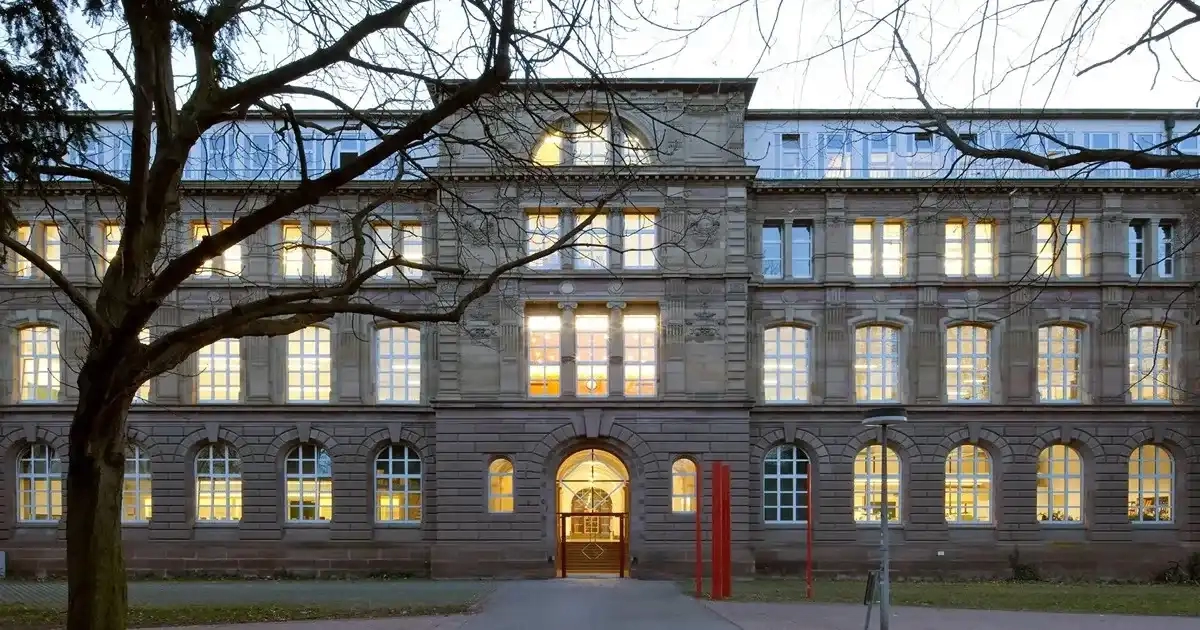
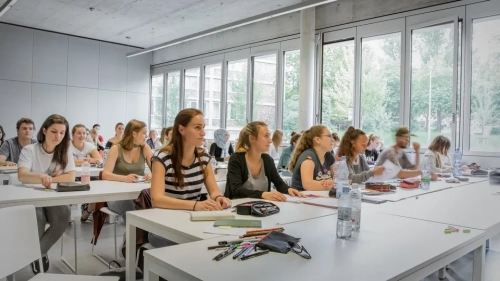
Courses of the study program. They take place in manageable groups. Personal contacts with professors. Advice for prospective students. The school will support you in your studies. The university is known for its close ties to industry and attractive companies.
HFT Stuttgart is located near Stuttgart Central Station and is therefore very easy to reach. Surrounded by packs, cafes and shops, you'll find everything you need within easy walking distance.
Universities of Applied Sciences are successful due to their clear profile of translating scientific results into practice-oriented teaching and applied research. The range of subjects is oriented towards the labor market and is constantly being expanded. The central profile element is its strong practical relevance.
Equipped with the necessary theoretical foundations and the knowledge to implement them in their professional field, graduates are in great demand as young professionals for the economy, nationally and internationally. More than any other type of higher education institution, Universities of Applied Sciences primarily train in engineering subjects.
Admission requirements vary by program. View the requirements on the program page.
Detailed and up-to-date information on the admission requirements, especially on the specific requirements for your Bachelor's degree, language certificates (German and/or English) and deadlines can be found on the pages of the respective Master's programme. Click on the desired degree programme in the table below.
The selection criteria are regulated in the admission or selection regulations.
Admission requirements vary by program and course. View the program page for course specific requirement.
Detailed and up-to-date information on the admission requirements, especially on the specific requirements for your Bachelor's degree, language certificates (German and/or English) and deadlines can be found on the pages of the respective Master's programme. Click on the desired degree programme in the table below.
The selection criteria are regulated in the admission or selection regulations.
*see overview list and course of studies, if required
UNDERGRADUATE:
Apply directly on our HFT application portal
POSTGRADUATE:
The application procedure is online for almost all degree programs. HFT application portal
Email: [email protected]
Phone : +49 (0)711 8926 -2662
2017-2020 President and Managing Director of SRH University of Applied Sciences, Heidelberg
2001-2007 Professor of Business Administration and Controlling at Baden-Wuerttemberg Cooperative State University (DHBW)
2000-2001 Project Manager at Sustainable Business I... read more
2000-2004 Doctoral Thesis at Technical University (TU)-Berlin.
since 2022 Member of Baden-Württemberg Center of Applied Research (BW-CAR)
since 2020 Member of the expert commission Technology; Baden-W... read more
2018 Visiting Professor, University of New Brunswick (Transportation Group), Fredericton, NB, Canada
2019 - 2023 Scientific Director of the Institute for Applied Research at HFT Stuttgart
2017 - 2023 Spokesman Research Prior... read more
1900
Extensions
After the number of pupils had increased to 800, the school building was extended under the direction of Karl Walter (1834 - 1906), Egle's successor, by adding side wings in the neo-renaissance style of the old building. Thus the formal unity was preserved.
1924
Renaming to Staatliche Höhere Bauschule Stuttgart
Run as Württembergische Baugewerkeschule since 1918, the name changed again in 1924. One year later, due to the increased demands on general education, the secondary school leaving certificate was introduced as an entrance requirement.
1963
Joseph-von-Egle-Heim
With 99 beds for students, the association "Freunde der Hochschule für Technik Stuttgart e.V." was able to hand over the Joseph-von-Egle-Heim as a residence close to the university.
1968
Student unrest
The following years were marked by student unrest, strikes and demonstrations. As a result of the numerous discussions, it became clear that the decision-making bodies would include a representation of the students and assistants as voting members.
1971
Renamed the Stuttgart University of Applied Sciences
In the course of the development towards ever higher demands on engineering education, the State Building School became the Stuttgart University of Applied Sciences (FHT). Since then, it has been part of the tertiary education sector and, as a public corporation, has the same status as the universities.
The university is growing The faculties of architecture, civil engineering, mathematics, surveying and foundations were established at the FHT. Admission requirements were the Abitur or the Fachhochschulreife. The course of study lasted eight semesters including two practical semesters. The Egle Building, designed in 1870 for 450 students, has since had to accommodate 1,200 students. As this led to unbearable conditions, rooms were rented in neighbouring buildings.
1990
Number of students increases
In the winter semester 1990/91 the number of students rose above the 2,000 mark.
1995
Renaming, new buildings
Due to the new law on universities of applied sciences, the name Fachhochschule für Technik Stuttgart was changed to Fachhochschule Stuttgart - University of Applied Sciences (HFT). The HFT was awarded the building Kienestraße 45. In the so-called Building 4, the faculties of civil engineering as well as basic and building physics were accommodated. The first pavilion in the courtyard, called Block 4, was designed and built by students as part of a cross-degree study project. The wooden construction was financed with donations and is available as a student meeting place.
2010
New image, solar decathlon, 3,000 students
Communication designers developed a new image from the specifications of a university-wide working group in order to clearly express the university's diverse profile. The HFT Stuttgart received a new logo, its own corporate typeface and an exclusive colour system. In the international competition "Solar Decathlon", 20 universities from all over the world competed in Madrid to design and build a residential building powered by solar energy. With the plus energy house "home+", the HFT Stuttgart team achieved third place overall. In the winter semester 2010/11, the number of students exceeded the 3,000 mark for the first time. At the same time, the universities of applied sciences in Baden-Württemberg became universities of applied sciences (HAW). The change of name took into account the increased tasks of the type of university. However, the individual name Hochschule für Technik did not change.
2020
Change of Principal and Chancellor
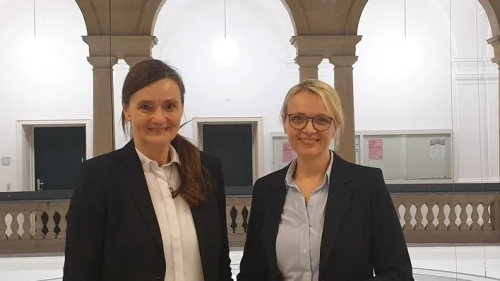
Prof. Rainer Franke retired after 13 years as Principal of the HFT Stuttgart. His successor Prof. Dr. Katja Rade took over the office in the winter semester.
From July 2020 to December 2025, Dr. Doreen Kirmse was Chancellor of HFT Stuttgart.