
Osnabrück University of Applied Sciences is the largest and most successful university of applied sciences in Lower Saxony. With four faculties (Agricultural Sciences and Landscape Architecture, Engineering and Computer Science, Management, Culture and Technology in Lingen, and Business and Social Sciences) and the Institute of Music, the university has campuses in Osnabrück and Lingen.
The university has grown significantly in recent years. Despite this growth, with more than 13,000 students (as of the 2024/25 winter semester) and around 100 degree programs at the bachelor's, master's, and continuing education levels, we have maintained the character of a familiar and personal place of teaching and learning. The university has pioneered many areas of academic education – for example, in establishing new degree programs – and has thus earned a reputation as an innovative and progressive institution.
| Founded | 1971 |
| Location | Osnabrück, Lower Saxony, Germany |
| Address | Osnabrück University of Applied Sciences, Albrechtstr. 30, 49076 Osnabrück, Germany |
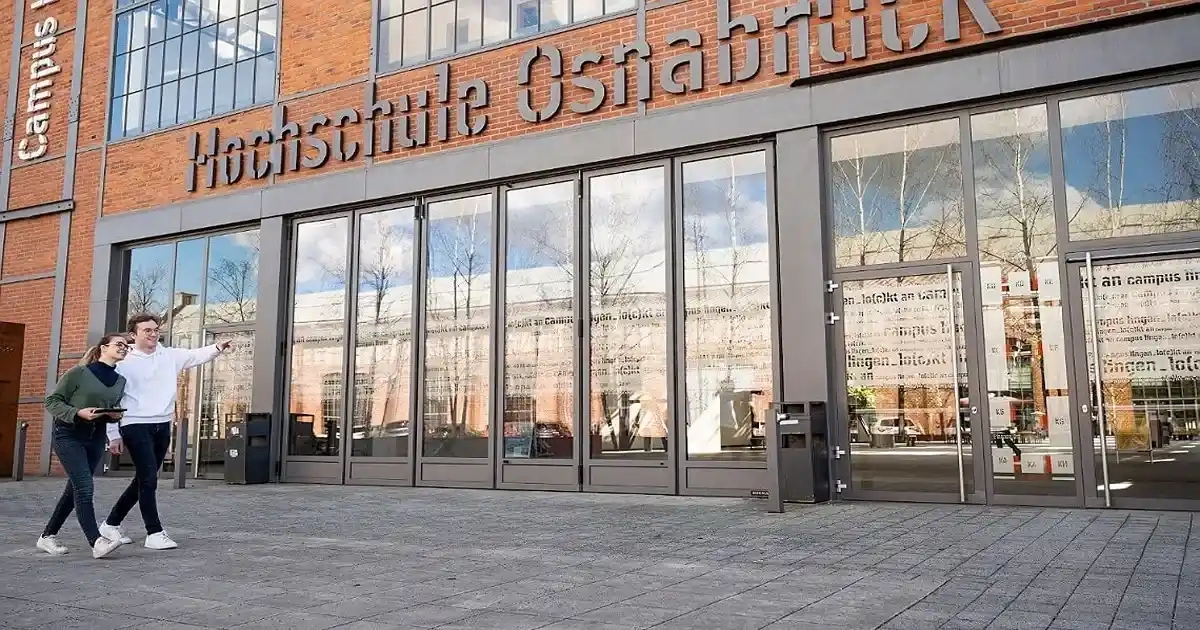
The university, often ranked high for student satisfaction, focuses on merging academic theory with real-world application, including "Future Skills" modules to prepare for upcoming job market needs.
The university boasts 6% international students and partnerships with over 200 universities globally. It offers strong support, including assistance with visas and German language development.
Admission requirements vary by program. View the requirements on the program page.
Whether your higher education entrance qualification is valid for Germany depends on the country and school in which you obtained it.
You can easily have this checked here:
DAAD database or anabin (database in German)
What are my options if my university entrance qualification is not recognized?
For some degree programs, you must prove that you have previously completed an internship in a company. You will need a portfolio for artistic degree courses.
Find out well in advance about any other admission requirements for your desired degree program.
These requirements can be found on the Bachelor's or Master's degree program page you are interested in.
Admission requirements vary by program. View the requirements on the program page.
Whether your higher education entrance qualification is valid for Germany depends on the country and school in which you obtained it.
You can easily have this checked here:
DAAD database or anabin (database in German)
For some degree programs, you must prove that you have previously completed an internship in a company. You will need a portfolio for artistic degree courses.
Find out well in advance about any other admission requirements for your desired degree program.
These requirements can be found on the Bachelor's or Master's degree program page you are interested in.
View the how to apply. If you have completed your school or university degree abroad, you can apply to us via uni-assist. The website has everything you need to know.
Email: [email protected]
Phone : +49 (0)541 969-0


Alexander Schmehmann is a German academic administrator and the president of Hochschule Osnabrück, a major applied sciences university in Lower Saxony. His leadership focuses on strategic institutional development, research innovation, and strengthening ties between academia and regional industry.




Today, four faculties and our Institute of Music together form Osnabrück University of Applied Sciences, with campuses in Osnabrück and Lingen. Their history forms the foundation of the university as it exists today.
We take a look back at the history of all the campuses: How did a former barracks, a women's clinic, a railway repair shop, and a farm become two state-of-the-art universi... read more
We take a look back at the history of all the campuses: How did a former barracks, a women's clinic, a railway repair shop, and a farm become two state-of-the-art university campuses in Osnabrück and Lingen, with over 14,000 students and 1,300 employees? What were the milestones in the university's development at each campus? And how do contemporary witnesses remember their time at the university in the 1970s, 80s, 90s, and 2000s?
Osnabrück University of Applied Sciences has developed significantly in recent decades. This section lists some events that have contributed to the university's high reputation beyond the region. While not exhaustive, this list provides an insight into the dynamics at the Osnabrück and Lingen campuses. Those interested in historical information will find many more resources on the university archive's website .
1995 to 2000: Osnabrück University of Applied Sciences is one of the model universities in the "Model project for testing the global management of university budgets in Lower Saxony."
2014: The Osnabrück Innovation Center (ICO) is inaugurated. It is located on the grounds of the former Scharnhorst barracks, not far from the Westerberg campus. Several start-ups work closely here with scientists from Osnabrück's universities.
More than 15,000 visitors flock to the Osnabrück University terrace festival over three days . Organized by students, the event has been running since the mid-1970s and has become Northern Germany's largest student festival.
2015: The new library building on the Westerberg campus is opened on Barbarastraße. The central library of Osnabrück University of Applied Sciences and the science/mathematics branch library of Osnabrück University share the 6,800 square meter premises on four floor.