The Humboldt-Universität combines academic excellence with social responsibility. Guided by Humboldt's legacy, it stands for free, independent research, research-based learning and an open exchange of knowledge with society. It offers space for diversity, critical debate and new perspectives – right in the heart of Berlin, with a global network. As a vibrant community, it actively shapes a sustainable, just and knowledge-based future.
| Acronym | HU |
| Colour | Blue |
| Founded | 1810 |
| Location | Berlin, Berlin, Germany |
| Address | Unter den Linden 6, 10117 Berlin, Germany |
In line with our mission statement, we act in a value-based and future-orientated manner: We live, promote, protect and defend freedom, truth, equality, diversity as well as pluralism and democracy - in teaching, research and in our social commitment. Sustainability is a particular concern of ours. We see ourselves as role models in this area and want to set an example.
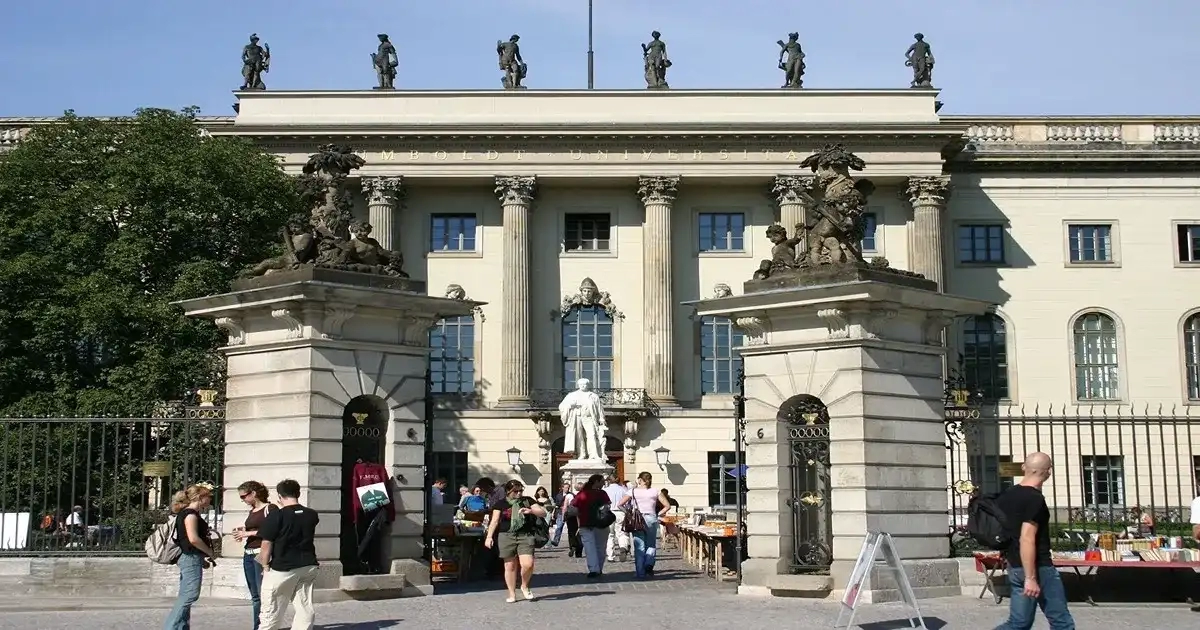
Humboldt-Universität zu Berlin places knowledge at the center of its mission. The university preserves, creates, and shares knowledge through education and research. It views science as a source of innovation and a public good, making knowledge accessible to students, researchers, and society. At HU, education is a fundamental human right and a lifelong journey, offering learning opportunities for people of all ages and professional backgrounds.
Humboldt-Universität zu Berlin places knowledge at the heart of its mission. It preserves, creates, and shares knowledge through education and research. The university sees science as a public good and makes learning accessible to students, researchers, and society. At HU, education is a fundamental right and a lifelong journey for people of all ages.
Humboldt-Universität prepares people for a changing world of work by combining knowledge with values, critical thinking, and social responsibility. Students receive excellent education with strong theoretical foundations, practical knowledge, and interdisciplinary skills. The university’s teaching and research span major fields including humanities, social sciences, law, natural and life sciences, medicine, agriculture, and sustainability.
The Berlin University Alliance is Germany's first and only Consortium of Excellence, funded by the German Research Foundation. Together with Freie Universität Berlin, Technische Universität Berlin and Charité - Universitätsmedizin, Humboldt-Universität pursues the vision of being the core and driving force of Berlin as a leading centre of knowledge and innovation in Europe.
Following the example of our namesake, research and teaching at Humboldt-Universität are directly linked. This explicitly includes early-career researchers who are able to conduct independent research and teaching at an early stage. HU is an excellent research university that achieves top results in many areas in national and international comparisons.
Entry requirements vary by program. View the programme page for entry requirements.
The basic requirement for the application is proof of a:
The degree must have been obtained in fuDepending on the Master's degree programme, there may be additional requirements, e.g:
The specific requirements result from
Email: [email protected]
Phone : +49 30 20 93-46 724


Humboldt-Universität zu Berlin is recognized and affiliated with several major academic and research organizations:
In addition to his activities at HU Berlin, Prof. Pinkwart acts as Scientific Director of the Educational Technology Lab at DFKI Berlin.
Prof. Pinkwart has authored more than 250 peer-reviewed publications and has conducted several research projects with funding from DFG, Federal Government and foundations. He is a regular member of a variety of program committees of scientific conferences and currently acts as associate editor of the International Journal of Artificial Intelligence in Education and as a member of the editorial boards of the Journal of Educational Data Mining.
After initial training in graphic design, she studied design, art, and cultural studies in Zurich, Berlin, and Linz. In 2009, she received her doctorate with a dissertation on the discourse history of design as a culture of knowledge. From 2009 to 2011, she was a research lecturer at the Bern University of the Arts, and from 2011 to 2013, a postdoctoral researcher at the National Centre of Competence in Research (NCCR) for Image Criticism "eikones" at the University of Basel. Research stays took her to the Max Planck Institute for the History of Science in Berlin in 2009 and to MIT in Cambridge, Massachusetts, in 2012. From 2013 to 2021, she held a professorship in design theory and research at the Basel School of Design and Art FHNW. There, she headed the Institute for Experimental Design and Media Cultures and the Critical Media Lab, which she founded.




The "University of Berlin", undisputedly prominent worldwide, criticised and praised from the outside and inside at the same time, has its own history. Opened in the winter semester of 1810, from 1828 called "Königlich... read more
In the 20th century, this foundation was exaggerated to become the "Humboldt model" by attributing structures and effects to it that did not apply to Berlin at all. Contrary to what his "myth" says, Humboldt did not establish the university as a purposeless institution, far removed from the state and society, academic professions and economic importance, autonomous in all dimensions. Rather, he praised its benefits for Prussia's glory and economic well-being to the king, enforced strict examinations to protect the state from mediocre qualifications, and reserved the right of appointment to the state, for example, because he was sceptical of the professors' self-interest. In addition, the university successfully sought links with the city's culture and major industry, early on and then continuously. The international impact, never as a copy, always locally moulded, can also be said to be more in favour of the German model of the university than exclusively for the "Humboldtian" one. But however differentiated the impact was, the research imperative prevailed, as did the clear distinction between technical colleges and universities or the integration of the natural sciences. With the practice of its disciplines, the University of Berlin truly became a model.
This situation came to an end in 1990. Initiated from within by students and teaching staff, the university only found its own form after lengthy, conflict-ridden processes with the state of Berlin, internally in the new committees and with newly appointed players. In the 1990s, it was reorganised in the name of its innovative tradition and the liberalism associated with the Humboldt brothers, with a disciplinary basis in research and teaching, open to interdisciplinarity. The freedom of research and teaching was re-established in law, the relationship with the state was also stabilised economically in contractual regulations, the university's ability to act and innovate was secured with the presidential constitution, all members of the university were involved in its self-administration, and a self-image in the spirit of legitimate traditions was adopted. The success in the Excellence Initiative, symbolised in the Humboldtian slogan "Education through Science", has shown worldwide since 2012 that it is once again the practice of the disciplines, the teaching staff and the students, in which the "University of Berlin" shows its real strength.