
Leuphana University Lüneburg was founded on the specific legal mandate of the Lower Saxony State Parliament to rethink the university and create a model university for the Bologna Process. It is supported by a public foundation and sees itself as a place for the free pursuit of knowledge, ingenuity, personal development, and social engagement. For its degree programs, it has developed a multi-award-winning study model with three schools, which remains unique in Germany. Five faculties represent Leuphana's research priorities in the fields of education, culture, sustainability, management and entrepreneurship, and political science.
| Nickname | Leuphana |
| Mascot | Humanism, Sustainability, Application/Action orientation |
| Founded | 1946 |
| Location | Lüneburg, Lower Saxony, Germany |
| Address | Leuphana University of Lüneburg, Universitätsallee 1, 21335 Lüneburg |
Leuphana University of Lüneburg bases its development on a comprehensive educational and research concept. It sees itself as
HUMANISTIC UNIVERSITY
In its understanding of education, Leuphana combines personality development and professional training and places the process of acquiring knowledge in concrete contexts.
Against this background, Leuphana understands the basic idea in the long tradition of humanism to be that man has the freedom to form his own character. This freedom to self-determination takes the university members of Leuphana into responsibility and requires a constant willingness to learn.
In order to promote this responsibility as well as self-determined learning processes in their studies, one third of the studies at the College and one quarter of the studies at the Graduate School consist of a special core curriculum: the Leuphana semester (at the College) and the complementary studies. In addition, Leuphana's doctoral programs are also specifically designed to stimulate reflection on academic self-understanding.
In research, digitality, cultures of criticism, democracy research, entrepreneurship, sustainability and diversity are important focal points on the fundamental question of freedom and responsibility.
For academic life on campus, we strive to create an atmosphere that is inspiring through lived diversity and mutual appreciation.
SUSTAINABLE UNIVERSITY
Leuphana contributes to the sustainable development of society through education and research. It contributes to the promotion of skills in dealing with complexity, interdisciplinary problem solving, independent and self-directed learning, the willingness and ability to assume social responsibility, in short: the ability to shape society.
Against this background, sustainability is a holistic and continuous challenge for Leuphana. Leuphana has the first and so far only school for sustainability in Europe and an exemplary sustainable campus. Along the way, Leuphana has been EMAS-certified since 2000, awarded the title of family-friendly university in 2010 and Fairtrade University in 2016, and was nominated for the German Sustainability Award in 2017. The university uses 100 percent green electricity, is supplied with regenerative heat, has installed photovoltaic systems on ten buildings and has been climate neutral since 2014.
ENTREPRENEURIAL UNIVERSITY
Leuphana educates responsible and entrepreneurial personalities who possess creativity, reflexivity as well as the will and skills to creatively shape society. It makes an important contribution to solving societal problems through research, studies, further education and scientific services.
Against this background, Leuphana understands entrepreneurship as the recognition of opportunities as well as the courage and ability to act independently in the public interest. From the first semester onwards, Leuphana students are therefore challenged to work on practical projects on their own responsibility, especially during a opening week and a conference week. In research, all schools attach particular importance to transdisciplinary research approaches in order not only to explore the framework conditions for concrete social effectiveness, but also to test them in practice.
Leuphana offers its students and alumni start-up advice, scholarships, networks and support in the development and implementation of their projects. The Social Change Hub specifically promotes social-social entrepreneurial commitment. As a result, Leuphana has been one of the most start-up-friendly universities in Germany for many years. Many of these young companies are committed to sustainability.
Leuphana is an innovation university with a keen sense for the major transformations of our time. Its striving for renewal and its high innovative capacity are founded in its eventful history and in its dynamic development since the realignment (2006/2007). This is also reflected in the diverse educational and teaching innovations that it regularly produces.
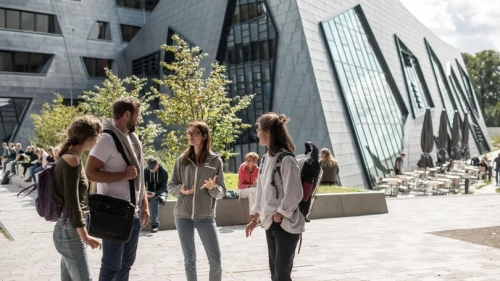
Leuphana is a modern campus university with an international orientation. It offers attractive research conditions for international scientists and scholars and is popular with international students from all over the world for its diverse English-language study programs, its personal study atmosphere and its lively campus.
Equality and diversity are core values of Leuphana University. On the basis of participation and committee processes, these values have been anchored in several concepts, guidelines and directives and are lived out in daily interaction.
Sustainability is a principle that the university practises at all levels, is anchored in its mission statement and is specified in its Sustainability Strategy 2030. Leuphana sees itself as a sustainable university in all areas, from research and teaching to transfer activities and collaborations to campus development and infrastructure.
Entry requirements vary by program. View the program page for requirements.
The admission requirements are the basis for a successful application to the Leuphana Graduate School. In order to apply for a Master's programme at Leuphana, the following admission requirements must be met:
Entry requirements vary by program. View the program page for requirements.
Email: [email protected]
Phone : +49.4131.677-2277

Leuphana University Lüneburg has been system accredited since 2014 and conducts the accreditation of its study programmes under its own responsibility. With the award of the Quality Seal, Leuphana confirms that a study programme meets the criteria of the Lower Saxony Study Accreditation Ordinance (Nds. StudAkkVO) and that this has been verified in a procedure by external experts (programme Advisory Board). In accordance with the guidelines for quality reports (Drs. AR 85/2019), the accreditation report includes the audit process, a short profile of the programme, the names of the experts, the evaluation of the programme by the programme Advisory Board and the agreed measures for the further development of the programme.
Leuphana University of Lüneburg holds institutional accreditation in Germany and is recognized for its program-level accreditations by agencies such as FIBAA and ACQUIN. These accreditations confirm that its Bachelor and Master programs meet high-quality standards.
Sascha Spoun is a German-Swiss economist and President of Leuphana University Lüneburg, a position he has held since 2006. His work focuses on higher education management, institutional reform, and innovative university models. He previously taught at the University of St.




1946: Foundation of a College of Education (PH) in Lüneburg on the initiative of the British. The university was to help establish a new democratic tradition in Germany by training teachers.
1971: Foundation of the University of Applied Sciences Northeast Lower Saxony (FH NON) as successor institution of the State Academy of Engineering for Water Management and Cultural Technology in Suderburg and the State Academy of Engineering for Civil Enginee... read more
1980s: In the 1980s, the subject spectrum is expanded to include economics, social sciences and cultural studies. In 1989, the former Hochschule Lüneburg becomes a university by resolution of the Lower Saxony state parliament.
1990s: In the 1990s, the subject spectrum is expanded to include environmental sciences. In 1997, the university moves from its previous location in Rotes Feld to the former Scharnhorst Barracks of the German Armed Forces, today's central campus, as part of a conversion project that attracts nationwide attention.
2003: As one of the first five universities in Germany, the University of Lüneburg is converted into a foundation under public law. It thus gains extended possibilities for independent action, among other things through an independent right of appointment, through independent building ownership and through independent job and financial planning.
2005: By law of the Lower Saxony State Parliament, the University of Lüneburg merges with the University of Applied Sciences Northeast Lower Saxony and receives the mandate to develop a model university for the Bologna Process. On the one hand, this leads to an expansion of the subject spectrum of the respective predecessor institutions: From the point of view of the former university, by engineering, business law and business psychology; from the point of view of the former university of applied sciences, by teacher training, cultural studies, economics and social sciences, and environmental sciences. On the other hand, due to subject overlaps, the merger also leads to cutbacks, especially in business administration and social pedagogy. The new university is initially organized into three faculties (Faculty I: Educational and Cultural Sciences, Faculty II: Economics and Social Sciences, Faculty III: Environmental, Natural and Technical Sciences) and four locations (Scharnhorststraße Campus, Rotes Feld Campus, Volgershall Campus, Suderburg Campus).
2006: In implementation of the state mandate to develop a model university, the University of Lüneburg begins a comprehensive reorientation. It develops a university model that is unique in Germany to date, with a college for bachelor's studies, a graduate school for master's and doctoral studies, and a professional school for continuing education and lifelong learning.
2007: As a result of its realignment, the university gives itself a new name as Leuphana University of Lüneburg and implements its new study and university model. Leuphana College for undergraduate students begins operations with a new type of study model and initially 10 major and 27 minor degree programs, as well as 3 degree programs with a teaching option and 12 teaching subjects. The Leuphana Professional School for continuing education students starts with initially 7 master's degree programs. The Leuphana Graduate School for master's and doctoral students follows a year later with an initial 8 master's degree programs.
2009: With the Innovation Incubator Lüneburg, Leuphana launches a major EU project with a volume of around EUR 98 million as a contribution to the development of the Lüneburg region. Among other things, international competence tandems for the development of new research focuses, joint projects for the promotion of practical cooperation, company start-ups and settlements as well as new continuing education courses and study offers strengthen the knowledge base of the region. Also in 2009, the Suderburg campus with engineering courses in soil and hydraulic engineering is transferred to the Wolfenbüttel University of Applied Sciences, now Ostfalia University of Applied Sciences.
2010: The university reorganizes its faculties again and establishes the four faculties of education, culture, sustainability and economics that exist today.
2013: The DFG Research Training Group "Media Cultures of Computer Simulation" (MECS) begins its work.
2016: The DFG Research Training Group "Cultures of Critique" - the first DFG-funded research training group at Leuphana - begins its work. Using specific cases of art, media, and social criticism, the Kolleg examines the connection between criticism and culture in the history of modernity up to the present.
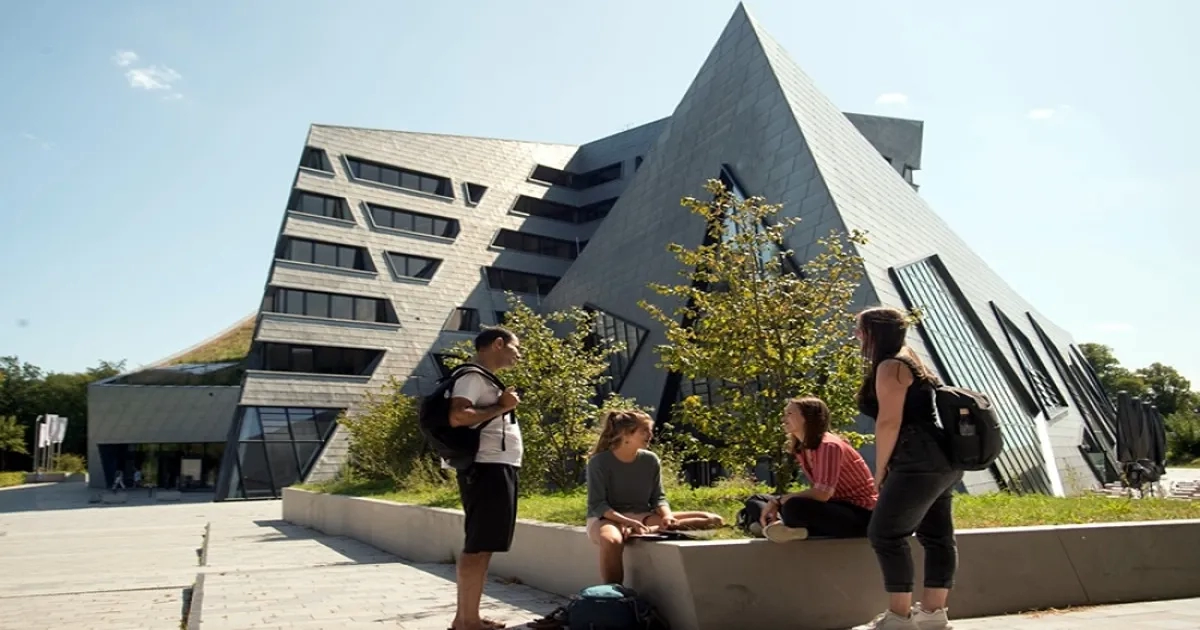
2017: Leuphana's new central building, designed by Daniel Libeskind, opens.
2018: The first Utopia Conference takes place in the new central building.
2019: Together with the University of Glasgow, Leuphana founds the European Centre for Advanced Studies (ECAS).
2020: While many German universities postpone the start of lectures for the summer semester due to the Corona crisis, Leuphana manages to start the lecture period digitally on time with more than 90 percent of its approximately 1,600 planned courses, because it created the necessary technical as well as didactic prerequisites for digitally supported courses at an early stage.
2022: The university establishes the Faculty of Public Affairs. This fifth and youngest faculty carries a profile that is new in Germany and addresses the major transformations of our time in its research.
2023: Funded by the "Niedersächsisches Vorab" of the Volkswagen Foundation, Leuphana establishes the Leuphana Institute for Advanced Studies (LIAS) in Culture and Society. Over the next five years, it will offer international scientists the opportunity to conduct basic research in the social and cultural sciences at the highest level.