Ludwig-Maximilians-Universität München is a leading research university in Europe. Since its founding in 1472 it has been committed to the highest international standards of excellence in research and teaching.
| Acronym | LMU |
| Motto / Slogan | Spotlight on excellence |
| Colour | Green and White |
| Founded | 1472 |
| Location | Munich, Bavaria, Germany |
| Address | Geschwister-Scholl-Platz 1, 80539 München, Germany |
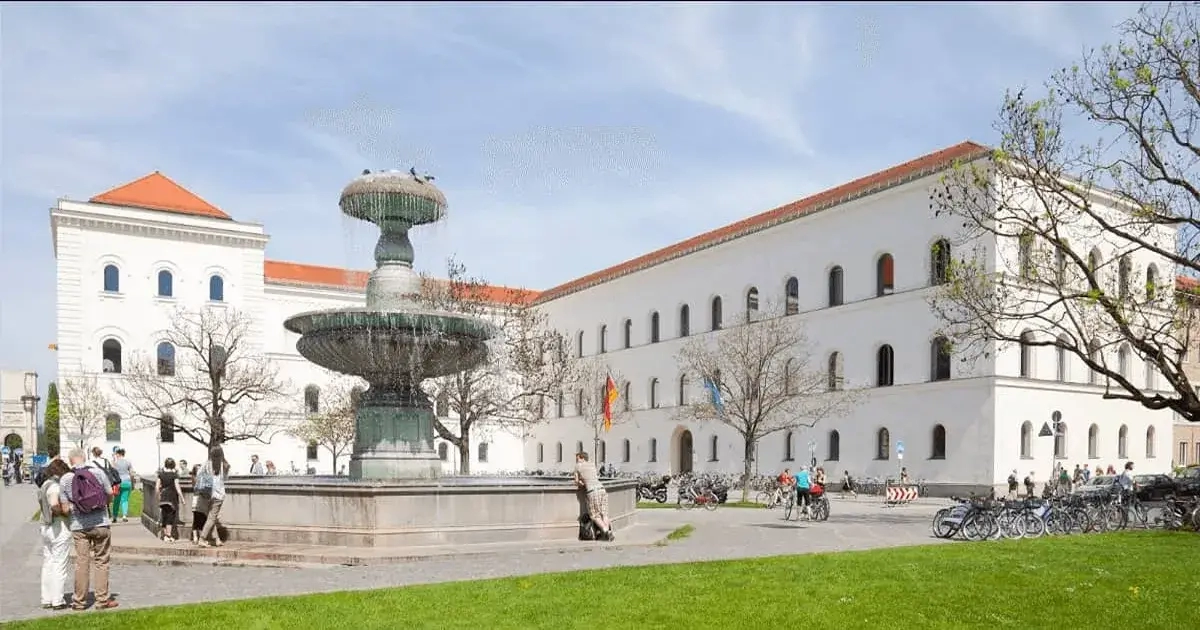
At LMU, researchers from all over the world encounter excellent conditions for their work — in their own research field and in interdisciplinary networks alike.
LMU offers state-of-the-art research infrastructure, an outstanding international network, attractive career opportunities and a broad spectrum of continuing personal development programs. In doing so, LMU supports its members in nurturing their talents and helping to shape their working environment.
Ludwig-Maximilians-Universität München consistently ranks among the top universities in Germany and Europe. It has produced numerous Nobel Prize winners and leading researchers, making it a prestigious place to study.
LMU is one of Europe’s leading research institutions, providing students with opportunities to participate in cutting-edge research projects, laboratories, and academic collaborations.
LMU cooperates with universities around the world within the framework of the programs Erasmus+, UK, SEMP, and LMUexchange. If you are interested in becoming a visiting student here, your university must be an LMU partner university. An overview of all LMU partner universities can be found in our database. Your home university is responsible for nominating students for an exchange at LMU. As soon as your home university nominates you, further information on this process can be found in our nomination section - LMU's International Office will send you the information you need to apply.
International Applicants:
1. A university entrance qualification:
The university entrance qualification is a high school leaving certificate which qualifies you to embark on a degree program at a German university. In Germany, this is known as Abitur (German higher education entrance qualification). In general, high school leaving certificates in EU states are deemed equivalent to the German Abitur, and qualify you to begin studying in Germany. If you have an high school leaving certificate from another country, an official assessment will be required to ensure it is equivalent to the German Abitur. In some countries, school leaving certificates do not qualify the holder for university entrance. Sometimes the school leaving certificate can be combined with a one-year course of study in the home country or a different country to reach a level equivalent to that of the German Abitur. Completion of a degree program (six semester degree program) at a German university also qualifies the holder for university entrance.
2. Furnishing evidence of proficiency in German:
The linguistic demands when studying at LMU are high. In order to complete a bachelor's degree or a State Examination degree program, you will first need to pass a recognized German language test.
1. A first academic degree (bachelor’s or equivalent):
2. Furnishing evidence of proficiency in German:
The linguistic demands when studying at LMU are high. In order to complete a master's degree program, you will first need to pass a recognized German language test, unless the program in question is English-speaking.
View the requirements on the admission page.
International Application: In general, international applicants (EU/EEA citizens and non-EU/EEA citizens) apply and register via the International Office. In some cases, applications are submitted via the Office of the University Registrar or the central SfH (Foundation for University Admissions).
Email: [email protected]
Phone : +49 89 2180-3156, +49 89 2180-3743


With his groundbreaking discoveries – including the identification... read more
As President, he pursues a bold vision for the future: to further strengthen LMU’s role as a globally visible university of excellence – a hub for world-class research, a home for inspiring teaching, and an independent forum for responsible societal discourse. Tschöp sees LMU’s unique breadth as a comprehensive university as a decisive strength. Such diversity enables bridges across disciplines – from natural and life sciences to the humanities and social sciences – opening new perspectives and creative solutions to the complex challenges of our time. Emerging technologies such as artificial intelligence will not only be actively employed at LMU, but also critically advanced and rigorously reflected upon.
A trained science journalist with a background in chemistry, Lugger serves on multiple councils as a science communication expert, including the steering committee of the German Federal Ministry of Research, Technology, and Space’s #FactoryWisskomm initiative and the advisory board of the Bavarian AHA Science Communication Hub. She also contributed to the German Science and Humanities Council’s position paper on science communication.
From 2022 to 2024, Mülke served as spokesperson for the Chancellors of Bavarian Universities and was part of the federal Association of University Chancellors’ spokesperson team. He is also a board member of the Society for Academic Study Preparation and Test Development and represents German universities in the General Assembly of the Heads of University Management & Administration Network in Europe.


Having obtained a Papal brief from Pius II, Duke Ludwig IX (the Wealthy) of Bavaria-Landshut founds the first university in the Bavarian heartlands (Altbayern) in Ingolstadt. The official inauguration took place on 26 June 1472, but the institution (die Hohe Schule zu Ingolstadt) had received its first students in March of that year. As well as the Duke himself, many eminent guests attended the opening ceremony, including the learned counsellor Dr. Martin Mair, who was the principal speaker.
Konrad Celtis (1459–1508) was one of the ... read more
On 15 December 1494, Ludwig IX’s son and successor, Duke Georg the Wealthy of Bavaria-Landshut, set up an endowment to finance the establishment of the Georgianum, a foundation for impoverished theology students at the University, which initially provided fellowships for 11 scholars. The Georgianum was only the second Catholic seminary to be set up in Bavaria. As part of Ingolstadt University, it was later relocated to Landshut, and then moved to Munich in 1826. In November 1841 the College took up residence in a new building designed and built by Friedrich von Gärtner on what is now Professor-Huber-Platz. Over 500 years after its foundation, the Georgianum remains an integral part of the University. Joseph Ratzinger – later to become Pope Benedict XVI – and Father Sebastian Kneipp are among its best known alumni.
The results of the second phase of the Excellence Initiative were revealed in June 2012. LMU emerged as the most successful of the participating universities. All of its proposals – for four Graduate Schools, four Clusters of Excellence and LMUs institutional strategy LMUexcellent – were accepted. The decision not only ensured that funding for the existing Graduate School and three Clusters of Excellence will continue until 2017, it provided for three further Graduate Schools in Systems Biology (Graduate School of Quantitative Biosciences Munich (QBM)), Ancient Societies (Distant Worlds: Munich Graduate School for Ancient Studies) and – in cooperation with the University of Regensburg – Eastern European Studies (Graduate School for East and South East European Studies) and a new Cluster of Excellence in Systems Neurology (Munich Cluster for Systems Neurology (SyNergy).
LMU has been successful in the German Excellence Competitions from the beginning in 2006. For the first time, the Excellence Strategy provides a permanent funding opportunity which offers LMU the possibility to build on its successful strategy and to expand its position as an internationally leading university with the long-term program "LMUexcellent: A New Perspective".