ListOfUni

Universität Bonn (UNI BONN)

North Rhine-Westphalia, Germany
Visit School Website
  • Public Type
  • 31,500 Students
  • 7 Faculties
  • 1818Founded
  • YesAccept Int. Studs
  • YesDistance learning

About

We are one of eleven German Universities of Excellence , the only university with six Clusters of Excellence —eight from January 2026—and have produced more Nobel laureates and Fields Medalists than any other German university in recent decades. For 200 years, our university has been shaped by outstanding personalities from a wide range of disciplines and a research-led approach to education. Here you can get to know us and our values. 


Acronym UNI BONN
Motto / Slogan Excellence in Research and Teaching
Colour Blue, Yellow, and Grey
Founded 1818
Location Bonn, North Rhine-Westphalia, Germany
Address Regina-Pacis-Weg 3, 53113 Bonn, Germany

Mission

In Germany's city of the United Nations and the cradle of our free and democratic state, we continuously strive for excellence in research, teaching, and knowledge transfer. In doing so, we strengthen our position as a leading European university and one of the world's most prestigious academic institutions. We generate and share knowledge, drive technological and societal innovation, and empower our members at all career stages.

A central concern of our mission is the promotion of younger generations: We inspire and support young talents and emerging leaders who play a crucial role in securing our democratic order and shaping a future of progress, prosperity and sustainable transformation in a digital and globally networked world.

Guided by Humboldt's ideal of the unity of research and teaching, and by our conviction that cutting-edge research and teaching are inherently collaborative, we combine disciplinary strength with transdisciplinary collaboration by fostering networks between our scientists and partners locally, regionally, nationally and internationally.

Vision

We make evidence-based scientific contributions that significantly support our modern, complex and changing society in tackling the global challenges of the 21st century.
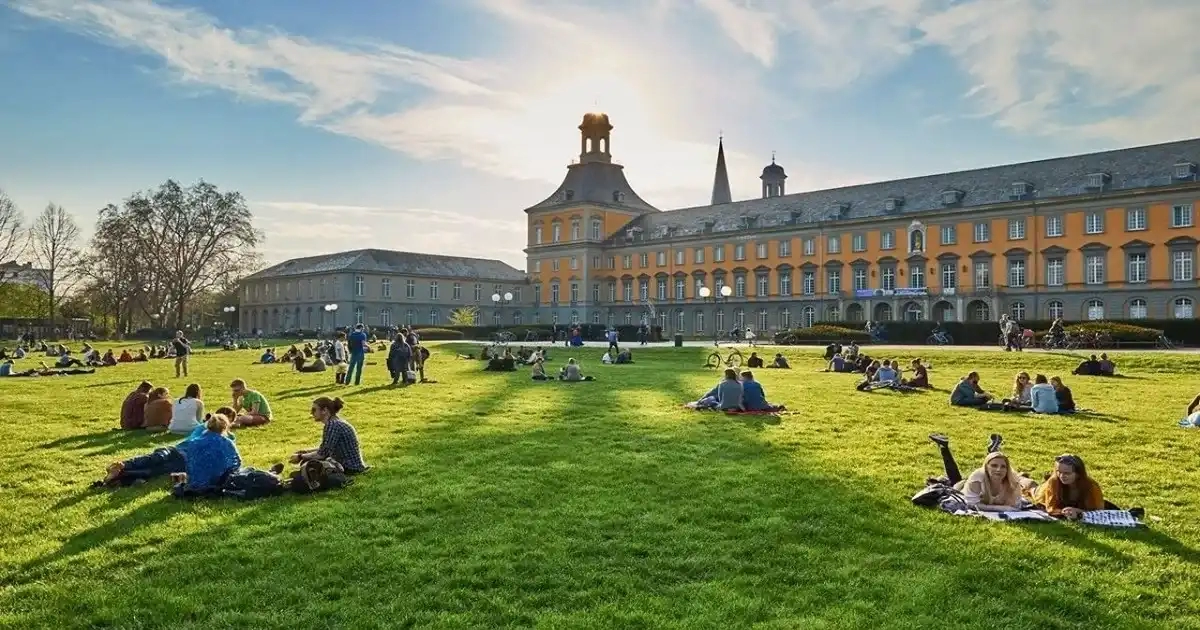


Universität Bonn

Main Academic Divisions (Faculties)

  1. Faculty of Catholic Theology
  2. Faculty of Protestant Theology
  3. Faculty of Law and Economics
  4. Faculty of Medicine
  5. Faculty of Arts (Humanities)
  6. Faculty of Mathematics and Natural Sciences
  7. Faculty of Agriculture

Reasons to Study at Universität Bonn

  1. The Most Successful University of Excellence

    Since the summer of 2019, we have been one of eleven German Universities of Excellence. We are the only German university to have been selected in the Excellence Initiative competition of the federal and state governments.(The "Excellence Strategy," or ExStra for short) has secured funding for eight Clusters of Excellence. This makes us the most successful University of Excellence. Learn more about our plans as a University of Excellence.


  2. International

    Openness to the world and interculturalism shape university-wide interactions, as do our strategic partnerships and networks. With around 5,000 students from over 130 countries, the university also makes a significant contribution to the international flair of the city of Bonn. Our university is also among the most popular host institutions for international guests coming to Germany for research stays.

  3. Excellence

    We are one of eleven German Universities and Universities of Excellence and the only university with six Clusters of Excellence, eight from January 2026. We have also produced more Nobel Prizes and Fields Medals in recent decades than any other German university. 

  4. Learning from World-Class Experts at the University of Bonn

    Studying at the University of Bonn means learning from the best: In our more than 200 (partial) degree programs, internationally renowned experts teach at the cutting edge of science. Our wide range of subjects gives students the opportunity to develop an interdisciplinary focus early on.


  5. Where Innovation Meets Academic Excellence

    At the same time, a network with partners on five continents enables students to study in international contexts and fosters intercultural dialogue. Our students learn to develop their own questions, ideas, and solutions and to represent them in academic discourse. In this way, we prepare them to successfully meet and shape the dynamically changing professional challenges of the modern knowledge society.


Admission

Undergraduate Admission Requirement

  • Check whether your university entrance qualification is sufficient for your chosen degree program at the University of Bonn by visiting the following website:  www.anabin.kmk.org or the database on admission requirements of the DAAD 
  • German language proficiency DSH level 2, CEFR level C1, as per DSH examination regulations.    
  • A few degree programs also require an aptitude test.


International Students:

View the international students page for entry requirements.


Postgraduate Admission Requirments

There are specific enrollment conditions for each master’s degree program that applicants need to meet in addition to holding a relevant first degree. These conditions are listed in the description of the corresponding academic discipline on the page for the degree program: Degree programs

How To Apply For Admission


Applicants from non-EU/EEA countries may need to do some paperwork in their home country before they are able to send us relevant documentation. The following website sets out in detail what you need to do:

Website for applicants from non-EU/EEA countries


Admission Contacts

Email: [email protected]
Phone : +49 228 73-3915

Apply For Admission

Campus Tour

Facilities

  • Classrooms
  • Library
  • Laboratory
  • Research Center
  • Accommodation
  • Hospital
  • Sports
  • Gym
  • ICT
  • Cafeteria
  • Sports: The university sports program at the University of Bonn, with its cost-effective range of sport-specific courses, health-oriented courses, fitness courses, free sports activities and a university-owned health training center, primarily pursues goals geared towards broad and recreational sports.


  • Library: Bonn boasts numerous libraries with large and sometimes highly specialized collections, all open to the public. A shared, parallel search across the holdings of participating institutions can be found on the cooperative platform.


  • Cafeteria: Here you will find all our locations near your institutes and university at a glance. The Bonn Student Union's university catering service operates a total of 13 catering establishments in Bonn, Sankt Augustin, and Rheinbach. These include five cafeterias and eight cafés. We offer students and staff at the University of Bonn and the Bonn-Rhein-Sieg University of Applied Sciences balanced meals in the cafeterias and fresh snacks in the cafés. Our work focuses on balance, variety, diversity, and consistent quality, combined with good value for money. We also prioritize sustainability and incorporate current nutritional trends.
     

School Contact

Address

Regina-Pacis-Weg 3, 53113 Bonn, Germany

Phone Number

+49 228 73-0

Website Address

https://www.uni-bonn.de/de

Social Media Pages

Accreditations

  • The University of Bonn has launched a dedicated system accreditation project to develop and test out its internal, closed-loop quality management (QM) system. The QM system is expected to share the same values and standards as the University’s mission statement for teaching, which is already reflected in the curricula for its various degree programs. The system is geared toward continuous improvements in study quality and is underpinned on several levels by a closed control loop (“plan, do, check, act,” or PDCA cycle) for continuous quality improvement. This loop provides basic guidance by identifying various stakeholders and formats and specifying (minimum) cycles for activities at the various levels.


  • The University of Bonn’s study programs are accredited under Germany’s national quality assurance system supervised by the German Accreditation Council, ensuring that its academic programs meet national higher-education standards.

Vice Chancellor

Prof. Dr. Dr. hc Michael Hoch

  • Prof. Dr. Dr. h.c. Michael Hoch has been the 143rd Rector of the University of Bonn since May 2015.
  • The Rector is the head of the University of Bonn. He acts as its representative and ensures that University rules are observed.
  • He is responsible for defining the University’s strategic objectives (e.g., Excellence Strategy) and coordinating their implementation. He is... read more
    also responsible for the area of knowledge transfer.
  • The Rector is assisted by the Rectorate’s Executive Management.

2024: Re-elected as Rector 

2020: Re-elected as Rector

  • 2019: Under his leadership, the University of Bonn became the most successful institution in the German Excellence Strategy (6 Clusters of Excellence and title University of Excellence)

2019: “University Manager of the Year 2019” (CHE and DIE ZEIT)

2015: Elected as Rector of the University of Bonn

Academic Staff

  • Holger Gottschalk

    Rector Holger Gottschalk has headed the University Administration since 2017. Qualified in business administration, his main responsibilities include budget management, human resources and legal matters, and... read more
    construction and property management. The University Administration consists of nine divisions. A further six units and the Appointment Management and Onboarding team also report to the Provost.


  • Dr. Birgit Ulrike Münch

    Vice Rectorate for International Affairs Professor Dr. Birgit Ulrike Münch is the Vice Rector for International Affairs. Her area of responsibility includes cooperation with universities, research institutions and research networks worldwid... read more
    e, the University’s integration into the European research landscape and the international organizations and institutions based in the region, in particular the United Nations in the UN city of Bonn.


  • Dr. Ilona Grunwald

    Vice Rectorate for Research and Career Development As Vice Rector for Research at the University of Bonn, Ilona Grunwald oversees research and the affairs of early-career scientists. Her responsibilities as Vice Rector include implementing the measure... read more
    s of the Excellence Strategy, quality assurance in research, the provision and optimization of research infrastructure, the promotion and expansion of interdisciplinary research networks, cross-university collaboration in the context of TRAs as well as the cooperation with research institutions outside the University. Another important focus is the promotion of young scientists and the development of sustainable scientific career paths.


View More Staff

Notable Alumni

View More Alumni

History

The university's forerunner was the Kurkölnische Akademie Bonn (English: 'Academy of the Prince-elector of Cologne') which was founded in 1777 by Maximilian Frederick of Königsegg-Rothenfels (who was also one of the first employers of Beethoven), the prince-elector of Cologne. In the spirit of the Enlightenment the new academy was nonsectarian. The academy had schools for theology, law, pharmacy and general studies. In 1784 Emperor Joseph II granted the academy the right to award academic degrees (Licentiat and Ph.D.), turning the academy into a university. The academy was closed in 1798 after the left bank of the Rhine was occupied by France during the French Revolutionary Wars.

The... read more

Rhineland became a part of Prussia in 1815 as a result of the Congress of Vienna. King Frederick William III of Prussia thereafter decreed the establishment of a new university in the new province (German: den aus Landesväterlicher Fürsorge für ihr Bestes gefaßten Entschluß, in Unsern Rheinlanden eine Universität zu errichten) on 18 October 1818. At this time there was no university in the Rhineland, as all three universities that existed until the end of the 18th century were closed as a result of the French occupation. The Kurkölnische Akademie Bonn was one of these three universities. The other two were the Roman Catholic University of Cologne and the Protestant University of Duisburg.