Today, we are one of the most successful young universities in Germany. The University of Bayreuth is ranked 38th out of the world's top 673 universities younger than 50 in the 'Times Higher Education (THE) Young University Ranking 2024'.
Interdisciplinary research and teaching is the main feature of our more than 186 degree programmes offered at seven faculties in the natural sciences, food sciences, engineering, law and economics, as well as language, literature and cultural studies. The University of Bayreuth has about 12,000 students, 1,639 academic staff (281 of them professors) and 1013 non-academic employees on the campus in Bayreuth and at satellite campus in Kulmbach. This makes it one of the largest employers in the region.
Moreover, the University of Bayreuth is making its mark with research: the Africa Multiple Cluster of Excellence conducts cutting-edge research at an international level, the excellence of the Bavarian Research Institute of Experimental Geochemistry & Geophysics – BGI is recognised worldwide, and polymer and colloid research is an innovation driver of future-oriented materials. And so, it is not surprising that the University has raised more than € 56 million in third-party funding in 2020 – making up a quarter of its annual budget.
But the University of Bayreuth aspires to be more than just a university. And so, we consider it indispensable to constantly improve and to examine each classic field of action, to see whether and how it can adequately address the four questions of our time – internationalization, digitalization, equal opportunities and diversity, and sustainability. We therefore consciously perceive these areas as cross-cutting issues honing our profile in a new dimension.
| Motto / Slogan | Ordo et Claritas (Order and brightness) |
| Colour | Green and White |
| Founded | 1975 |
| Departments | 3 |
| Location | Bayreuth, Bavaria, Germany |
| Address | University of Bayreuth Universitätsstraße 30 95447 Bayreuth Germany |
The green campus of the University of Bayreuth is a meeting place of people and ideas where academic life is more varied and personal than it is at Germany's large universities. Top-notch research, state-of-the-art teaching methods, international influences, diversity, and a springboard to a successful career – these are all things the University of Bayreuth stands for. In truth, many universities fit this description. However, the University of Bayreuth really is much more than that!
The University of Bayreuth stands for the qualitatively excellent teaching and comprehensive education of our students. Our goal is to enable graduates to act independently, responsibly and successfully in their subject and the world of work, but also beyond.
In achieving this goal, the following principles are decisive for us:
A place for creative thinking. Our campus gives you space to think. We provide lecturers, students, and staff with the freedom to reach their full potential. We recruit the best and brightest to come to Bayreuth, resulting in top research at the highest international standards. We also offer a motivating work environment. We have an equal appreciation for the individual contributions of each person on campus. Our campus hosts activities that are open to the public and which are meaningful beyond the domains of research and teaching. The creative culture of diversity in thinking and acting that prevails on campus leaves a lasting impression.
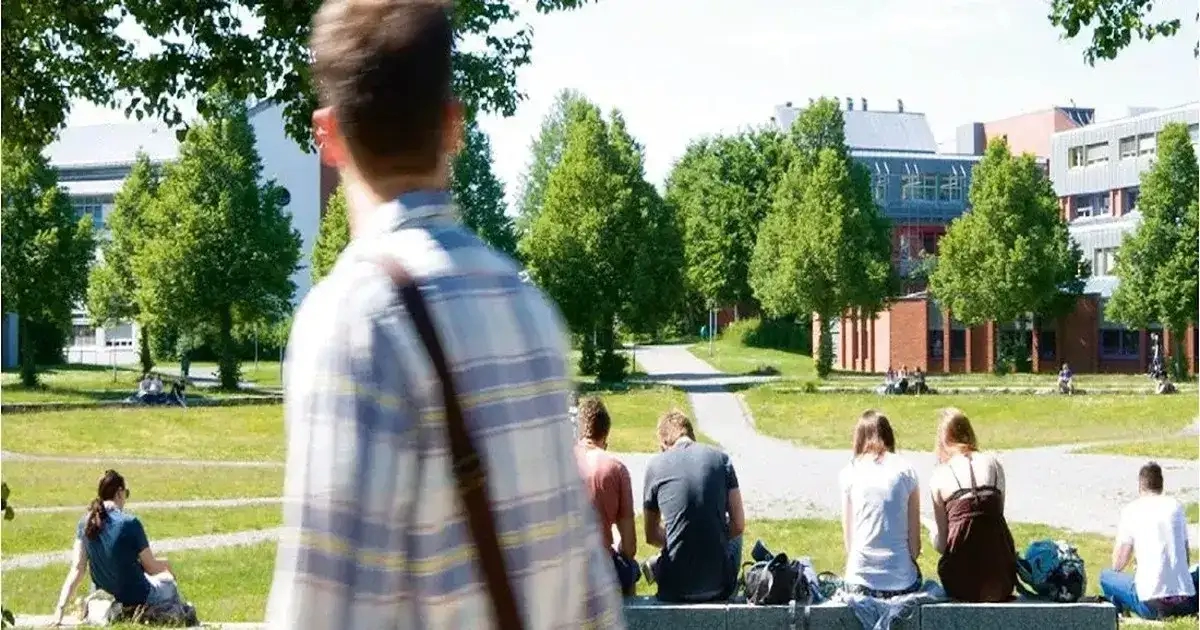
It is the heart and soul of the University, and a perpetual source of inspiration. It is where friendships are made, collaboration is initiated, and ideas are conceived. And scholarly exchange profits tremendously from the wide variety of disciplines our communicative campus in Bayreuth brings together. Whether you came to the University to study, work, or conduct research – there is one point on which we can all agree: You immediately feel at home on campus.
Bayreuth is a charming and cosy student city. With a population of around 75,000, not particularly large, but that is precisely its advantage: You’re always running into someone! The town may be world-famous for its annual opera festival, but it also offers students and researchers a wealth of cultural and artistic attractions, beyond Wagner. It should come as no surprise that the town’s party and pub scene is firmly in the hands of its students.
This small town, picturesquely situated at the foot of Plassenburg Castle and famous for its beer, is home to various research institutes and authorities in the field of food, which are an ideal complement to the seventh faculty of the University of Bayreuth. The gastronomy on offer is correspondingly impressive. But Kulmbach offers more than just culinary delights: the Franconian Forest, for example, invites you to go hiking and cycling, while the Plassenburg Open-Air.
Excellent research thrives where great minds have freedom to think and adventurous spirits find inspiration, like at the University of Bayreuth. The communicative campus here brings together the most diverse disciplines and is enormously productive thanks to the scientific exchange generated. The university is committed to interdisciplinary research and offers tremendous opportunities with its modern research facilities and excellent research infrastructure.
Applicants who do not hold a university degree for a programme conducted in German will be asked to proof language skills at level A1 of the Common European Framework of Reference until the end of the first year of studies.
View the admission requirements on the application and enrollment page.
All applications must be submitted via the online application tool "CampusOnline". Change the language with the 'DE/EN' button (two speech bubbles) in the upper right corner of the CampusOnline homepage and create a basic account first. Afterwards, you can login and begin with the application process.
Email: [email protected],[email protected]
Phone : +49 921 55 5275, +49 (0) 921 55 4666



The University of Bayreuth has passed the system accreditation process, which empowers the university to accredit its own degree programs internally, ensuring they meet the standards of the German Accreditation Council.




On 5 November 1969, the Bayreuth City Council decided to deal with the economic stagnation and the migration trends in north-eastern Bavaria resulting from its location close to the borders with the GDR and Czechoslovakia. Accordingly, various measures were necessary in order to initiate effective structural improvement that would guarantee living conditions equivalent to those in the ... read more
On 19 March 1970, a university association was founded, whose membership quickly grew to 800. Besides Bayreuth, Bamberg, Coburg, Landshut, Passau, and Ingolstadt also applied as locations for a university or college. Members of all parties represented in the Bavarian state parliament, the District Parliament of Upper Franconia and numerous public figures campaigned for the construction of the University. On 16 July 1970, they achieved a Landtag resolution according to which the next Bavarian state university was to be built in Bayreuth. In 1971, the Science Council recommended that the University be included in the measures contained in the Higher Education Construction Promotion Act.
The University was established by the Bavarian Parliament on 1 January 1972 as the seventh Bavarian state university. The site chosen was the former parade ground south of the Kreuzstein and Birken districts. The office of the University of Bayreuth began its activities in 1972, initially in the "Stenohaus" (House of German Shorthand) on Luitpoldplatz, which had been built by the National Socialists. In October 1973, Founding President Klaus Dieter Wolff took office. The laying of the foundation stone followed on 23 March 1974, and on 27 November 1975, Minister of Education Hans Maier opened the University of Bayreuth with a focus on natural sciences with a state ceremony in the Margravial Opera House.
In 1986, the Bayerisches Geoinstitut (Bavarian Geoinstitute) was built, and in May 1987 the Institute for Sports Science and the Central Library were completed. The latter was officially opened in July 1988. This was followed by the Sports Centre (1988), Humanities II (1989, today: GW I), Central University Administration, the Upper Franconia Association for Student Affairs, and the Audimax (all inaugurated in 1994). In addition, the sixth Bayreuth faculty, the Faculty of Applied Natural Sciences (FAN), was established in 1995.
Things also progressed in terms of studies, research, and campus life. The first graduate college in Bavaria was established in 1987 under the name of "Plant-Herbivore Systems". In 1989, the first Women's Representative was appointed, and in 1991 the University's Symphony Orchestra was founded.
In the 1994/95 winter semester, 8,717 students were enrolled at the University of Bayreuth.
The campus continued to grow in the late 1990s/early 2000s. For example, FAN was opened in September 1998, followed by its inauguration in 2000. In April 2001, the Faculty of Cultural Studies moved from Bayreuth's Geschwister-Scholl-Platz to the newly constructed Humanities II building on campus. In October 2004, the laboratory building of the Bayreuth Centre for Colloids and Interfaces was inaugurated.
At the end of the millennium, the University once again considerably raised its profile by extending its research foci to nine and introducing the bachelor's and master's system in the 1999/2000 winter semester as part of the European degree programme reforms (Bologna Process). The University Council held its constituent meeting in November 1998.
In the 2004/05 winter semester, 9,530 students were enrolled at the University of Bayreuth - after the numbers had temporarily dropped to 7,301 around the turn of the millennium.
In December 2006, the Bayreuth Centre for Material Science & Engineering (BayMat) was established, and in April 2007 the Bavarian University Centre for China (BayCHINA). In 2009, construction began on the Law I building (inaugurated: February 2012), and in January 2011 the foundation stone was laid for Natural Sciences III (inaugurated: July 2013). In addition, the Fraunhofer Centre for High Temperature Lightweight Construction (HTL) was built in 2012.
In 2007, a new, now well-established educational format was born: the University for Children, which took place for the first time that summer. In addition, FAN got a new name in 2013: The Faculty of Applied Natural Sciences became the Faculty of Engineering Science.
In 2011, the University of Bayreuth was the focus of media attention throughout Germany in the course of the plagiarism affair surrounding Karl-Theodor zu Guttenberg. On 23 February, the doctoral committee revoked his doctoral degree.
In the 2014/15 winter semester, 13,280 students were enrolled at the University of Bayreuth. There were a total of 147 degree programmes offered at six faculties and taught by 234 professors.
In recent years, the University of Bayreuth has further sharpened its profile and established itself as an internationally networked research institution. Following its anniversary in 2015, the University of Bayreuth expanded its international contacts: In April 2016, the Gateway Office opened on the campus of the Shanghai International Studies University (SISU) in China, in June 2018 the one on the premises of the Australian-German Energy Transition Hub at the University of Melbourne in Australia and in July 2020 the one at the Université de Bordeaux in France. A significant milestone was the establishment of the Africa Multiple Cluster of Excellence, with which the University was successful in the Excellence Strategy of the German federal and state governments in 2019. Interdisciplinary and international research was also further strengthened with the establishment of the Bayreuth Humboldt Centre.
In 2018 and 2019, two Collaborative Research Centers (SFB) received funding from the German Research Foundation (DFG): Since 2018, the SFB 225 “Biofabrication. From the Fundamentals of Biofabrication to Functional Tissue Models” has been funded for a total of four years, and since 2019 the CRC 1357 ”Microplastics. Principles of formation, transport, physico-chemical behavior and biological effects: From model to complex systems as a basis for new solution approaches” also for four years.
A third SFB was added in 2023: The new SFB 1585 “MultiTrans” will receive a total of around 11 million euros from the DFG over the next four years. The interdisciplinary research into nanostructured functional materials aims to revolutionize the performance of batteries, solar cells, fuel cells and photocatalysts, thereby opening up new perspectives for a sustainable energy industry.
The university has also developed structurally: in 2019, the seventh Faculty of Life Sciences was opened in Kulmbach, which is dedicated to the topics of nutrition, health and sustainable development. In addition, the Bavarian Center for Battery Technology (BayBatt) was created as a new research center dedicated to innovative energy storage technologies.
At the same time, important new infrastructures were created on campus: the Technology and Application-oriented Building (TAO) created additional opportunities for knowledge and technology transfer. The construction of the Research Center for Society, Technology and Ecology in Africa (FZA), which will further intensify research and exchange with African partner institutions, was also driven forward in Bayreuth. On April 8, 2024, Bavaria's Minister of Science Markus Blume opened the new NW IV building and the BayBatt Cell Technology Center at the University of Bayreuth. Funded by the High-Tech Agenda, state-of-the-art research facilities have been created on the campus.
In addition to these building and structural developments, a strategic course was also set for the future. In 2021, the University of Bayreuth adopted a comprehensive strategy paper on internationalization and introduced a sustainability strategy, making it one of the first universities in Bavaria to systematically anchor sustainability in research, teaching and administration.
Today, in 2025, the University of Bayreuth is an internationally networked research institution with almost 12,000 students, around 190 degree programs, seven faculties, 281 professors and 1,350 other researchers. In total, there are 2,661 employees who work together to create a future-oriented, sustainable and internationally focused university.