
Around 38,000 students from 130 countries study and conduct research at our university in more than 300 degree programmes, including around 140 teacher training programmes. They shape a lively, diverse campus university that stands for quality, progress, democracy and openness. With over 6,500 employees, we are also one of the largest employers in the region.
Our twelve faculties cover a broad spectrum of subjects, ranging from the humanities, social sciences and education to economics, engineering, natural sciences, computer science and medicine. With more than 500 professors and 13 interdisciplinary research centres, we are strongly positioned in all scientific fields. Our research profile is based on four key areas: biomedical research, nanosciences, water research and the transformation of contemporary societies.
Our research and teaching give rise to innovations with impact – supported by strong transfer structures, digitalisation, start-up support and an active start-up culture, for example in the Bryck Startup Alliance.
We have a strategic partnership with Ruhr University Bochum and Dortmund Technical University under the umbrella of the University Alliance Ruhr (UA Ruhr). We cooperate closely in research and teaching and also have a joint presence on three continents with our own branch offices. In addition, we maintain partnerships with over 100 universities around the world.
| Acronym | UDE |
| Motto / Slogan | Offen im Denken Open-minded |
| Colour | Blue and White |
| Founded | 2003 |
| Location | Essen, North Rhine-Westphalia, Germany |
| Address | Universitätsstraße 2, 45141 Essen, Germany |
The UDE is dedicated to being a sustainable, open-minded institution that serves its community through high-quality research, education, and social commitment. It embraces diversity as a core strength, actively fostering educational equity and equal opportunities.
The vision of the university is to be a top-performing, internationally recognized university that plays a key role in the Ruhr region's development. It seeks to be one of the top young universities globally, promoting academic excellence in all eleven faculties.
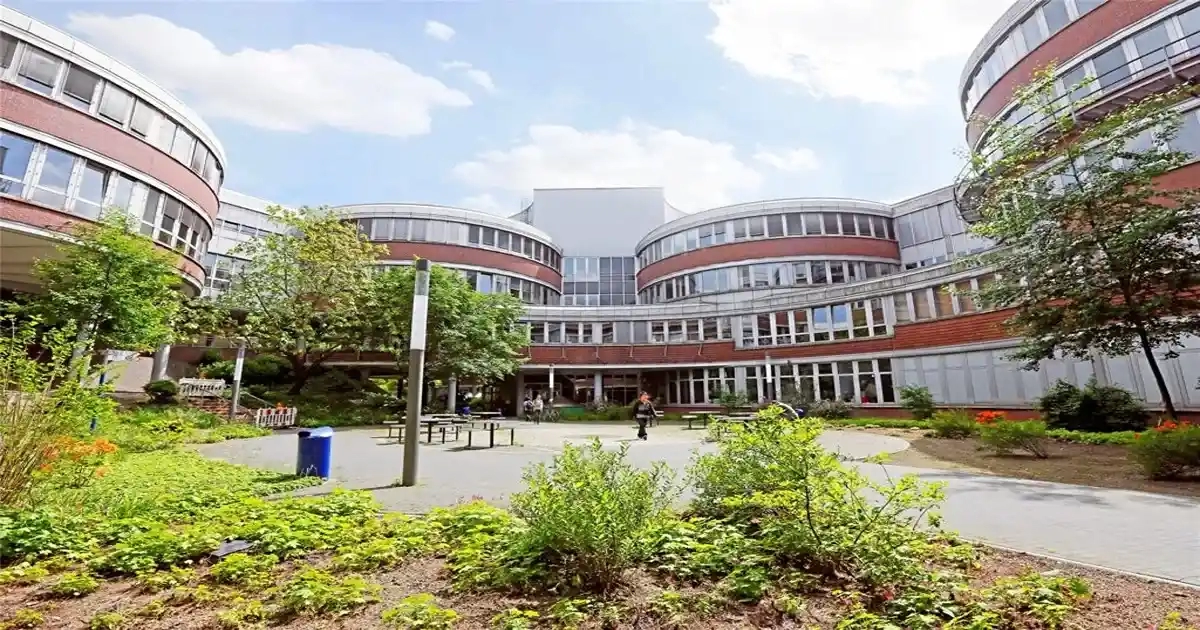
We create scope for excellent science, transfer and promotion of young researchers: In four profile focal points and a wide variety of other research focal points.
We create many perspectives because we embrace educational equity as a task and offer space for heterogeneous potentials and different study strategies.
We promote potential, realize equal opportunities and use the innovative power of diversity management for research and teaching.
Outstanding research, academic education and social relevance characterise us, the University of Duisburg-Essen, as a place of knowledge and individual advancement. Anchored in the heart of the Ruhr region and internationally networked, we combine scientific excellence with a clear commitment to educational equity and sustainability.
Entry requirements vary by course and program. View the requirements on the program page.
General university entrance qualification ("Abitur") or
Language Requirements Bachelor
When enrolling, applicants must prove that they have knowledge of the German and English language according to the completed level B1 of the European Framework of Reference for Languages.
Students must take placement tests immediately at the start of their studies to determine their knowledge of German and English and for placement.
Applicants who have not obtained their study qualification at a German-speaking institution must have demonstrated German language proficiency at level B2 by the time they register for the modules taught in German.
Studying in a Bachelor's program in ISE requires proof of level B2 in both languages as a prerequisite for graduation. The language courses required for this in individual cases are part of the study program.
Language Requirements Master
When enrolling, applicants must prove that they have knowledge of the German and English language according to the completed level B2 of the European Framework of Reference for Languages (CEFR).
English language certificates must be submitted with the application documents. The German language certificates can be submitted later.
UNDERGRADUATE:
Online Application via uni-ASSIST
Applicants who would like to apply for a Bachelor course as a part of the study program International Studies in Engineering (ISE) must first use the application portal of uni-assist.
POSTGRADUATE:
Applicants who would like to apply for a Master course as a part of the study program International Studies in Engineering (ISE) must use the application portal of UDE.
Email: [email protected]
Phone : +49 201 183 4128

2020–2021
Vice President for Research and Early Careers at the Technical University of Darmstadt
Since 2016
Member of a DFG review board for chemistry
2012–2013
President of the German Chemical Society (Gesellschaft Deutscher Chemiker; ... read more
Since 2012
LocosLab GmbH, Bonn (Germany)
Co-founder and CEO
Chancellor University of Duisburg-Essen
2013 until 2024
Chancellor University of Siegen
2010 to 2013
... read moreAdministrative Managing Director of the Helmholtz Centre for Infection Research GmbH Braunschweig.
2018–2022
Scientific Dire... read more
Since 2017
Faculty Council, International Max Planck Research School on the Social and Political Constitution of the Economy
Since 2019
Speaker of the Managing Board of the Gesellschaft für Didaktik der Chemie... read more
Since 2016
Speaker of the Graduiertenkolleg zu querschnittlichen Fragen der Lehrerbildung (GKqL; graduate school for cross-disciplinary issues in teacher training)
2016–2021
Academic Director of the Centre for Teacher Training (ZLB)

Only a few decades later the university was in competition with the much better equipped Dutch universities. Since only about one third of the population in the western provinces of Prussia were member of The Reformed Church, most Lutheran and Catholic citizens in the second half of the 18th century sent their sons to other universities.
The university declined rapidly and was closed on 18 October 1818, due to a Cabinet Order of Friedrich Wilhelm III. At the same time, the University of Bonn was founded. Large parts of the Duisburg University Library were relocated to Bonn and formed the basis of the newly formed Bonn Library. The sceptre of the University of Duisburg was given to the University of Bonn, where it is still located today.
In 1891, the Rheinisch-Westfälische Hüttenschule was relocated from Bochum to Duisburg. Subsequently, the school was transformed into the Königlich-Preußischen Maschinenbau- und Hüttenschule, and in 1938 was renamed to Public School of Engineering.
After a decision of the federal state government in 1960, the teacher training college of Kettwig was settled to Duisburg and was named Pedagogical University Ruhr. In 1968, the university was founded again in Duisburg, related to the old one, bearing the name: Comprehensive University of Duisburg. Initially only small, the university was developed rapidly in the 1970s up to about 15,000 students. In 1972 the Pedagogical University Ruhr and the Public School of Engineering, which was renamed in 1971 to University of applied sciences Duisburg. Other schools were also relocated to Duisburg. The University of Duisburg was then called Comprehensive University of Duisburg. In 1994 the university was renamed Gerhard Mercator University.
In 2003, Gerhard Mercator University merged with the University of Essen to form the University of Duisburg-Essen, which is today one of the largest universities in Germany with about 40,000 students.