
The University of Hildesheim became a university in its own right in 1978 and a Foundation under Public Law in 2003 – one of the first of its kind in Germany. The range of subjects covers study courses in Educational and Social Sciences, Cultural Studies and Aesthetic Communication, Linguistics and Information Science, Mathematics, Natural Sciences, Economics and Computer Science. In cooperation with more than 250 partner schools, Teacher Education students are able to relate basic theory to practical experience from an early stage of their studies onwards. Courses of study like International Communication and Translation, Double Degree programmes as in Culture Management (France) and International Information Engineering (South Korea) contribute to the University’s international profile.
The University of Hildesheim cooperates with more than 180 universities or institutions of tertiary education in about 50 countries and makes more than 400 student exchange places available annually. The University received the European Quality Label in 2007 and again in 2011, the European Language Label 2011 and was the sole German university to be honoured by the European Union for its Erasmus success story in 2010. Students appreciate the compact campus with about 8000 students and over 470 academic staff members in four faculties. There is a very personal atmosphere of learning with first-class tutoring and theory and practice are closely combined, the latter being a guiding principle of the University Foundation.
| Nickname | Uni Hildesheim |
| Founded | 1946 |
| Location | Hildesheim, Lower Saxony, Germany |
| Address | University of Hildesheim, Universitätsplatz 1, 31141 Hildesheim |
The mission is to support students and other members of the University of Hildesheim in shaping a transformation towards a sustainable university.
That's why we are committed to...
» to establish the Green Office as a central institution for sustainability,
» to establish new and practical teaching and learning formats,
» to enable broad participation of all university members,
» To develop and promote measures for a sustainable university life,
» to establish a committee for sustainable development at the University of Hildesheim.
The University of Hildesheim is developing into a real-world laboratory where sustainability is practiced , taught , and researched as a cross-cutting theme . A critical mass of students, as the decision-makers of tomorrow, will play a key role in shaping the University of Hildesheim as a student-run university with a role model character for society.
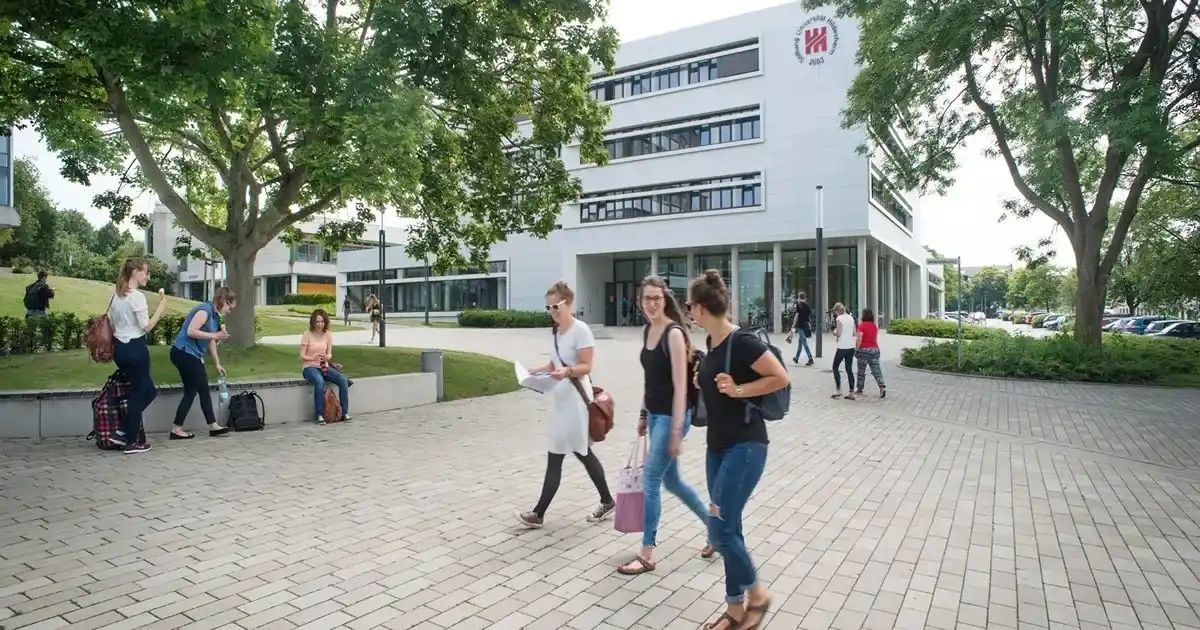
The University of Hildesheim offers study programmes in the academic core areas Educational Studies, Cultural Studies, Linguistics, Natural and Information Studies.
Academic training at the University of Hildesheim is characterized by an especially close connection between theory and practice – the so-called »Hildesheim Model. Students here benefit from the unique networking of the University of Hildesheim with regional, supra-regional, and international partners from science and industry.
If you want to study at the University of Hildesheim, you need a university entrance qualification (HZB). This is a school or university degree that qualifies you for a degree program.
You can find out whether your school or university degree is recognized in the Anabin or uni assist database.
Further information on this topic can be found on the DAAD website. Is
your school or university degree not recognized? Find out more about the Studienkolleg in the next section. You can also learn more about alternative ways of gaining admission to the University of Hildesheim.
Not all foreign university entrance qualifications are recognized as equivalent to the German qualification. You can find out whether your university entrance qualification is equivalent to the German qualification on the DAAD website and at Anabin.
If your university entrance qualification is recognized as equivalent to the German qualification, you can be admitted directly to the degree program, provided there are enough places available.
If your university entrance qualification is not equivalent to the German one, you must take an assessment test to determine your suitability for the intended degree program.
If you have already started studying abroad, uni-assist can only determine whether you meet the requirements for studying in Germany by examining your individual case (however, if you have completed a university degree abroad, you definitely have a university entrance qualification).
Important: If you have already been enrolled at a German university, you must also submit a certificate of good standing. This serves to determine whether you are still eligible to take exams in your desired degree program. The certificate of good standing is issued by the German university where you were previously enrolled.
If you are applying for a master's program, you must already have a degree in an undergraduate program. The undergraduate program must be relevant to the chosen master's program.
For some master's programs, you will also need:
You can find more detailed information on the other requirements in the descriptions of the individual degree programs and in the respective selection regulations. We would be happy to advise you on this.
Please apply via uni assist.
Uni-assist will check your application documents for completeness, evaluate your educational qualifications, and convert your grades. Please upload your application documents directly to the uni-assist online portal. Applications that meet the requirements will be forwarded by uni-assist to the University of Hildesheim.
Create your application in the uni-assist applicant portal.
Checklists, online seminars, and country information will help you with your application.
Email: [email protected]
Phone : +49 5121 - 883 92 010







1945
Establishment of the teacher trai... read more
1962
Following the Sputnik shock, teacher training was professionalized nationwide through the further development of teacher seminars at universities; the Alfeld University of Education was established.
1969
Merger of the eight teacher training colleges in Lower Saxony to form the Teacher Training College of Lower Saxony (PHN)
Conversion of the Alfeld University of Education into the Hildesheim branch of the PHN
1978
Dissolution of the Lower Saxony University of Education
Founding of the University of Hildesheim
1981
Renamed Hildesheim University of Applied Sciences
1989
Renamed University of Hildesheim
2003
Transfer of the university to the sponsorship of a public-law foundation (University of Hildesheim Foundation)