Our university is one of the oldest in Europe. Numerous world-renowned figures have taught or studied here. Important impulses for the development of science have repeatedly originated in Leipzig. As a cosmopolitan, modern, comprehensive university, we strive for a leading position among German universities. Today, as a member of the German U15 network, we are among the major research-intensive and leading universities in Germany in terms of medicine.
Our university comprises 14 faculties with over 130 institutes and centers, as well as 21 central facilities. The range of subjects offered at our comprehensive university extends from the humanities and social sciences to the natural sciences, life sciences, and medicine.
Our university employs approximately 460 professors and more than 2,800 academic staff members who conduct research and teach. In total, our university employs around 5,600 people. Women make up 52 percent of the academic staff and 62 percent of the medical faculty.
| Motto / Slogan | Aus Tradition Grenzen überschreiten Crossing boundaries out of tradition |
| Colour | Red and Light Blue |
| Founded | 1409 |
| Location | Leipzig, Saxony, Germany |
| Address | Ritterstraße 26 04109 Leipzig |
With the vision of a "comprehensive university of the future – committed to excellence, sustainable, networked and cosmopolitan, dynamic and innovative", we are continuing the successful “Leipzig Way”.
In our strategy process, we formulated a concise vision that helps us to successfully achieve our goals. Various stakeholders from the university were invited to participate in order to jointly develop a sound and sustainable path for the comprehensive university of the future.
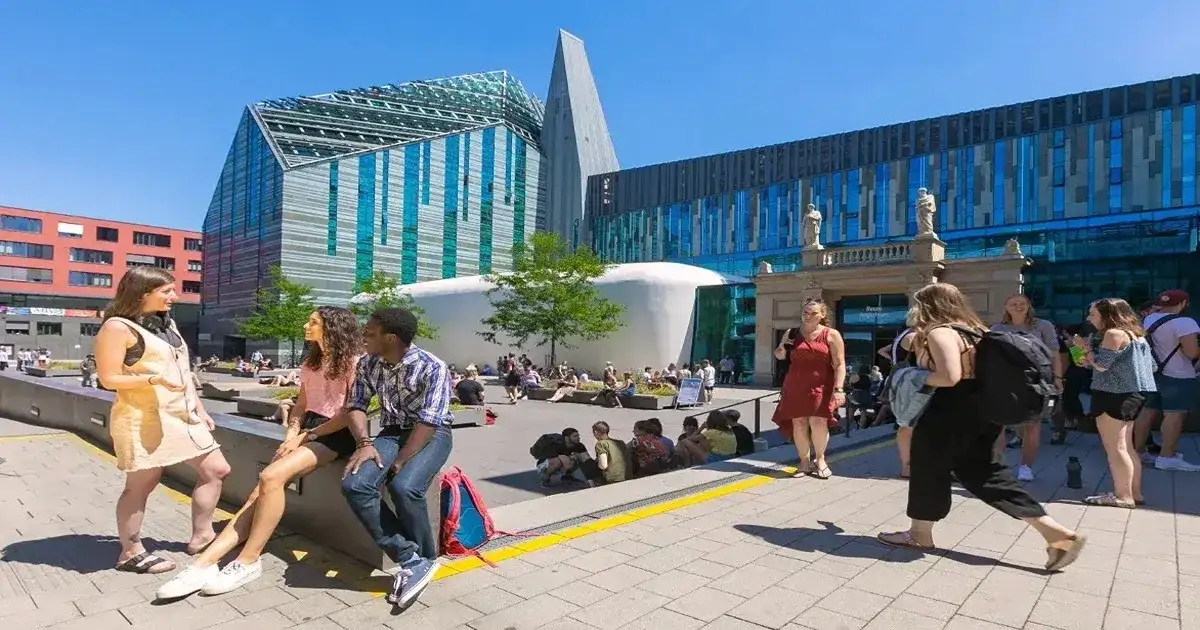
With 152 degree programs ranging from African Studies to Dentistry, our university offers a unique diversity of subjects. It is the most sought-after university in the Free State of Saxony. Currently, approximately 31,000 students are enrolled – over 7,000 young people begin their studies each year. The proportion of female students is an above-average 60 percent, and the proportion of international students is around 12 percent.
Our university has significantly improved its competitive position in research: In the 2018 funding ranking of the German Research Foundation (DFG), we improved our ranking by ten places compared to 2012, reaching 28th place. Third-party funding increased from 53 million euros in 2006 to 175 million euros in 2019.
Our cosmopolitan university is part of a global network of research and teaching collaborations. It ranks highly in German Academic Exchange Service funding and partners with institutions worldwide, including Stellenbosch University and University of Graz. As a member of the Arqus Alliance, it is recognized as a European University.
We focus on interdisciplinary research collaborations, integrate these into the Excellence Strategy of the federal and state governments, and strive for the status of a University of Excellence. We optimize the framework conditions required for top-level research, education, and knowledge transfer, and cultivate a broad concept of excellence that takes into account the diversity of disciplines at our university.
If you want to study in Germany, you will need a direct higher education entrance qualification (HZB) for studying at German universities. You can check whether your secondary school certificate entitles you to study in a bachelor’s, state examination or Diplom programme in Germany using the Anabin database or the DAAD admission database. If you are applying with a certificate from a Feststellungsprüfung (FSP), please make sure that it qualifies you to study at all universities (Universitäten, not just universities of applied sciences (Fachhochschulen)) in Germany.
Language Skill:
The degree programmes at our university are mostly taught in German, but there are a few degree programmes with English as a language of instrThe application process and deadlines depend on the following:
Degree programmes with admission restrictions have a limited number of spots. Applicants are selected based on certain criteria. In contrast, in degree programmes without admission restrictions all applicants are admitted who fulfil the formal admission requirements.
At our university, you can apply for a maximum of two degree programmes at the same time, but only one of these may be a degree programme without admission restrictions. In our courses of study overview, you can find out whether the degree programme on which you would like to study has admission restrictions or not.uction. Depending on the degree programme, there are certain requirements you have to fulfil when it comes to your language proficiency.
Depending on your chosen course of study, different documents are required for your application. We will inform you which documents we need from you and what special cases need to be considered.
Further information on the documents can be found on the Application document page .
If you want to work on your master’s degree with us, then at the latest when you enrol you will need to have a recognised first university degree, for example a bachelor’s degree. You can check whether your degree entitles you to study on a master’s programme in Germany using the Anabin database.
Language Skills:
Our university offers degree programmes taught in German and programmes taught in English. Depending on the degree programme, there are certain requirements you have to fulfil when it comes to your language proficiency. You can find more information about this in the overview of our courses of study.
Aptitude Test/ Subject-Specific Admission Requirements:
Most master’s programmes also require an aptitude test (EFP) or a review of the subject-specific admission requirements (FZV). This review is carried out by looking at transcripts or work samples or by carrying out personal interviews at the respective institute. You can find the specific requirements in our overview of the courses of study.
The dates for the aptitude test (EFP) or the review of the subject-specific admission requirements (FZV) can be different from the application deadlines for the master’s degree programmes. The tests usually take place some time before the application deadlines listed below. Make sure you get information well in advance from the responsible institute.
Online via the application portals
Email: [email protected]
Phone : +49 341 97 - 32058, +49 341 97 32079
Accredited and recognized by the Saxon State Ministry for Science, Culture and Tourism
2021 – 2022
Spokesperson (with Professor M.... read more



2017
The Paulinum – Aula and University Church of St. Pauli of the University of Leipzig will be officially opened with a ceremony on December 1st.
In 2011,
the new Augusteum was presented to the public for the first time on December 2nd.
On March 1st, Professor Beate Schücking became the first woman to assume the office of Rector in the history of our university.
2009:
600th Anniversary of Leipzig University: ... read more
2001:
Call for tenders for an EU-wide architectural competition for the new construction and redesign of the inner-city university complex at Augustusplatz.
1990 – 1994
After German reunification, the University of Leipzig abandons its interim name “Karl Marx University” and returns to the classic faculty and institute structure.
1989–1990:
Many university members demonstrate for freedom and civil rights in the streets of Leipzig. The students establish a democratically legitimized student council.
1973
The university high-rise building is handed over to the Karl Marx University on August 31st.
1971
The new main building will be handed over to the Karl Marx University on September 3rd.
In 1968,
as part of the third higher education reform in the GDR, the traditional faculty and institute structures were dissolved and sections were established.
The University Church of St. Paul, which had remained undamaged during the Second World War, was demolished on May 30th based on a resolution of the Politburo and the Leipzig City Council.
The story of Leipzig University continues. Every year, important events, honors and awards, as well as new political and social developments, shape our university. A selection of the most important milestones from 2023 onwards provides a quick overview.
The Open Day at Leipzig University will take place on-site on January 12, 2023, for the first time since 2020. Faculties and institutes will open 235 courses and offer information sessions and academic advising on their degree programs to eleventh and twelfth graders and other prospective students. Students will gain diverse insights into university life and have the opportunity to learn about various fields of study, financing options, and student life in general.